

New research conducted by a graduate student in astronomy at Georgia State University has taken an important step forward in the search for stars that may have Earth-like planets capable of supporting life. Sebastián Carrazco-Gaxiola presented his findings at a meeting of the American Astronomical Society in January 2026 in Phoenix, Arizona.
Observation methods
Carrazco-Gaxiola’s research focuses on more than 2,000 stars located less than 130 light-years from Earth. The observations consist of precise measurements of the spectra, or rainbow of colors, emitted by these stars.
The observations were made using advanced spectrographs on the 60-inch SMARTS mirror telescope at the Cerro Tololo Inter-American Observatory in the Chilean Andes and on the Tillinghast telescope of the same size at the Fred Lawrence Whipple Observatory in southern Arizona. Together, these two telescopes, located in opposite hemispheres, allow K-class dwarfs to be observed across the entire sky.
The CHIRON spectrograph on the SMARTS telescope in Chile and the TRES spectrograph on the Tillinghast telescope in Arizona are complementary instruments. These two telescopes in opposite hemispheres allow us to access all K-type dwarf stars across the entire sky.
K-class dwarfs and their significance
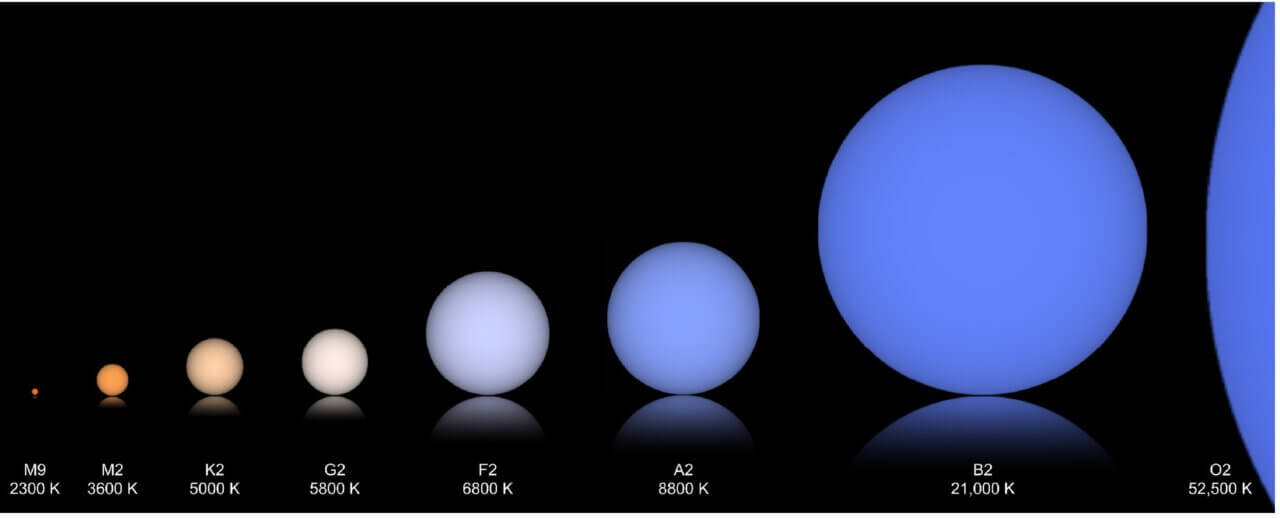
Stars have a wide range of temperatures and masses, and the group of K-class dwarfs is slightly cooler and dimmer than the Sun. But there are about twice as many K-class dwarfs in our “solar neighborhood,” our region of space, as there are stars similar to the Sun. They also have a much longer lifespan than stars similar to the Sun. Any life forms that emerge on planets around K-type dwarfs will enjoy the stars’ continuous light almost indefinitely.
Careful analysis of measurements allows astronomers to estimate the temperature, age, rotation speed, and motion of stars in space. In addition, certain colors indicate the presence of heated upper layers of the star, which receive energy from stellar magnetic fields. All these factors are crucial for the environment in which planets orbiting stars exist.
Upcoming consequences and presentation details
“This survey will be the foundation for studies of nearby stars for decades to come,” said Distinguished University Professor of Physics and Astronomy Todd Henry, who serves as Carrazco-Gaxiola’s advisor and is a senior author on the study. “These stars and their planets will be the destinations for spacecraft exploration in the far future of space travel.”
Carrazco-Gaxiola’s survey, entitled “An All-Sky Spectroscopic Reconnaissance of More Than 2,100 K Dwarfs Within 40 Parsecs Using High-Resolution Spectra,” will be presented at a press conference at the American Astronomical Society meeting on January 6. The presentation contains new, unpublished results selected for the AAS press conference because of their broad scientific interest.
According to phys.org

