

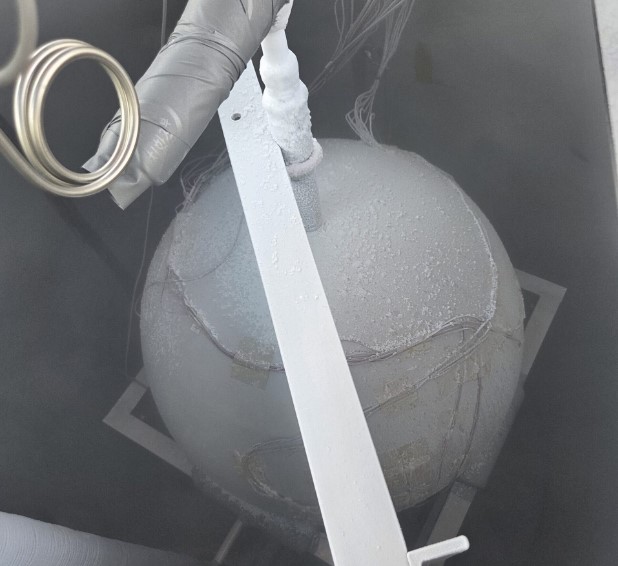
Engineers from the Korea Institute of Industrial Technology (KITECH) collaborated with partners to manufacture and test a large titanium rocket tank printed using Directed Energy Deposition (DED) technology. A spherical tank with a diameter of 640 mm made of Ti-6Al-4V alloy withstood a load of 330 bar under cryogenic conditions – when cooled to −196 °C with liquid nitrogen. According to the developers, this is the world’s first confirmation of the ability of a large-scale titanium 3D-printed structure to operate under high pressure in a cryogenic environment, as in real space mission conditions. KARI, KP Aviation Industries, AM Solutions, and Hanyang University have joined the project.
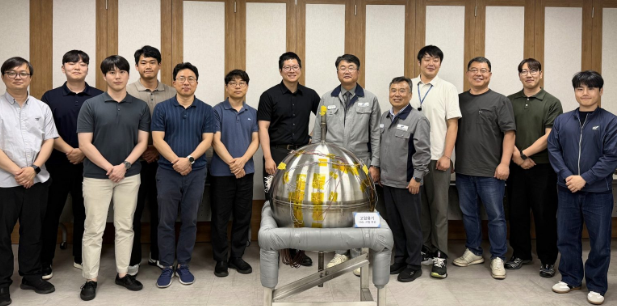
KITECH printed two titanium hemispheres using a wire DED laser, then performed heat treatment, high-precision machining, and welding into a seamless vessel. According to the team, printing took about three days, and the entire production cycle took only a few weeks, which significantly reduces the time required compared to traditional forging, which requires expensive dies and has geometric limitations. Cryogenic testing was conducted at KARI using strain gauges and high-speed imaging to confirm strength calculations. Next, cyclic tests and certification for flight qualification are planned.
Lighter and stronger cryogenic tanks accelerate the development of rockets and satellites, reduce launch costs, and provide design flexibility — from liquid oxidizer/fuel tanks to helium storage systems for spacecraft orientation. For scientific missions, this means faster deployment of telescopes and probes, increased payload capacity without increasing weight, and the ability to customize designs for specific experiments (e.g., long-term storage of cryogenic working fluids for infrared astronomy).
Want to understand more deeply why engineers are struggling so hard to develop larger and lighter cryogenic tanks? The best example is SpaceX’s evolution from Falcon to Starship: the transition to methane, a different material base, stage recovery, and in-orbit refueling required a tenfold increase in fuel tank capacity. How fuel density, heat loss, mass fraction, and mission profile change rocket architecture — read about it in the analysis “Starship vs. Falcon: Why did SpaceX increase the volume of tanks 10 times?”
According to interestingengineering, kamic

