

NASA announced the selection of two missions for further development in the Earth System Explorers (ESE) program. They are STRIVE and EDGE. Both satellite missions should enhance the ability to forecast hazardous natural phenomena and support decisions on managing the risks and consequences of natural disasters.
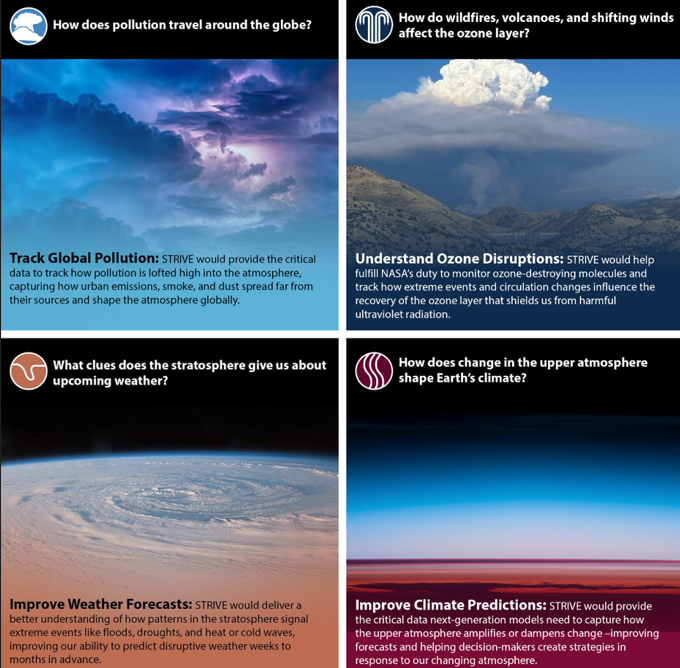
STRIVE (Stratosphere Troposphere Response using Infrared Vertically-resolved light Explorer) will provide near-global, high-resolution measurements of temperature, atmospheric components, and aerosol properties from the upper troposphere to the mesosphere on a daily basis. A separate focus is on vertical profiles of ozone and trace gases, which are necessary for a better understanding of ozone layer recovery and for longer-range weather forecasting. The mission is led by Lyatt Jaeglé of the University of Washington.
STRIVE — atmospheric thermometer + air analyzer
- The satellite observes the Earth in the infrared spectrum, similar to a thermal imager.
- Different gases (ozone, water vapor, etc.) and layers of air emit and absorb heat in different ways.
- Based on these thermal traces, the device reconstructs a vertical profile: what the temperature and composition of the air are at different altitudes.
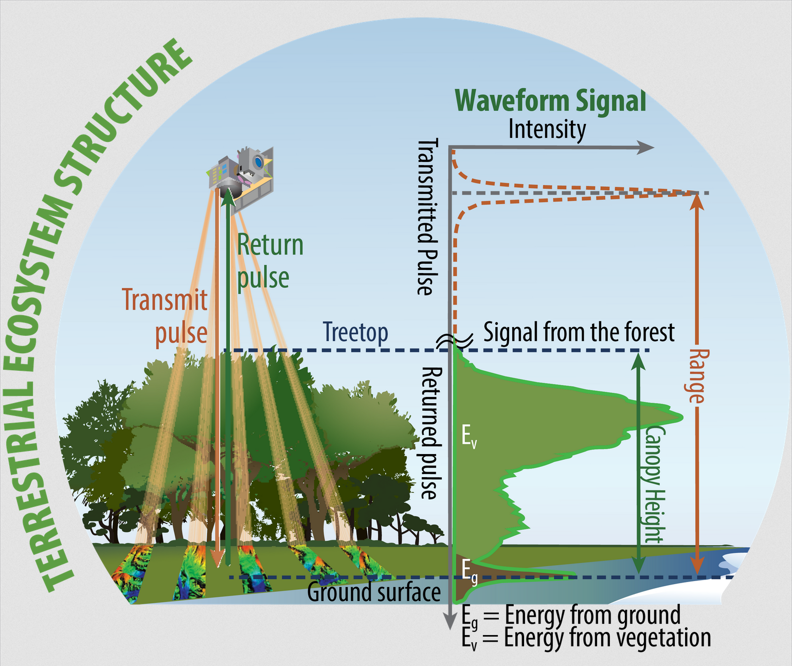
EDGE (Earth Dynamics Geodetic Explorer) will observe the 3D structure of terrestrial ecosystems and the topography of glaciers, ice sheets, and sea ice. EDGE will develop on the approach of the ICESat-2 and GEDI missions, in particular through new lidar surveys for denser mapping of critical regions. The project is led by Helen Amanda Fricker of the University of California, San Diego.
EDGE — a laser tape measure that measures 3D surfaces
- The satellite beams down laser pulses (lidar).
- Measures how long it takes for the reflected signal to return.
- Time → distance, and this gives a very accurate height/surface shape.
- The novelty lies in the fact that it does this not only with “dots,” but with a denser strip/grid to better see glaciers, ice sheets, sea ice, and even the structure of forests in 3D.
Both missions will undergo readiness testing in 2027; if approved, their cost (excluding launch) will not exceed $355 million each, and launch is scheduled for no earlier than 2030.
Why is this important? STRIVE data on temperature profiles, aerosols, and gas composition in the upper atmosphere directly improve the models used for flight planning and satellite operations (particularly in the context of forecasting conditions in the near-Earth environment). Meanwhile, EDGE provides more accurate 3D maps of ice and land relief, which is super important for validating remote sensing and calibrating methods used in planetary science. For ground-based astronomy, more accurate estimates of aerosols and ozone profiles help to more accurately account for atmospheric absorption and light scattering in photometry and spectroscopy, improving the quality of observations.

