

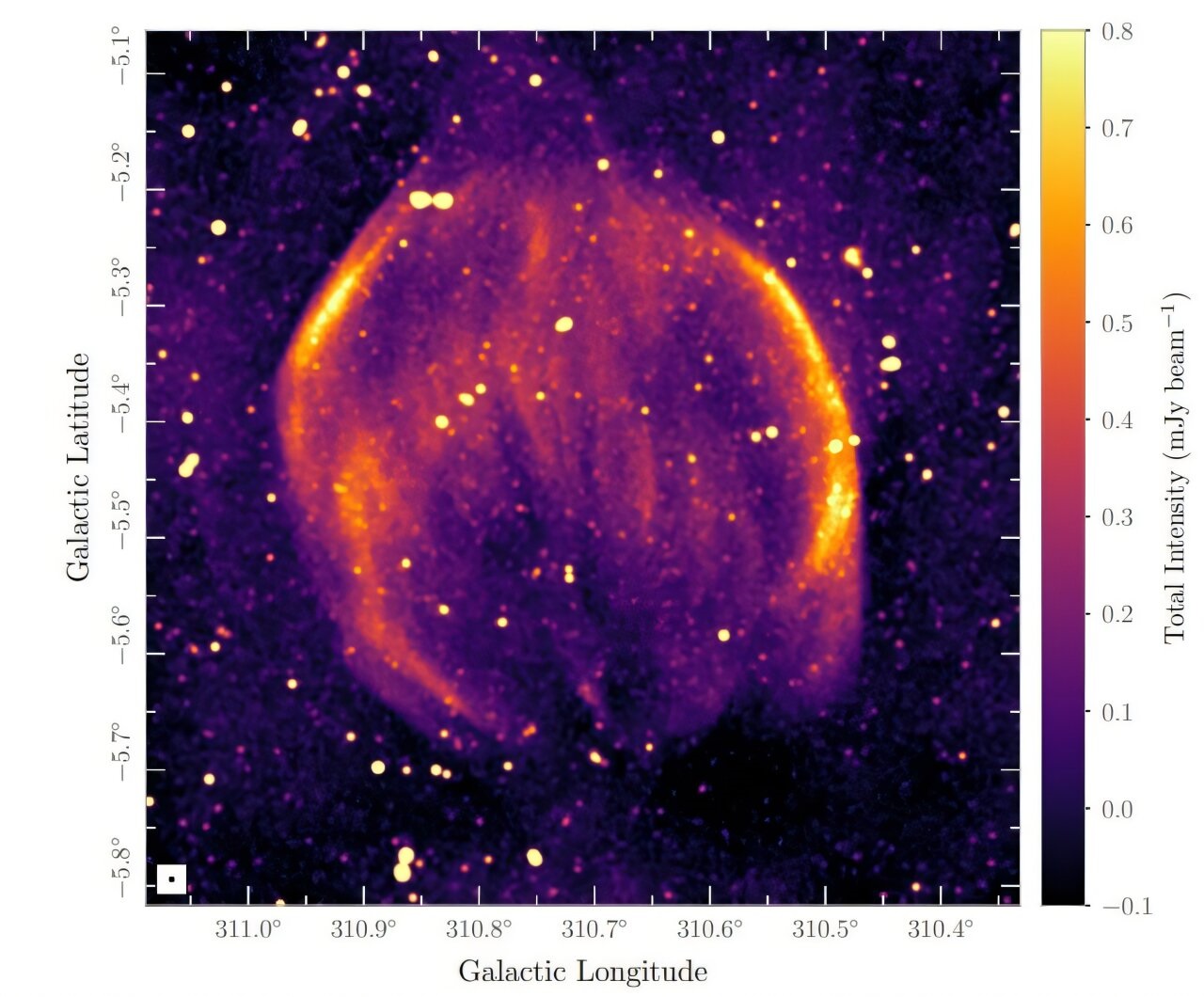
Scientists have announced the discovery of a new supernova remnant, G310.7-5.4. It has been named Abeona, after the Roman goddess. This object is interesting because it is extremely faint in the radio spectrum.
New supernova remnant
On April 21, a paper by a team of astronomers led by Christopher Burger-Scheidlin of the Dunsink Observatory in Ireland was published on the arXiv preprint server. It describes the discovery of a new supernova remnant.
Supernova remnants are gaseous clouds that rapidly expand into space following the colossal explosion that destroys massive stars at the end of their lives. They may also contain material from interstellar space that they have encountered along their path, and somewhere inside them lies a black hole or a neutron star.
The Australian Square Kilometre Array Pathfinder (ASKAP) detected the radiation source G310.7–5.4 back in 2014. Even back then, researchers suspected that it was the remnant of a supernova. However, they have only now finally confirmed this.
Abeona
Radio source G310.7–5.4 is an extended shell 30 arcminutes in length with a radio flux density of 1.5 J. At the same time, it is one of the faintest sources in terms of surface brightness.
The supernova remnant was given its own name: Abeona. This was the name given by the ancient Romans to the goddess who protected travelers. Scientists offer a rather interesting explanation for this name. The fact is that the supernova remnant lies far from the galactic plane, and it is primarily in this region that supernovae occur.
The physical size of this remnant is estimated to be approximately 137 light-years, and its distance is calculated to be about 16,000 light-years.
Actually, there’s nothing mysterious about it. After all, a supernova explosion is often asymmetrical, and in such cases, its remnants are accelerated in a specific direction, often perpendicular to the plane of the galaxy. It seems that in the case of Abeona, astronomers are dealing with just such a “traveler.”
According to phys.org

