

The exoplanet TRAPPIST-1 d does not have an atmosphere similar to Earth’s. Researchers came to this conclusion based on observations made by the James Webb Space Telescope (JWST).
Exoplanet TRAPPIST-1
The star TRAPPIST-1 is located 41 light-years from the Sun and is a red dwarf. It is famous for having seven rocky exoplanets orbiting around it. The orbits of three of them lie within the habitable zone. These are TRAPPIST-1 d, TRAPPIST-1 e, and TRAPPIST-1 f.
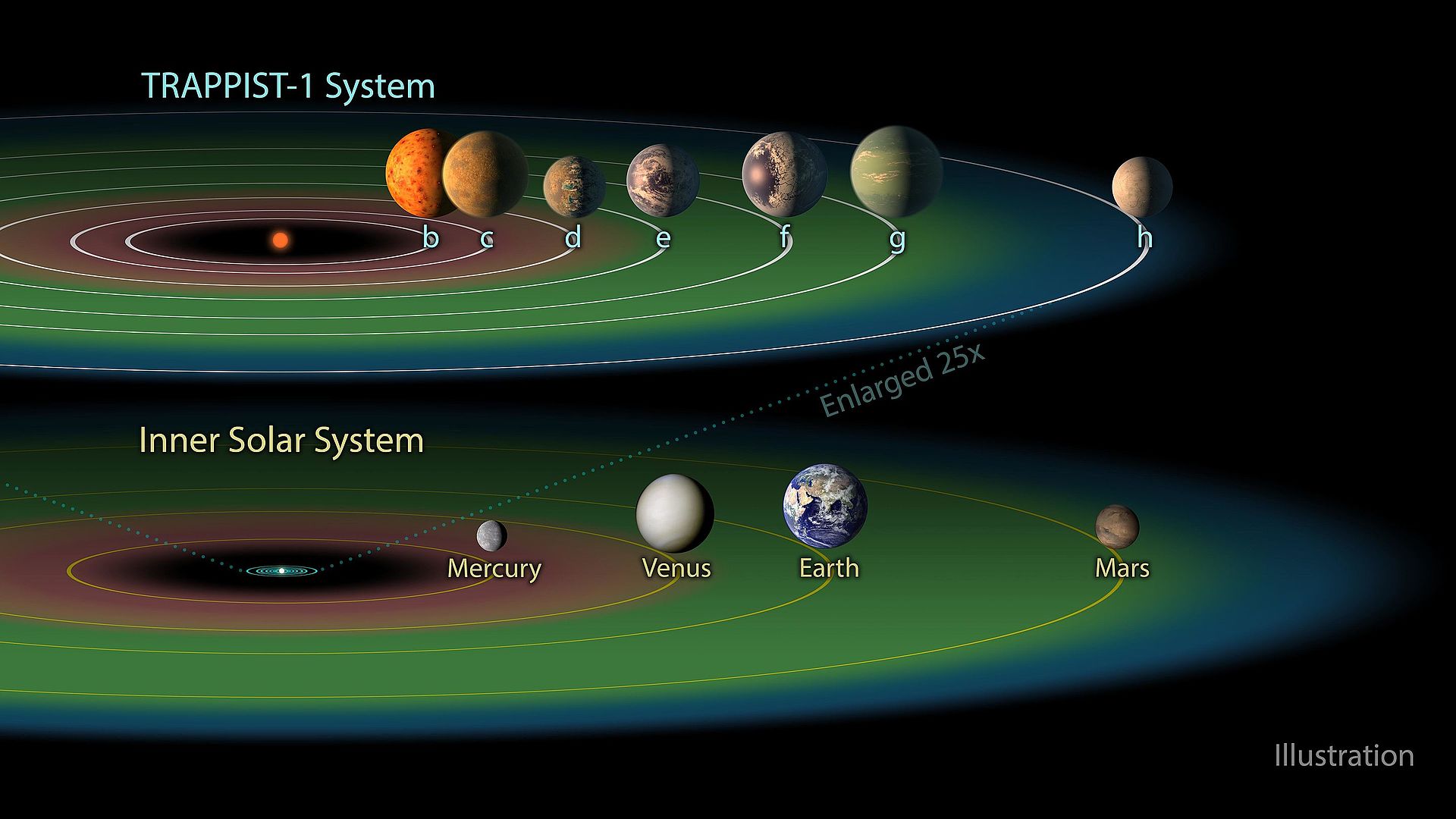
In terms of its physical characteristics, TRAPPIST-1 d is something between Mars and Venus. Its radius is 77% of Earth’s radius, and its mass is 38% of Earth’s radius. TRAPPIST-1 d’s orbital period is 4 days, and its orbit passes at a distance of only 3 million km from its parent star. Since red dwarfs emit orders of magnitude less energy than our Sun, this places it on the inner edge of the habitable zone. This means that if the atmosphere is dense enough, liquid water could exist on the surface of TRAPPIST-1 d.
No atmosphere
Although TRAPPIST-1 d’s orbit lies within the habitable zone, scientists had reasonable doubts that such a small body could retain a dense atmosphere. Especially considering that red dwarfs often produce very powerful flares. And if the planet has no protective magnetic field, they can simply blow away its gas envelope.
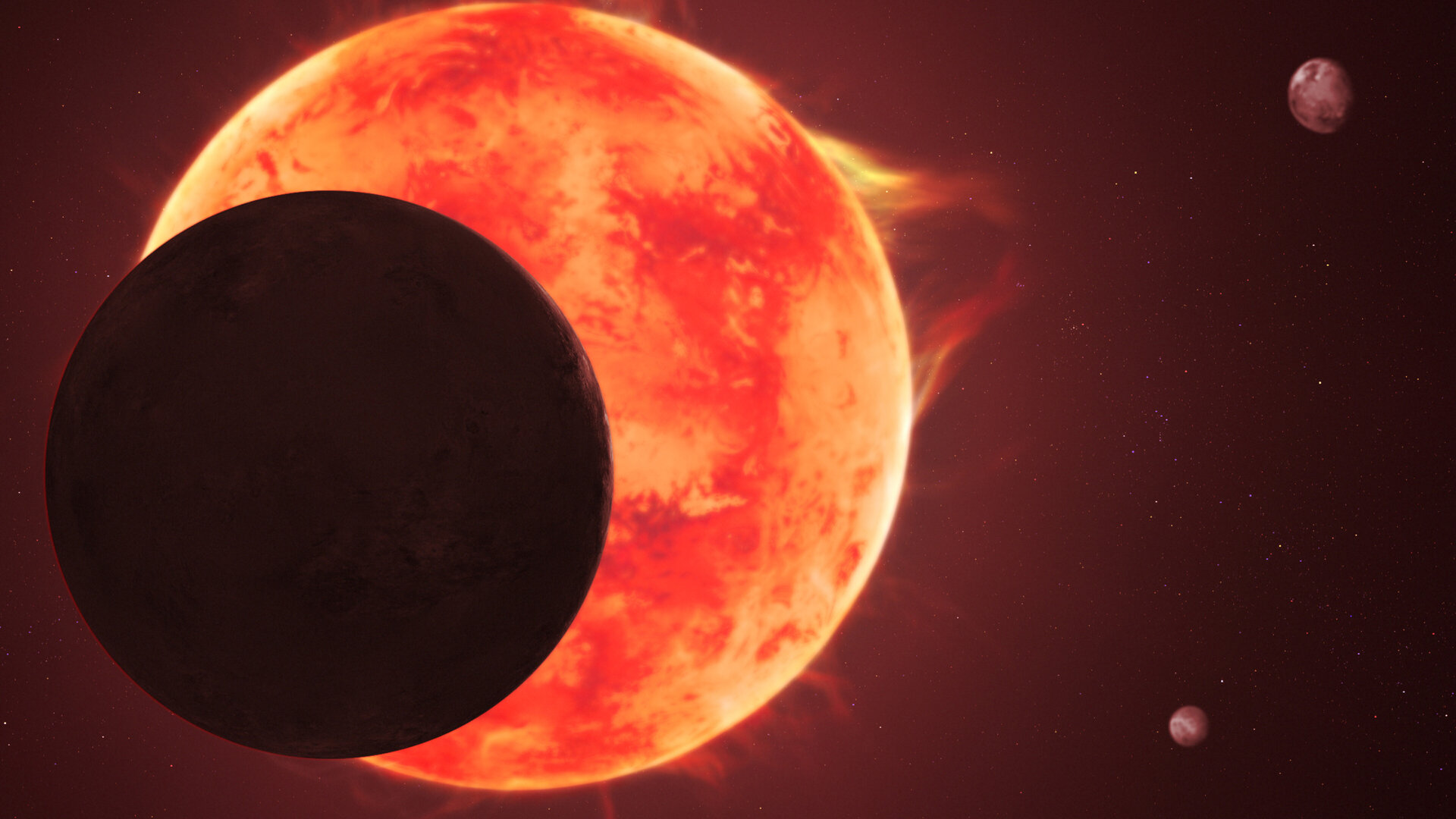
To finally determine whether TRAPPIST-1 d has an atmosphere, astronomers used the JWST. It scanned it using the NIRSpec (Near-Infrared Spectrograph) instrument.
After analyzing the data collected by JWST, researchers did not find any molecules on TRAPPIST-1 d that are commonly found in Earth’s atmosphere, such as water, methane, or carbon dioxide. However, according to them, it is still too early to draw definitive conclusions. TRAPPIST-1 d may actually be a barren rock with no atmosphere at all, or, like Mars, it may have an extremely thin gas envelope. However, there is also a possibility that it may have very thick high-altitude clouds that block the detection of certain atmospheric signatures. In that case, this world is more like Venus.
Exoplanets farther away from TRAPPIST-1, at least in theory, are more likely to have atmospheres. Therefore, astronomers intend to continue observing this system using JWST in the hope of finding traces of atmospheric signatures.
Earlier, we reported that astronomers found no traces of extraterrestrial transmissions between the planets of the TRAPPIST-1 system.
According to ESA

