

A new study has shown that a giant collision may not be the cause of Jupiter’s unusual “dissolved” core. This calls into question the theory of planetary formation.
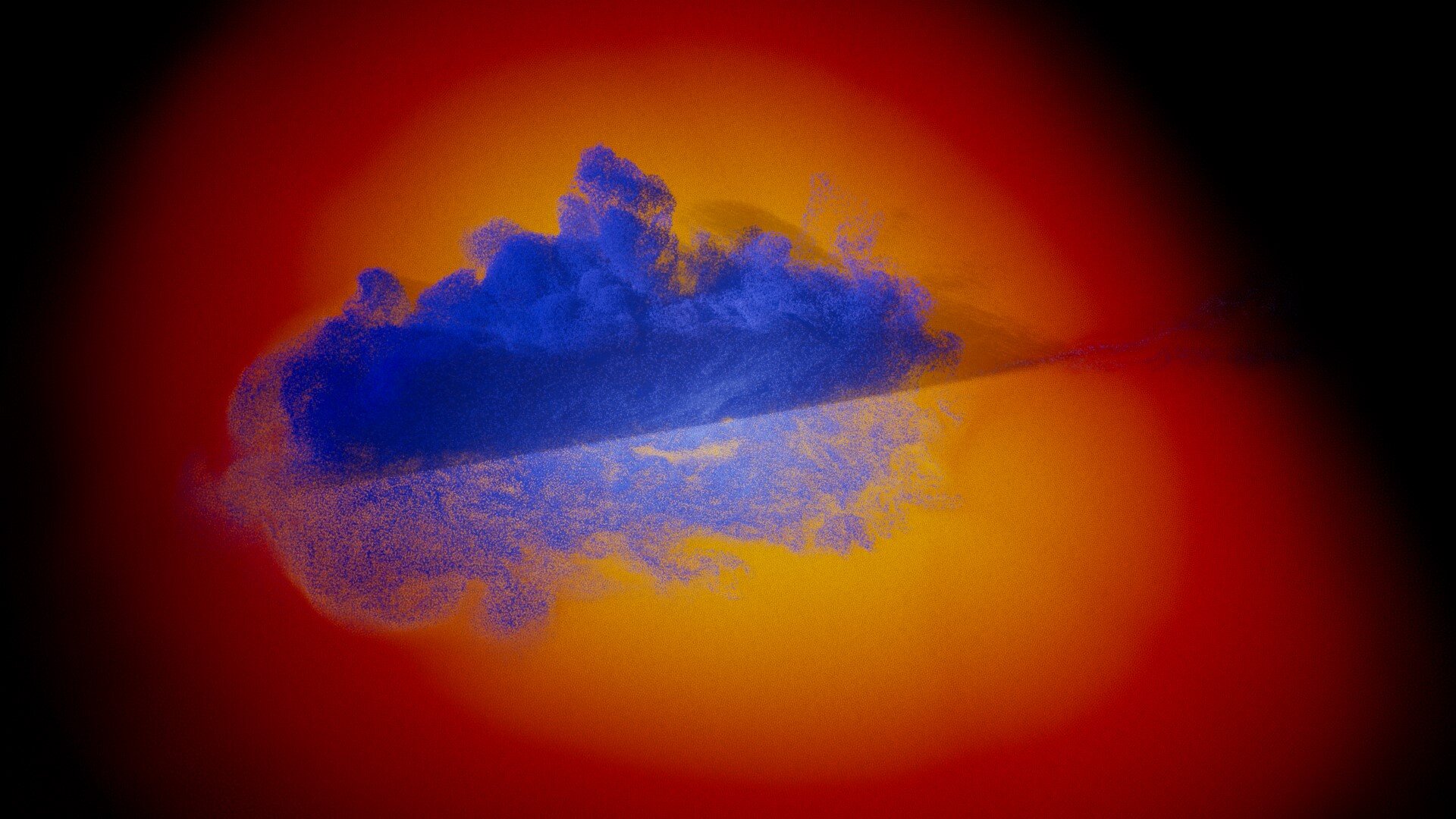
The depths of Jupiter hold a secret. The Juno mission showed that, contrary to what scientists once believed, its core does not have clear boundaries, but gradually transitions into the surrounding layers, consisting mainly of hydrogen (this structure is called a diluted core).
How this diluted core was formed remains a key question. Until recently, the dominant scenario was a colossal collision with a protoplanet containing half of Jupiter’s core material. Such an event could have completely disrupted the central region of the gas giant, which is sufficient to explain its current internal structure.
Using advanced supercomputer simulations of planetary collisions and a new method of processing material mixing in simulations, researchers from Durham University, in collaboration with scientists from NASA, SETI, and CENSSS, University of Oslo, tested whether such a massive collision could have created Jupiter’s core.
The study showed that a stable diluted core structure was not obtained in any of the simulations performed, even those that included collisions under extreme conditions. Instead, it demonstrates that the dense rock and ice material of the core, displaced by the collision, quickly settles, leaving a clear boundary with the outer layers of hydrogen and helium, without forming a smooth transition zone between the two regions.
Thus, the results of the study do not confirm the impact hypothesis. They rather suggest that Jupiter’s diluted core is the result of how the growing planet absorbed heavy and light materials during its formation.
Jupiter is not the only planet with a diluted core. Scientists have recently discovered evidence of its presence on Saturn. According to scientists, if diluted core formation does not occur as a result of rare and extreme collisions, then it is possible that most or all gas giants have a relatively complex internal structure.
Earlier, we reported on the results of another study showing that immediately after its formation, Jupiter was twice as large as now.
According to Phys.org

