

Space ice contains tiny crystals and is not a completely disordered substance, as previously assumed. This is according to the results of a study conducted by scientists from University College London and the University of Cambridge.
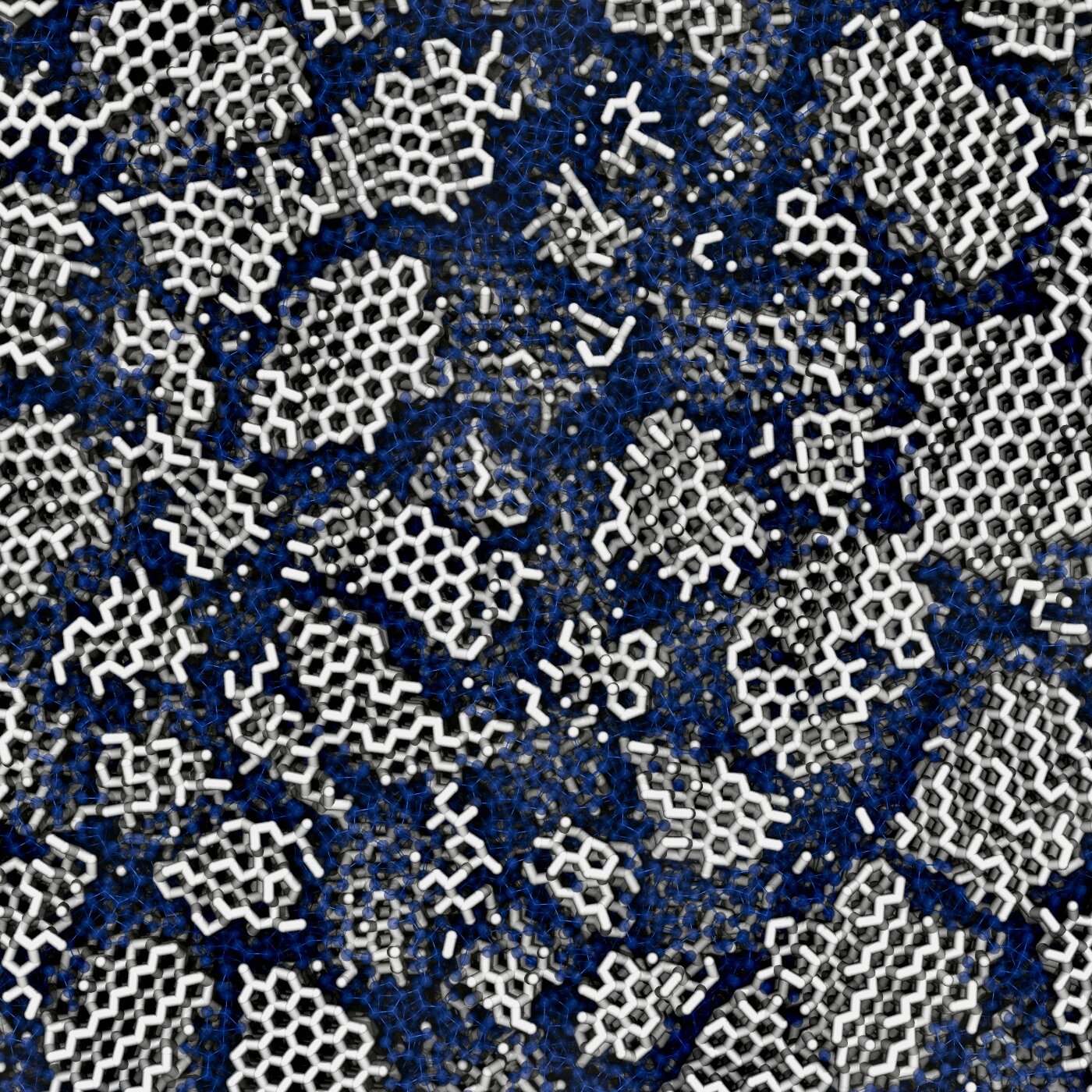
Ice in space differs from the crystalline (highly ordered) form of ice on Earth. For decades, scientists assumed that it was completely amorphous (without structure), and that lower temperatures meant that it did not have enough energy to form crystals when freezing.
However, it is quite possible that this point of view is not entirely correct. A group of British scientists has studied the most common form of ice in the universe — low-density amorphous ice, which exists in comets, on icy moons, and in dust clouds where stars and planets form. To do this, they used both computer modeling results and experiments in which real low-density amorphous ice was created. Various methods were used to achieve this: from depositing water vapor on an extremely cold surface (similar to how ice forms on dust grains in interstellar clouds) to heating so-called high-density amorphous ice (ice that has been crushed at extremely low temperatures).
Scientists have discovered that computer models best correspond to ice that is not completely amorphous, but contains tiny crystals about three nanometers wide (slightly wider than a single strand of DNA) embedded in its random structures.
During the experiments, scientists also recrystallized (i.e., heated) real samples of amorphous ice. They were able to establish that the final crystal structure varied depending on how the amorphous ice was formed. Researchers concluded that if ice were completely amorphous (completely disordered), it would not retain any traces of its former shape.
This discovery is important because ice is involved in many cosmological processes, such as planet formation, galaxy evolution, and the movement of matter in the universe. The results obtained are also significant for the theory of panspermia, according to which the building blocks of life were delivered to Earth by comets along with low-density amorphous ice. According to scientists, the study shows that this ice would be less suitable as a material for transporting the molecules that form the basis of life. This is because a partially crystalline structure has less space in which organic ingredients can be incorporated. However, the theory may still prove to be correct, as there are amorphous regions in ice where the building blocks of life can be trapped and stored.
The results obtained may also be useful in the development of advanced technologies, such as fiber optics. To perform its function, it has to be amorphous, or disordered. If scientists can figure out how to get rid of the tiny crystals in it, it’ll make it work better.
According to Phys.org

