

Cataclysmic variables are binary systems in which matter flows from one component to another, and when enough accumulates, an explosion occurs. Recently, scientists have suggested that such systems may form due to the presence of a third star.
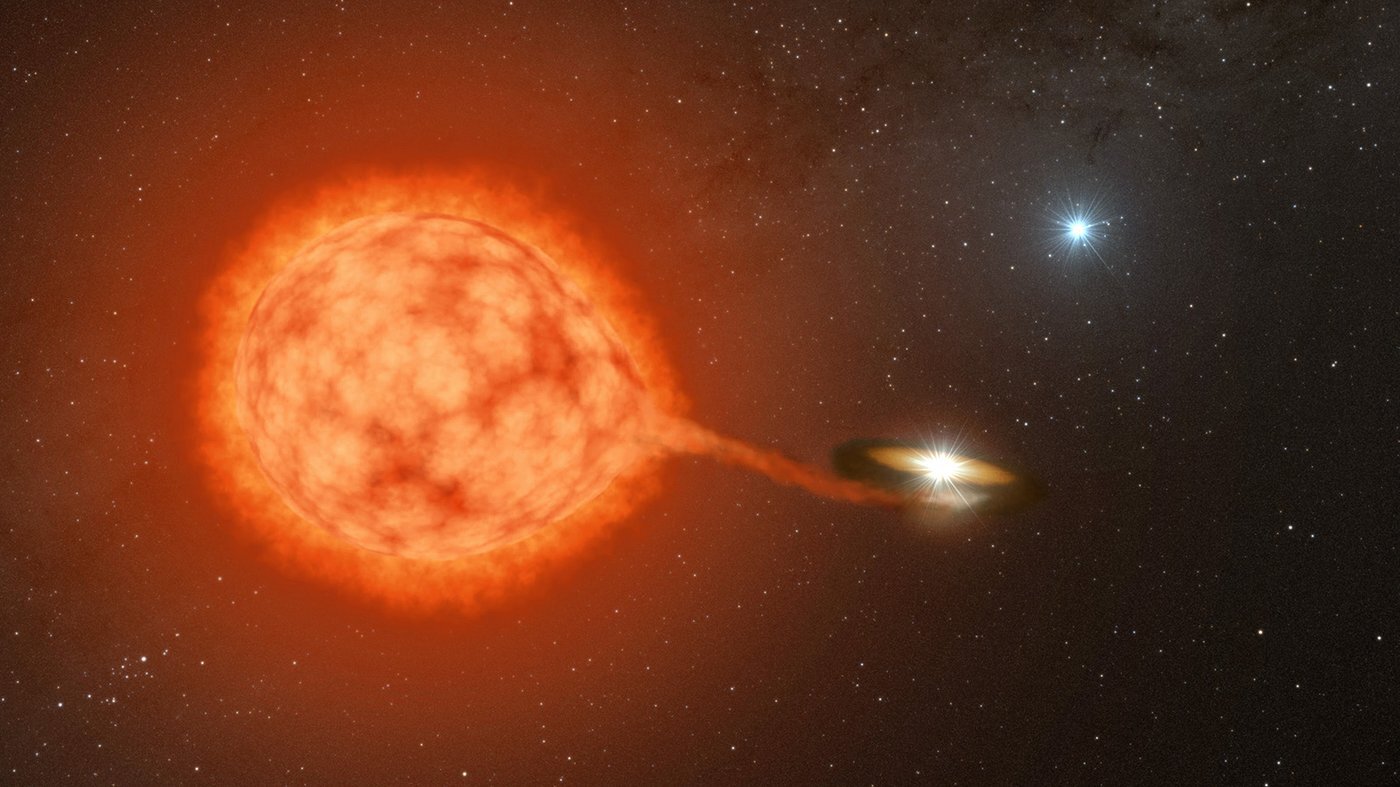
Cataclysmic variables
A group of researchers led by staff at the California Institute of Technology published a study on cataclysmic variables in the journal Publications of the Astronomical Society of the Pacific. They claim that these systems can form as a result of the interaction of three stars.
Cataclysmic variables are a broad class of binary systems that share the common feature of redistributing matter between their components, which periodically leads to powerful eruptions that we on Earth perceive as sudden changes in luminosity. This includes, for example, all new stars.
Conventional theory of formation
Cataclysmic variables are usually a pair consisting of a white dwarf and an ordinary star in a very close orbit. It is believed that everything began back when the first star was still an ordinary, but more massive star in the pair. They evolve faster, turning into red giants and forming a common envelope with the second star. It slows down the rotation and the stars move into a closer orbit.
Next, the red giant sheds its outer layers, turns into a white dwarf, and the cataclysmic variable begins to live in the mode familiar to us, in which the previously smaller component becomes externally visible.
New research
In the new study, scientists suggested that a close binary system could form if it was originally a triple hierarchical system. Simply put, if it was a pair of stars orbiting a third star.
To investigate the question of the third star’s involvement in the formation of CV in more detail, the scientists turned to data from the European Space Agency’s Gaia mission, which has now been completed. After analyzing these observations, they discovered 50 CVs in hierarchical triple star systems, or triples, as scientists call them. A hierarchical triple is a system in which two stars are quite close to each other, while the third is much further away and orbits around the primary pair. The results showed that at least 10% of all known CVs are part of triple systems.
Three-body simulation
This figure was higher than would be expected if triplets played no role in CV formation, so the researchers decided to find out more by conducting computer simulations. They conducted so-called three-body simulations on 2,000 hypothetical triples; these simulations accelerated the gravitational interactions of the triple stars, developing them over time.
Within 20% of simulations, triple stars formed without the traditional mechanism of common envelope evolution. In these cases, researchers claim, the third star influenced the main binary star. Within 60% of simulations, the triple star contributed to the onset of the evolution of the common envelope, bringing the two main stars so close together that they ended up in the same envelope. Within the remaining 20% of CV simulations, the CVs formed in the traditional way through the evolution of a common envelope, which requires only two stars.
When researchers took into account the realistic population of stars in our galaxy, including CVs, which are known to have formed from only two stars, their theoretical models suggested that about 40% of all CVs form in triple systems. This is more than the 10% they observed with Gaia, as in many cases third stars can be problematic to distinguish or separate from cataclysmic variables.
According to phys.org

