
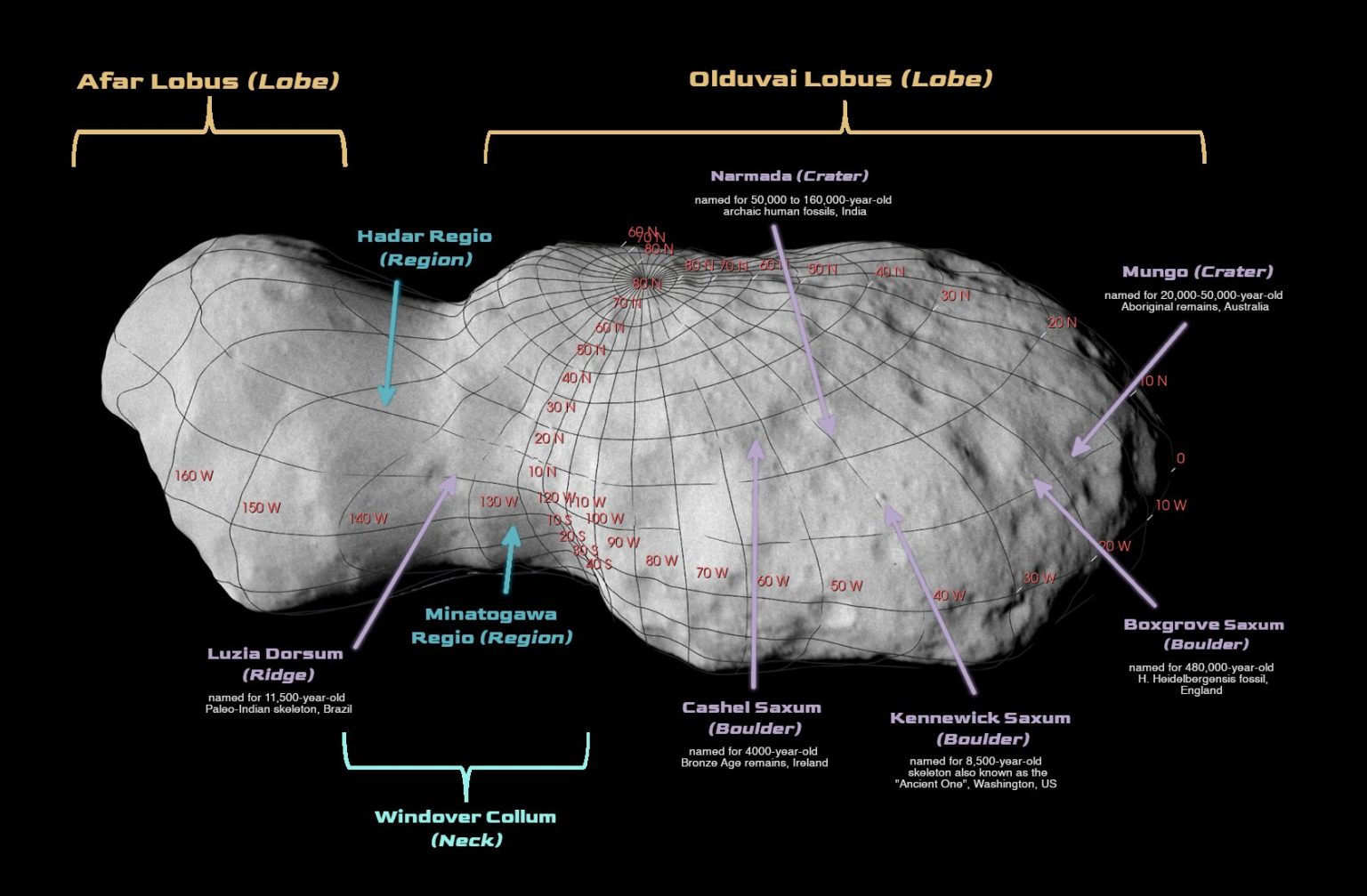
The International Astronomical Union has named several features on the asteroid Donaldjohnson. This piece of rock, with its exacting shape and length of several kilometers, is the main target of the Lucy mission.
Paleoanthropological names for asteroids
Recently, the International Astronomical Union (IAU) solved a relatively simple problem by approving a series of names for the asteroid Donaldjohnson, the first and only target of NASA’s Lucy mission in the main asteroid belt. With these names, a completely new way of talking about one of the asteroids that humanity has studied most closely to date has emerged.
The Lucy mission was named after Lucy the fossil, one of the most important paleoanthropological finds in history. Lucy’s skeleton, dated 3.2 million years ago, belongs to a species we now call Australopithecus afarensis, one of the ancestors of modern Homo sapiens. With this discovery in the Afar region of Ethiopia in 1974, American paleoanthropologist Donald Johanson inscribed his name in the annals of scientific history.
The IAU also allowed him to go down in the history of astronomy by agreeing to name an asteroid in the main belt after him, which the Lucy mission was to pass on the way to its main mission in the Trojan asteroid belt. The asteroid Donaldjohnson is approximately 8 km long and 3.5 km wide, and weighs approximately 8×10¹³ kg. Its shape offers some very unique places to name, and Lucy’s team tried to take full advantage of this in the names they submitted to the IAU.
Names for parts of the asteroid Donaldjohnson
All of the names are connected in some way to paleoarchaeological history, although some of them relate directly to Donald Johanson himself. The two main “lobes” of the asteroid are named Afar, after the region in Ethiopia where the Lucy fossil was discovered, and Olduvai, after the river gorge in Tanzania where many other discoveries related to early humans were made.
The two parts are connected by Windover Collum, named after an archaeological site near Cape Canaveral in Florida, where Lucy was launched and which gives an insight into the lives of the people living there more than 7,000 years ago. The two flat surfaces on the column, which can be considered the “neck” of the asteroid, are named Hadar, after the specific location where Lucy was found, and Minatogawa, the site of the oldest hominid remains found in Japan. Although JAXA, the Japanese space agency, did not participate in this mission, it has been NASA’s main partner for decades.
Names for boulders and craters
Large boulders and craters were also given names. Mungo, named after the archaeological site of Lake Mungo in New South Wales, Australia, is a crater at the end of the Olduvai lobe. Boxgrove is a nearby boulder named after a nearly 500,000-year-old fossil from England. Narmada is another crater named after archaic remains from India, located near boulders called Cashel, named after a 4,000-year-old find in Ireland, and Kennewick, an 8,500-year-old skeleton from Washington State near the Columbia River in the United States. They are all also located on the Olduvai lobe, which is larger than two.
Another feature of the Windover site is another ridge named after Luzia, an 11,500-year-old skeleton from Brazil. Undoubtedly, the other side of the asteroid has features, but unfortunately, Lucy only made a brief flyby and was unable to capture it completely.
However, this was because the spacecraft was heading towards its main mission, which was to visit eight Trojan asteroids. This will give the mission team much more options for naming.
According to phys.org

