

The problem of space debris is becoming increasingly acute: even fragments less than a centimeter in size can disable a satellite in orbit. Engineers at Southwest Research Institute (SwRI) have tested a new system for detecting and characterizing micrometeoroids and orbital debris (MMOD) that detects impacts before visible damage occurs and transmits collision data back to Earth. Initial tests have confirmed that the approach could become an early warning system for spacecraft.
The device is designed as a structural panel with built-in sensors. Algorithms analyze the signal and estimate the size, speed, and even the material of the particle that struck the covering. The system can be installed externally as a module or integrated into the device design. During ground testing, SwRI used a light gas gun in a vacuum chamber to simulate real hypersonic impacts in orbit. Based on the results, the team prepares a release version for real-world use during missions.
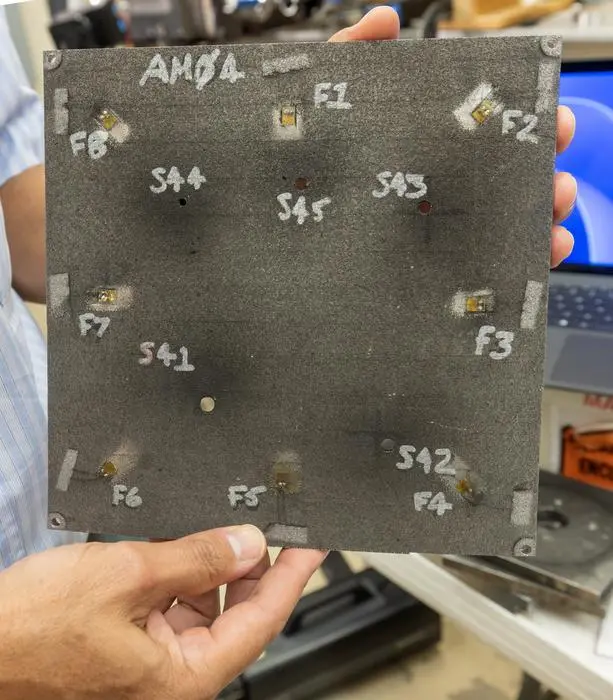
The sensor itself is a two-layer aluminum panel printed using the DMLS method and divided by internal columns. Each of the two plates has 8 strain gauges (16 in total) attached to it, which record elastic waves from micro-impacts. The difference in the time of arrival of the wave at the sensors gives the coordinates of the point of impact (triangulation), and the delay between the front and rear plates gives an estimate of the particle velocity. Based on the calibrated signal amplitude drop (approximately ~1/r of the distance), algorithms together with numerical modeling (CTH, 2D/3D) restore the diameter and density (material) of the fragment. The collected waveforms agreed well with simulations, which is critical for correct inversion of particle parameters under flight conditions. In operational configuration, the panel functions as a structural element with built-in telemetry: onboard filtering selects relevant events and sends them to Earth, where the data is combined with other observations to form an up-to-date picture of the MMOD environment.
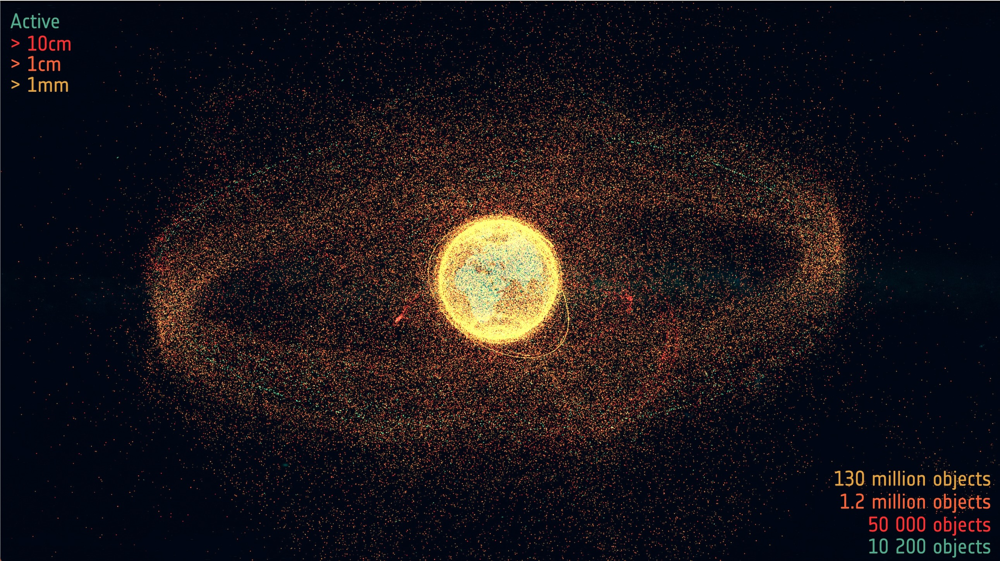
Local telemetry sensors for debris on satellites will enable other spacecraft in nearby orbits to be warned promptly and evasive maneuvers to be planned. An array of such panels will help map the MMOD field and more accurately design protection for spacecraft, telescopes, and future interplanetary missions. With the number of objects growing super fast (over 40,000 tracked objects in the ESA catalog, with about 11,000 of them active), these sensor systems are super important for keeping orbits safe.
Want to see how engineers are already dealing with chaos in orbit today? Check out our overview of active cleaning technologies — from harpoons and nets to robot grabbers and laser solutions. Find out what really works and what demonstrations have already taken place in the article “Orbital Cleaning.”

