

Researchers at Brigham Young University have introduced a new family of flat-folded origami structures called bloom patterns, which fold compactly into a disc and unfold into three-dimensional shapes in one continuous motion. Such designs can make antennas, optical nodes, and solar panel arrays lighter, more reliable, and technologically simpler to manufacture. The paper was published in Proceedings of the Royal Society A.
The article proposes a unified mathematical definition of bloom patterns and a classification based on geometry. The team demonstrated that these structures were radially expansive, developable, and completely flat-foldable, and tested their functionality on paper and 3D-printed plastics. The key result is reproducibility: the shapes unfold reliably, which is super important for orbital systems where deployment mechanism failures can disrupt the mission.
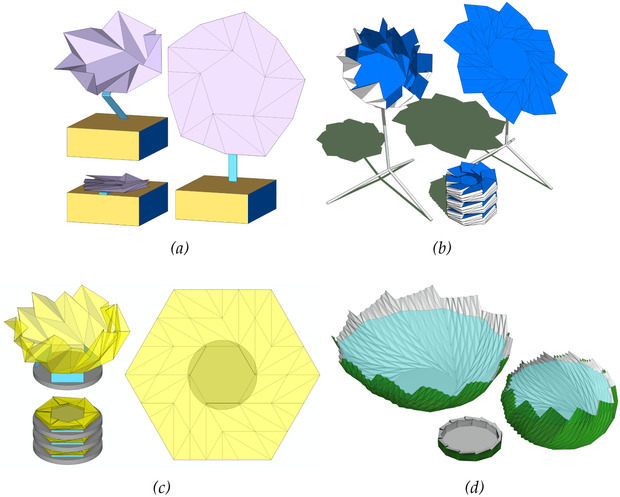
The authors showed an example of a full-size folding dome based on the Yoshimura pattern and suggested using it for rigid and membrane structures — from sun shields for space telescopes to antennas that need to be unfolded. A catalog of patterns, drawings of fold lines, and video demonstrations of unfolding are available; a computer program for generating ornaments is also provided.
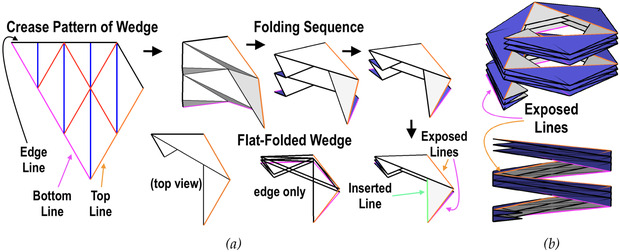
In general, the idea behind such unfolded mechanisms is a gray area of risk for telescopes, radio antennas, and solar panels. Bloom patterns minimize the number of sequential actions and nodes, which reduces points of failure during launch and in orbit. This paves the way for larger apertures in observation equipment, more efficient solar panel arrays, and lighter platforms for scientific missions in deep space, where every kilogram and every minute of operation counts.
Want to know what other unusual shapes could become real spacecraft? Let’s deal with the facts: the aerodynamics of disc-shaped forms, maneuverability in zero gravity, stabilization during atmospheric entry, and thermal protection challenges. Short, clear, and with examples of engineering solutions — click on the article “UFOs in space? Is it possible to launch a flying saucer into space and return it to Earth?” and see where science fiction ends and real technology begins.
According to royalsocietypublishing, scholarsarchive, interestingengineering

