

Three bright clusters: Orion Nebula Cluster, Pleiades and Hyades are located in the same section of the sky, but at first glance, they appear to have nothing in common. However, a recent study shows that they are different stages of development of the same type of objects.
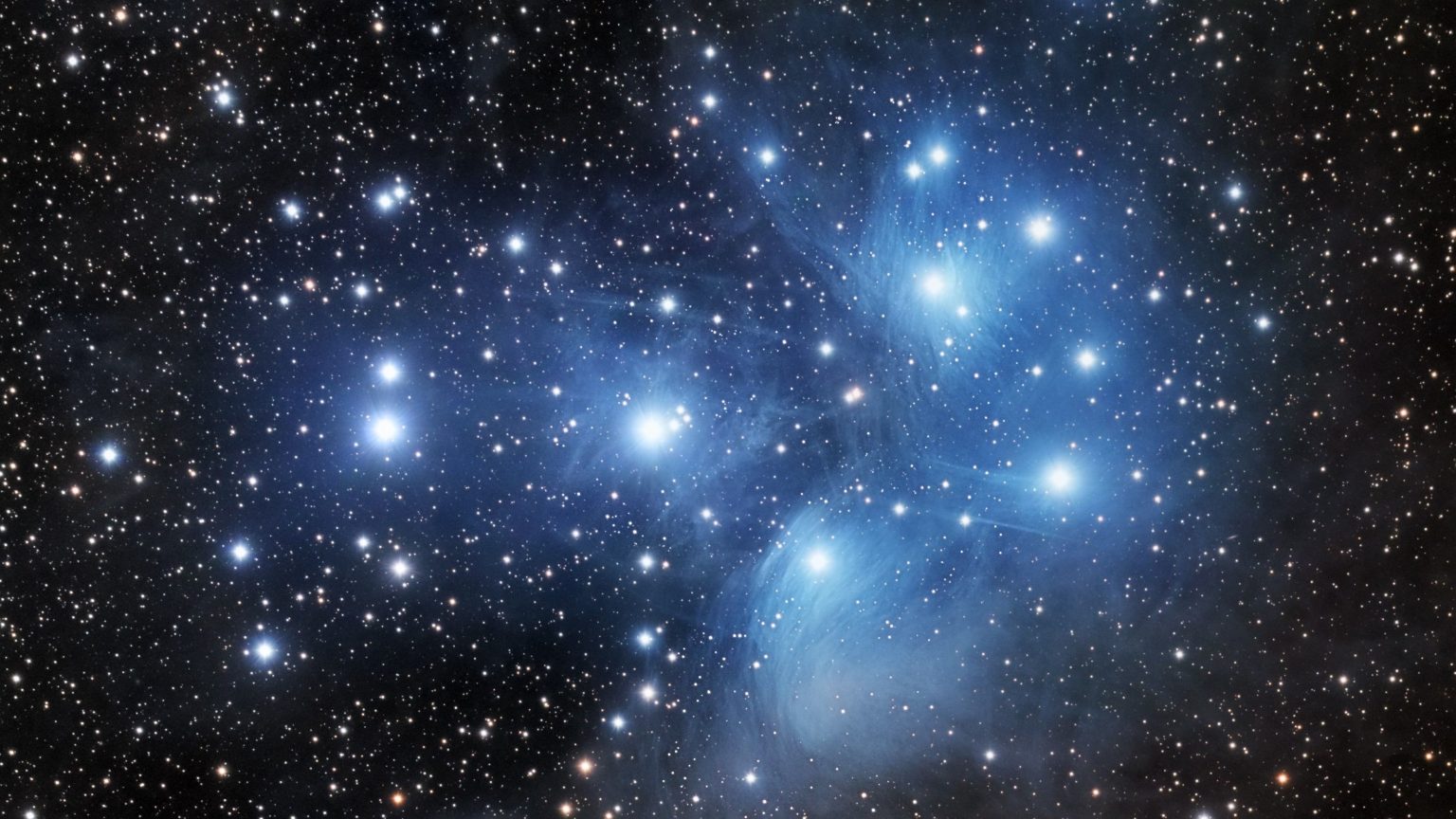
Three clusters
A group of scientists combined observational data and computer simulations to understand how similar the three most prominent clusters in the northern sky — the Pleiades, the Hyades, and Orion Nebula Cluster — actually are. The conclusion was somewhat unexpected.
The Pleiades and the Hyades are two open clusters located in the constellation Taurus and have been known since ancient times. The Orion Nebula Cluster is located near them in the constellation of the same name and illuminates one of the largest star-forming complexes in the region of the Galaxy closest to Earth.
Actually, the Orion Nebula Cluster originated from a huge complex of nebulae about 2.5 million years ago. Of the three nebulae, it is located furthest from us and therefore appears dimmer, although in reality it contains many more stars than the other two, all concentrated in one area of space.
In contrast, the Pleiades are considered to be a scattered star cluster 100 million years old. There are significantly fewer stars there, and those few that exist are scattered less densely. The Hyades, estimated to be 700 million years old, appear completely scattered and gravitationally unbound.
The same development scenario
However, could all these clusters, formed at different times, follow the same evolutionary paths? Scientists used computer simulations and initially looked at the evolution of the Orion Nebula Cluster over the next 700 million years.
Then they modeled what it looked like at the moment of its birth, and did the same for the Pleiades and Hyades. And it turned out that for all three clusters, the different stages of existence look extremely similar.
It seems that all open clusters start out as fairly dense groups of stars, but immediately begin to lose their members. The decrease in the number of stars in them over hundreds of millions of years may amount to 85% of the original number. However, even after this, the remaining stars continue to move as a single entity.
Interestingly, all three of these star clusters — in the Orion Nebula, the Pleiades, and the Hyades — are located in the same area of the night sky. This fact has long fascinated astronomers. The research team suspects that this is more than just a coincidence and may be related to how star clusters form and evolve in the Galaxy.
According to phys.org

