

Growth spurts are not unique to human children. Scientists have recently discovered an orphan planet where something similar is happening. This newborn world has no star, but it is growing extremely fast.
Record growth in mass
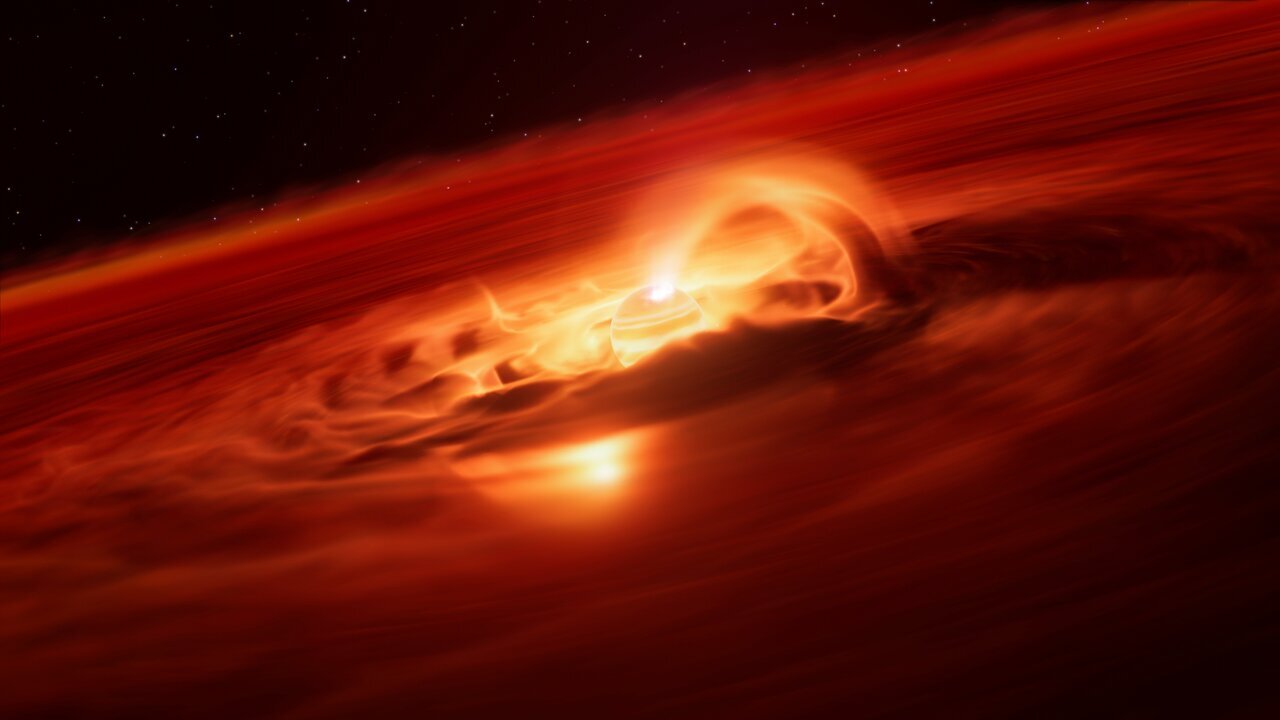
Astronomers have discovered a huge “growth spurt” in the so-called rogue planet. Unlike the planets in our Solar System, these objects do not orbit stars, but float freely in space on their own. New observations made with the European Southern Observatory’s Very Large Telescope (ESO VLT) show that this free-floating planet is consuming gas and dust from its surroundings at a rate of six billion tons per second. This is the fastest growth rate ever recorded for a rogue planet or any other planet, providing valuable information about how they form and grow.
The newly formed object, whose mass is five to ten times greater than that of Jupiter, is located approximately 620 light-years away in the constellation Chameleon. Officially named Cha 1107-7626, this rogue planet is still forming and feeding off the surrounding disk of gas and dust. This material constantly falls onto the free-floating planet, a process known as accretion. However, a team led by Víctor Almendros-Abad has discovered that the rate at which the young planet accretes is not constant.
By August 2025, the planet was accumulating material about eight times faster than just a few months earlier, at a rate of six billion tons per second! Scientists say this is the most powerful episode of accumulation ever recorded for an object of planetary mass.
How are rogue planets formed?
The team also used data from the James Webb Space Telescope, operated by the space agencies of the United States, Europe, and Canada, as well as archival data from the SINFONI spectrograph on the Very Large Telescope (VLT) of the European Southern Observatory (ESO). The origin of rogue planets remains an open question: are they the smallest objects that can form as stars, or are they giant planets ejected from their birth systems?
The results show that at least some rogue planets may have a similar formation pathway to stars, as similar accretion bursts have previously been observed in young stars. As co-author Belinda Damian, also an astronomer at the University of St Andrews, explains, “This discovery blurs the line between stars and planets and gives us a sneak peek into the earliest formation periods of rogue planets.”
Nature of the accretion process
By comparing the light emitted before and during the flare, astronomers gathered information about the nature of the accretion process. It is striking that magnetic activity appears to have played a role in triggering the dramatic mass influx that previously has only been observed in stars. This indicates that even low-mass objects can have powerful magnetic fields capable of fueling such accretion events. The team also found that the chemical composition of the disk around the planet changed during the accretion episode: water vapor was detected during it, but not before. This phenomenon has been observed in stars, but never in any planet.
Free-floating planets are difficult to detect because they are very faint, but the European Southern Observatory’s (ESO) future Extremely Large Telescope (ELT), which will operate under the world’s darkest astronomical sky, could change that. Its powerful instruments and giant primary mirror will enable astronomers to find and study more of these solitary planets, helping them to better understand how similar they are to stars.
According to phys.org

