

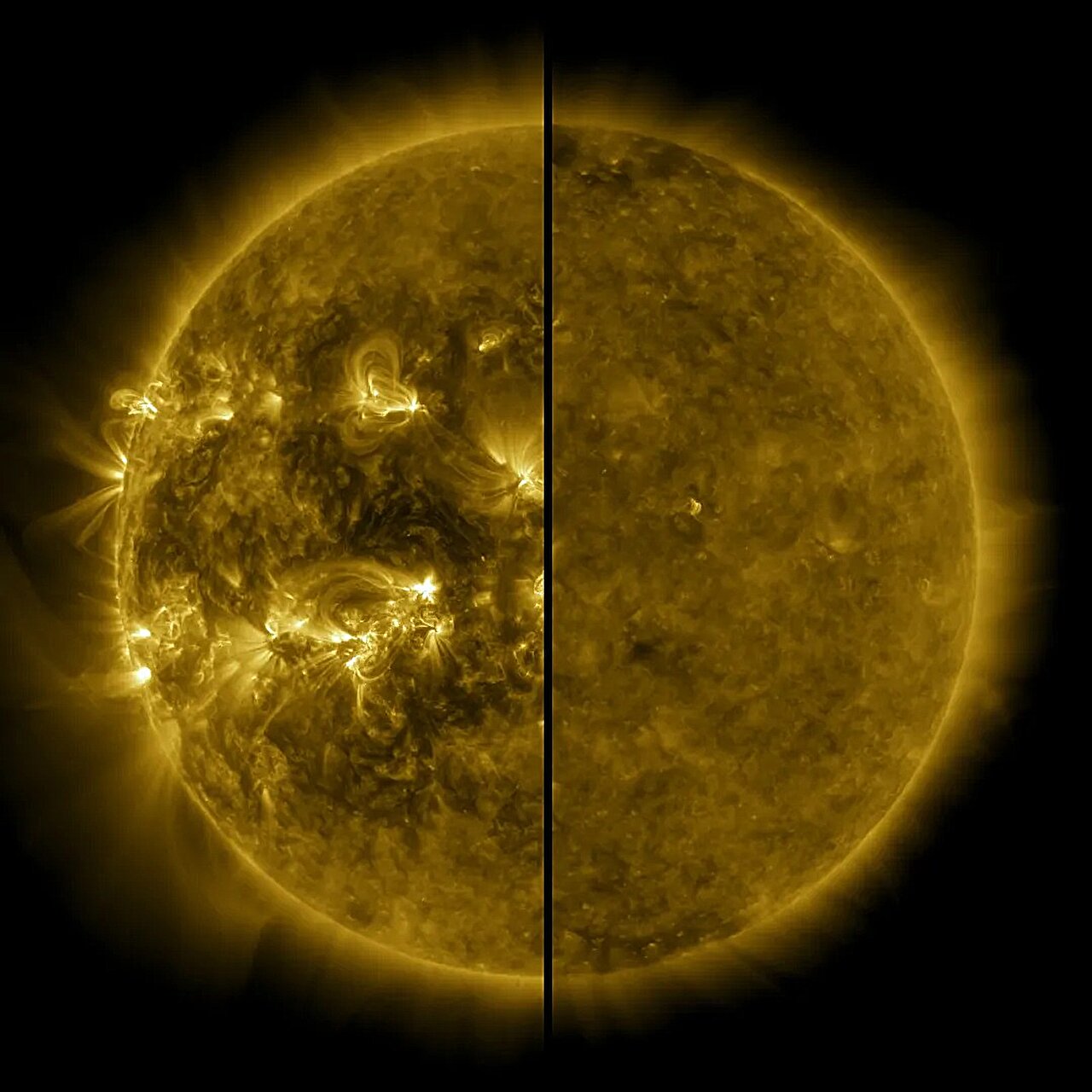
Scientists have learned to “listen” to the Sun and have detected changes that no conventional instrument can record. With each new cycle, the Sun’s magnetic activity is increasingly concentrated in a thin layer just below the visible surface. This may indicate that the Sun is gradually transitioning into a new phase.
Sounds from inside
Researchers from the University of Birmingham, together with an international team, analyzed nearly 40 years of helioseismology data. This method allows scientists to study the Sun’s internal structure through its own sound waves.
These vibrations travel through our star and respond to changes in the magnetic field, somewhat similar to how seismographs detect earthquakes within the Earth.
The observations were conducted by six telescopes around the world, linked together as part of the Birmingham Solar Oscillation Network (BiSON). The data collected covers solar cycles 22 through 25, spanning the period from 1987 to 2025.
What was found?
By analyzing fluctuations at different frequencies, the team was able to probe the Sun to varying depths. It turned out that, from cycle to cycle, the structural changes associated with magnetic activity are becoming increasingly superficial.

Today, they are concentrated in a layer about 1,000 km deep directly beneath the photosphere, which is less than 0.15% of the Sun’s radius. Interestingly, traditional observational methods that track flares, sunspots, and charged-particle eruptions do not detect these changes.
The current 25th cycle appears weaker based on conventional metrics, but high-frequency helioseismic data indicate that its activity is comparable to that of previous cycles.
Why is this important?
Solar activity directly affects space weather. Powerful coronal mass ejections can disrupt satellites, GPS, communication systems, and even power grids on Earth.
Understanding how the Sun’s magnetic field is organized internally is critical for accurate forecasts. Professor Sarbani Basu of Yale University argues that the observed trend cannot be explained simply by a weakening of the fields. It appears that a more profound restructuring of how magnetic processes are organized beneath the surface is taking place.
Whether this is a long-term systemic change will become clear from observations over the course of the 26th cycle. The results have been published in the journal Monthly Notices of the Royal Astronomical Society.
According to phys.org

