

Scientists have discovered a supermassive black hole that appears to have formed before its host galaxy. This contradicts current understanding of how such objects form. The observations were made using the James Webb Space Telescope.
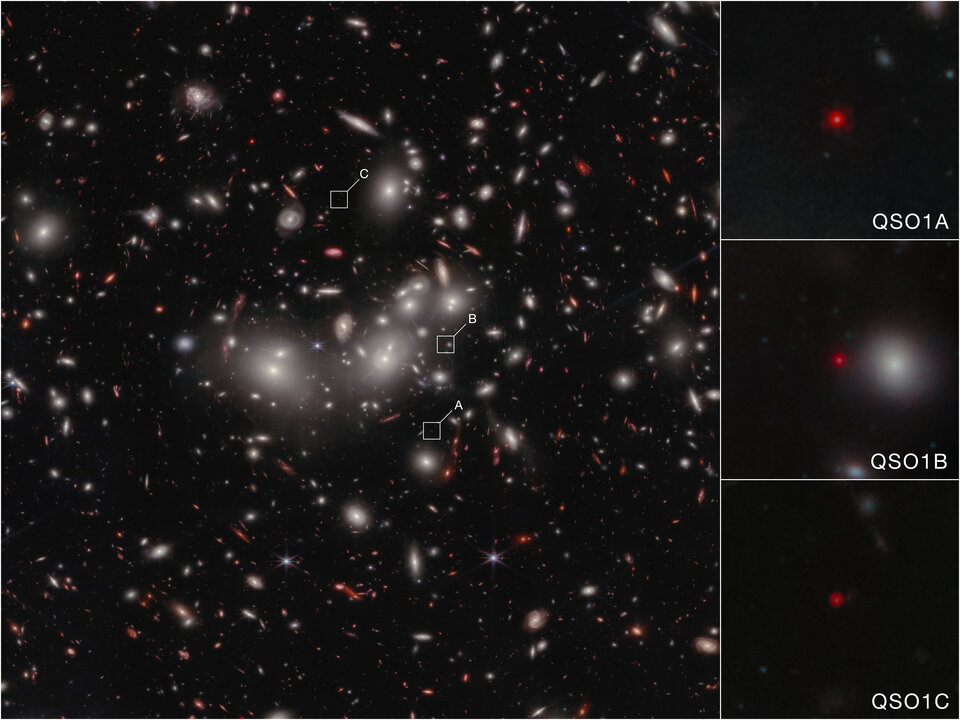
What are those little red dots?
The researchers focused on the object Abell2744-QSO1, one of the so-called “Little Red Dots.” These are a class of extremely bright objects from the early universe that were discovered in large numbers using the James Webb Space Telescope.
It formed just 700 million years after the Big Bang and spans only 1,300 light-years across. Despite the great distance, it is easy to study. The Abell 2744 galaxy cluster acts as a gravitational lens, creating three separate images of the object in different parts of the sky.

Keplerian motion as proof
The team used the telescope’s near-infrared spectrograph (NIRSpec) and its integral field unit to track the motion of gas around the black hole. It turns out that it obeys Kepler’s laws, meaning it moves in the same way as the planets of the Solar System around the Sun.
This means that almost all the mass is concentrated in the central black hole. If there were many stars there, the distribution of mass would disrupt this pattern, and the gas would move differently.
Black hole larger than a galaxy
The black hole’s mass turned out to be about 50 million times greater than that of the Sun. Interestingly, however, it accounts for two-thirds of the galaxy’s total mass.
In modern galaxies, a black hole accounts for only a tiny fraction of the system’s total mass, but here the picture is different. Furthermore, spectral analysis has shown that the gas in the galaxy contains almost no heavy elements such as oxygen, meaning there are almost no stars or stellar remnants there. The abundance of heavy elements, or the metallicity of the medium, is less than 0.5% of the solar value.
Black hole before a galaxy
According to the authors, such an object could not have formed gradually through the merger of smaller black holes. Most likely, it formed as a massive object all at once—either in the first few seconds after the Big Bang as a primordial black hole, or through the collapse of a giant gas cloud.
It appears that this black hole is just beginning to form a galaxy around itself. Researchers believe that such objects were common in the early universe, and are already analyzing similar sources to verify whether black holes truly preceded galaxies.
According to esa.int

