

The new e-MERLIN “virtual” radio telescope has enabled scientists to study pebbles in protoplanetary disks around young stars. This discovery confirms that they are an important stage in the formation of planets.
Mechanisms of planetary system formation
The key method of planet formation has finally been confirmed by observations thanks to a network of radio telescopes in the UK, which have detected the existence of a huge number of centimeter-sized rocks that stick together and turn into planets around two young stars.
“This is potentially enough to form planetary systems larger than our own Solar System,” said Katie Hesterly from the Square Kilometer Array (SKA) Observatory, headquartered at the Jodrell Bank Radio Observatory in the UK.
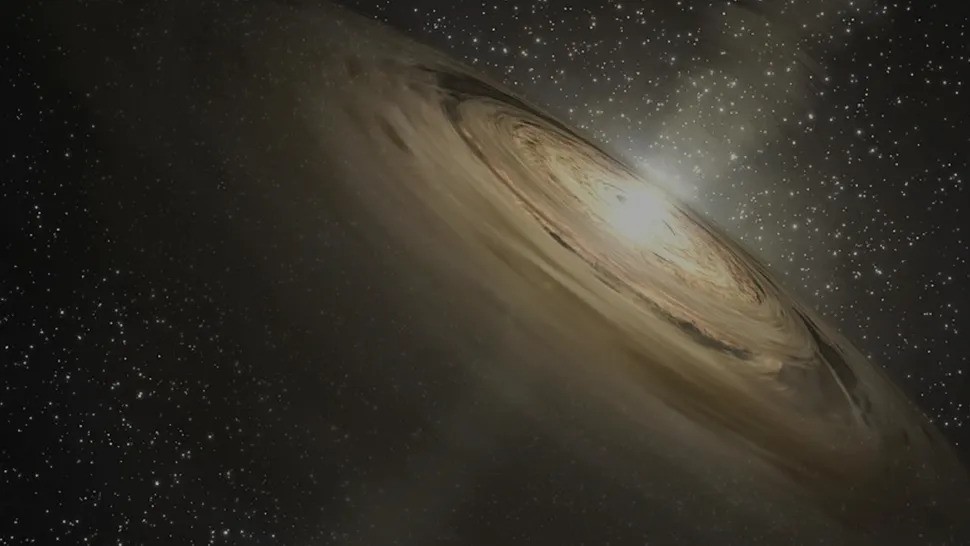
The Taurus Molecular Cloud is one of the closest star-forming regions to us, located at a distance of about 430 light-years. Many young stars that break out of molecular clouds when their ultraviolet radiation cuts through the gas are surrounded by protoplanetary disks. These are discs of gas and dust from which planets condense.
Pebble accretion model
The exact mechanism of planet formation remains a subject of research to this day. One popular model that may help explain the existence of gas giants is the pebble accretion model. It suggests that dust in the disk freezes and condenses into centimeter-sized pebbles, which then rapidly accumulate, accreting and forming large rocky bodies the size of super-Earths, which have sufficient mass to exert gravitational attraction capable of drawing large amounts of gas from the disk.
However, this model has problems. Some simulations cannot ensure the accretion of rocks to each other, rather than their fragmentation upon collision. It is also unclear what role they play in the formation of smaller planets. Still, although millimeter-sized dust particles have been detected in protoplanetary disks at submillimeter wavelengths using ALMA, the Atacama Large Millimeter/submillimeter Array, centimeter-sized particles have not been detected.
Research using the e-MERLIN radio interferometer
In this case, e-MERLIN helps, a radio interferometer that connects seven radio telescopes in the UK via an ultra-fast fiber-optic network, centered at the Jodrell Bank Observatory in Cheshire. Cold pebbles measuring centimeters in size in protoplanetary disks emit radio waves with a wavelength of about 4 centimeters (1.6 inches), which e-MERLIN is capable of detecting.
Targeting two stars in the Taurus molecular cloud — DG Tau and HL Tau — e-MERLIN discovered centimeter-sized pebbles throughout their protoplanetary disks.
“These observations show that disks such as DG Tau and HL Tau already contain reservoirs of pebbles from which planets form in orbits at least similar to Neptune’s,” says Hesterly.
These conclusions were drawn as part of the PEBBLeS (Planet Earth Building Blocks – a Legacy eMERLIN Survey) project, led by Jane Greaves from University of Cardiff.
It is not easy to detect these pebbles. Not only because this requires a radio observatory capable of observing waves as short as 4 cm, such as e-MERLIN, but also because, according to theory, after formation, the pebbles should quickly stick together and form planetary cores.
According to www.space.com

