

The Perseverance rover photographed a rock with a very unusual shape. It resembles a weathered medieval helmet.
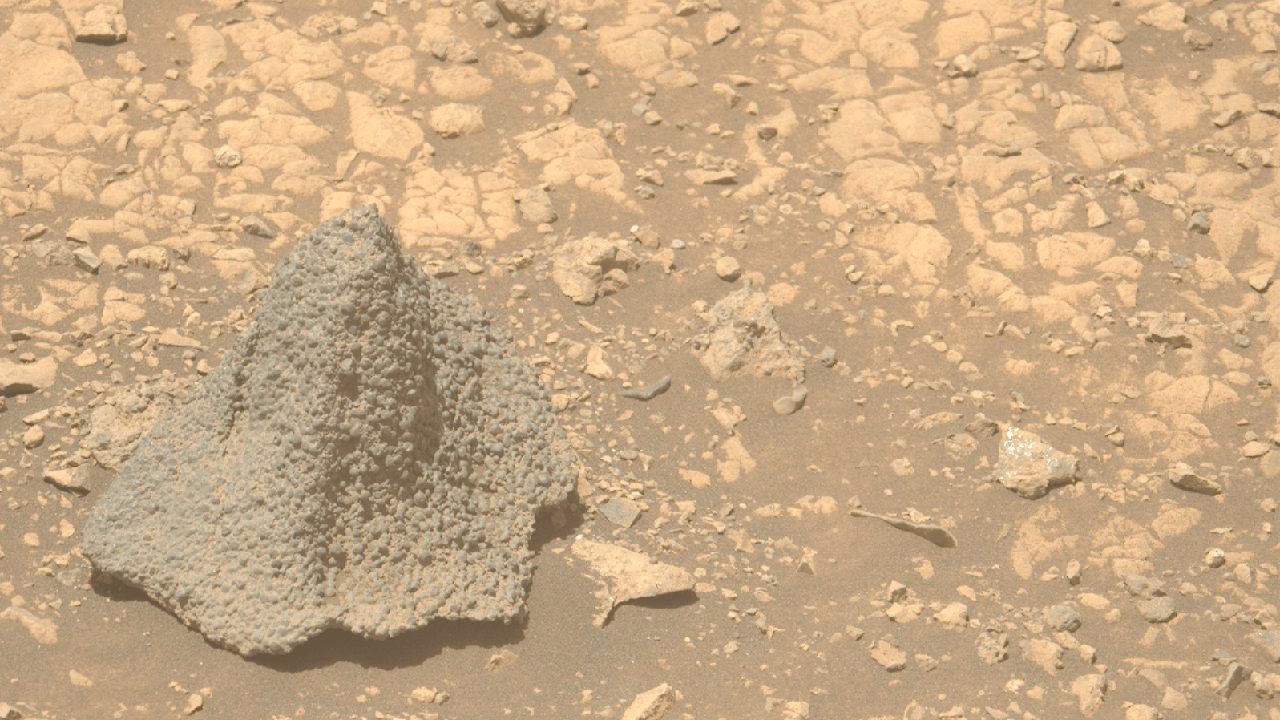
The image of this unusual formation was taken on August 5, 2025, using the Mastcam-Z instrument. It consists of a pair of cameras mounted on the Perseverance mast. They enable scientists to obtain high-resolution stereo images and study unusual objects, such as this rock covered with spherical formations, from a distance.
The rock has a pointed peak and a pitted, nodular texture, which makes it look like a helmet forged many centuries ago. On Earth, similar nodular textures can form as a result of chemical weathering, mineral precipitation, or even volcanic processes. Perseverance already found a similar rock in March 2025.
It was these spherical formations that intrigued scientists. The rock consists almost entirely of them. Researchers suggest that in some rocks found on Mars, these spherical particles formed when groundwater passed through pores in sedimentary rocks. But they are not sure that all of them were formed in this way.
The Perseverance science team will continue to analyze other rocks in search of answers to this mystery of Martian geology. Studying them will help reconstruct the environmental history of the Red Planet, showing how wind, water, and internal processes have shaped its landscapes over billions of years.
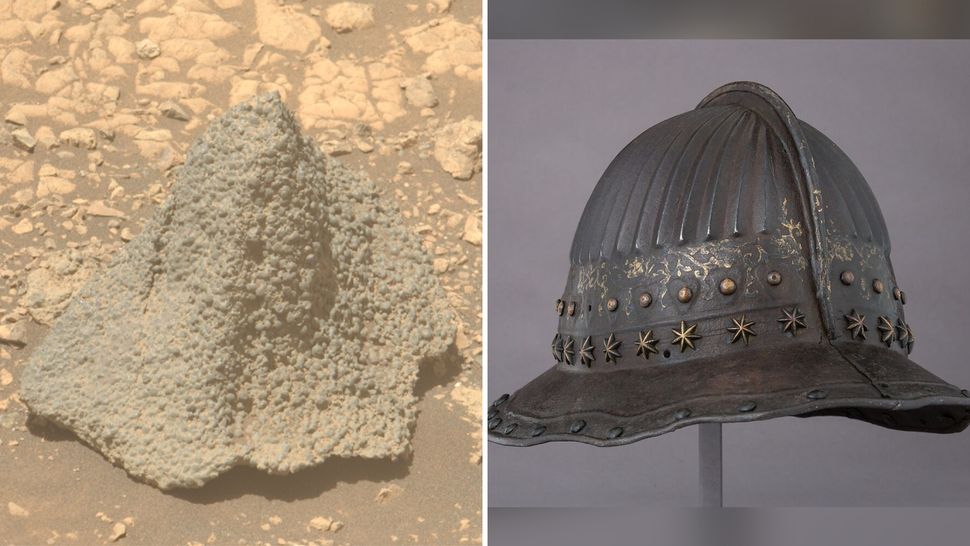
It is also worth noting that the “helmet” is a new addition to the growing collection of strange rocks and formations found on Mars: from a “doorway” to rocks shaped like avocados and ducks. All of these are examples of a phenomenon known as pareidolia. This describes the human brain’s tendency to superimpose familiar images onto random visual data — whether it be a face on the Moon or a Martian sphinx.
According to Space.com

