

Compact lasers, photonic chips, and stable data transmission systems for satellites, telescopes, and future interplanetary spacecraft are becoming increasingly important for the space industry, which is why the new work by physicists from the University of Warsaw, the Military University of Technology, and the Institut Pascal CNRS has attracted attention: researchers have created a miniature light tornado—a swirling laser structure that could serve as the basis for a new generation of simpler and more scalable photonic devices.

We are talking about light with orbital angular momentum—that is, the kind of light twisting around its own axis. It is usually complicated to get such states: this requires bulky setups or nanostructures. But this time, the scientists used a liquid crystal containing so-called torons—self-organized defects that can act as microscopic light traps. This made it possible to generate a controllable twisted light state inside the optical microcavity.
The key breakthrough is that the researchers managed to obtain this vortex state not in an excited state, but in the ground state. This is important because the ground state is more stable and has lower losses, which makes it easier to generate laser light. For verification, the team added a laser dye and demonstrated that the system truly emitted coherent laser light with a precisely defined energy and direction.
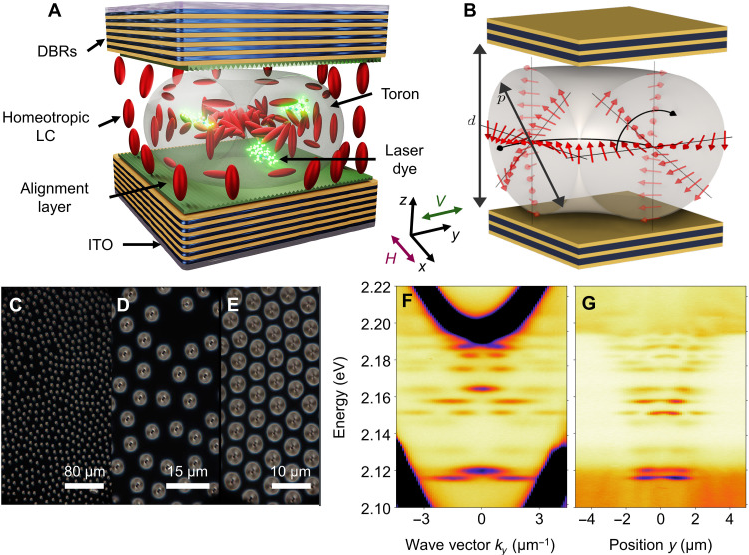
How does it work? Imagine that light doesn’t just travel forward, but also swirls around like a tiny vortex. To make it behave this way, the scientists created a special trap for the photons using a liquid crystal and a mirrored microcavity. Within this structure, the material’s properties cause light to move as if it were being influenced by a magnetic field, even though there is no actual magnet present. For this reason, researchers refer to it as a synthetic magnetic field. The result is a stable, spinning light pattern that can also function as a laser.
Why is this important? For the space industry, this is of particular interest as a path toward the miniaturization of photonics. Controlled twisted laser light has potential applications in optical communications, quantum technologies, precision sensors, and the manipulation of micro-objects. In the future, such solutions could find applications in compact satellite instruments, onboard spectrometers, inter-satellite data exchange systems, and high-precision scientific instruments, where stability, low mass, and low power consumption are critical.

