

Thanks to new research by engineers at the University of California, San Diego, astronauts on long-duration space missions may one day be able to use plants to produce fresh batches of medicine as needed. The team has developed a simple method for cultivating and repeatedly harvesting medicinal compounds from plants under conditions that mimic those in space, without damaging the plants or generating large amounts of waste. This method could also help establish cost-effective drug production in regions of the world with limited resources.
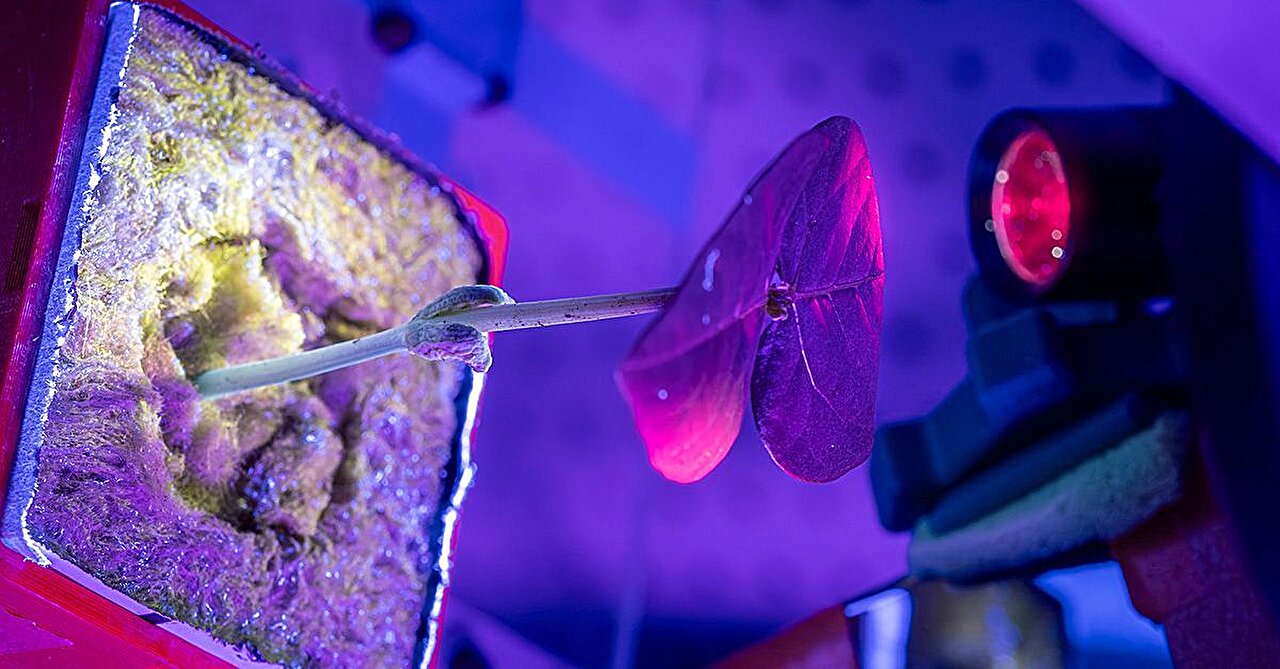
Plants: A source of medicine in space travel
One of the biggest challenges of space travel is ensuring that astronauts have access to safe and effective medications. Many medications degrade more quickly in space. Even aboard the International Space Station, it has been found that more than half of the medication stockpile will expire within three years. This would barely be enough for a trip to Mars, which could take as a minimum about 200 days one way. Regular restocking of medical supplies is simply impossible millions of kilometers from Earth. Plants offer a promising solution, as they can serve as mini-factories for producing medications.
“With plants, you can grow complex therapeutic compounds using light, water and soil,” said study senior author Nicole Steinmetz, who holds the Aiiso Yufeng Li Chair in Chemical and Nanoengineering at the Jacobs School of Engineering at the University of California, San Diego, funded by the Leo and Trude Szilard Chancellor.
This is a major advantage over modern drug manufacturing systems, which require massive tanks and sterile conditions. In addition, plants are already being grown in space, and they can help purify the air and water on board spacecraft.
A plant-based anticancer drug
Steinmetz and her colleagues demonstrated this concept using an experimental therapeutic agent they have been studying for more than a decade: a plant virus known as cowpea mosaic virus (CPMV). Although CPMV is better known for infecting legumes, Steinmetz’s team is familiar with it for its ability to stimulate the immune system to attack cancer cells. CPMV has demonstrated strong antitumor activity in preclinical mouse models and in clinical trials involving dogs with cancer.
To produce CPMV, Steinmetz’s team uses Nicotiana benthamiana plants and black-eyed peas. “Growing the compound in these plants is simple,” said study first author Patrick Opdensteinen, a graduate student in Steinmetz’s lab. “They can produce a whole lot of biomass in a short amount of time, and more biomass equals more product. The main difficulty now is figuring out how to get the product out of the plants.”
Extracting CPMV—and other pharmaceutical products—from plants typically involves picking the leaves and grinding them in a blender. A new study focused on simplifying this step.
The team drew inspiration from an approach used with bacterial and mammalian cells in pharmaceutical manufacturing: product secretion. Plants secrete substances into a compartment within the leaf called the apoplast—a network of interconnected spaces located outside the plasma membrane.
Technology for extracting medicinal compounds from plants
Researchers have discovered that they can extract the CPMV virus from the apoplast without damaging the leaves. First, the leaves are immersed in a buffer solution and placed in an airtight container. A vacuum is created, filling the apoplast with liquid. The saturated leaves are then placed in test tubes and gently centrifuged to extract the liquid containing CPMV particles. The resulting liquid is filtered to separate the larger CPMV particles from the finer unwanted plant material.
This method is easily scalable. The researchers were able to collect and purify CPMV particles from more than 50 plants in less than two hours. And since the leaves remain intact, the plants can continue to grow and, potentially, be harvested again and again. The team plans to adapt this process to whole living plants, not just leaves.
Testing drug production under space conditions
The team also tested this method on plants grown under simulated space conditions.
To simulate microgravity, the Steinmetz lab collaborated with the lab of Maziar Ghazinejad, a professor in the Department of Mechanical and Aerospace Engineering at the Jacobs School of Engineering at the University of California, San Diego, to create a special chaotic positioning machine that continuously rotates the plants, effectively neutralizing the effects of gravity. Ghazinejad’s laboratory typically uses these machines to study how materials behave in space. Steinmetz and Ghazinejad saw an opportunity to adapt this approach to plant research.
The plants were also exposed to temperature fluctuations and oxidative stress to mimic the effects of space radiation. In some cases, these stress factors slightly increased CPMV yield. The researchers hypothesize that this effect may be related to the nature of CPMV as a plant virus.
“Plants become more susceptible to disease when stressed, which is usually a disadvantage,” Opdensteinen said. “But since our product is derived from a plant virus, we can use that stress response to increase yields.”
The team’s ultimate goal is to test their method in actual space missions. Before that can happen, the team still has a lot of work to do. They will continue to study how space conditions affect processes in plants, such as the uptake of water and nutrients. They will also collaborate with the Rocket Propulsion Laboratory at the University of California, San Diego, to investigate how rocket launches affect plant seeds and the genetic material used in the process.
According to phys.org

