

Astronomers call the event, AT2025ulz, which was recorded this year, a “superkilonova.” It is quite possible that it was a double explosion. First, there was a kilonova, i.e., a collision of two neutron stars, which caused a supernova explosion.
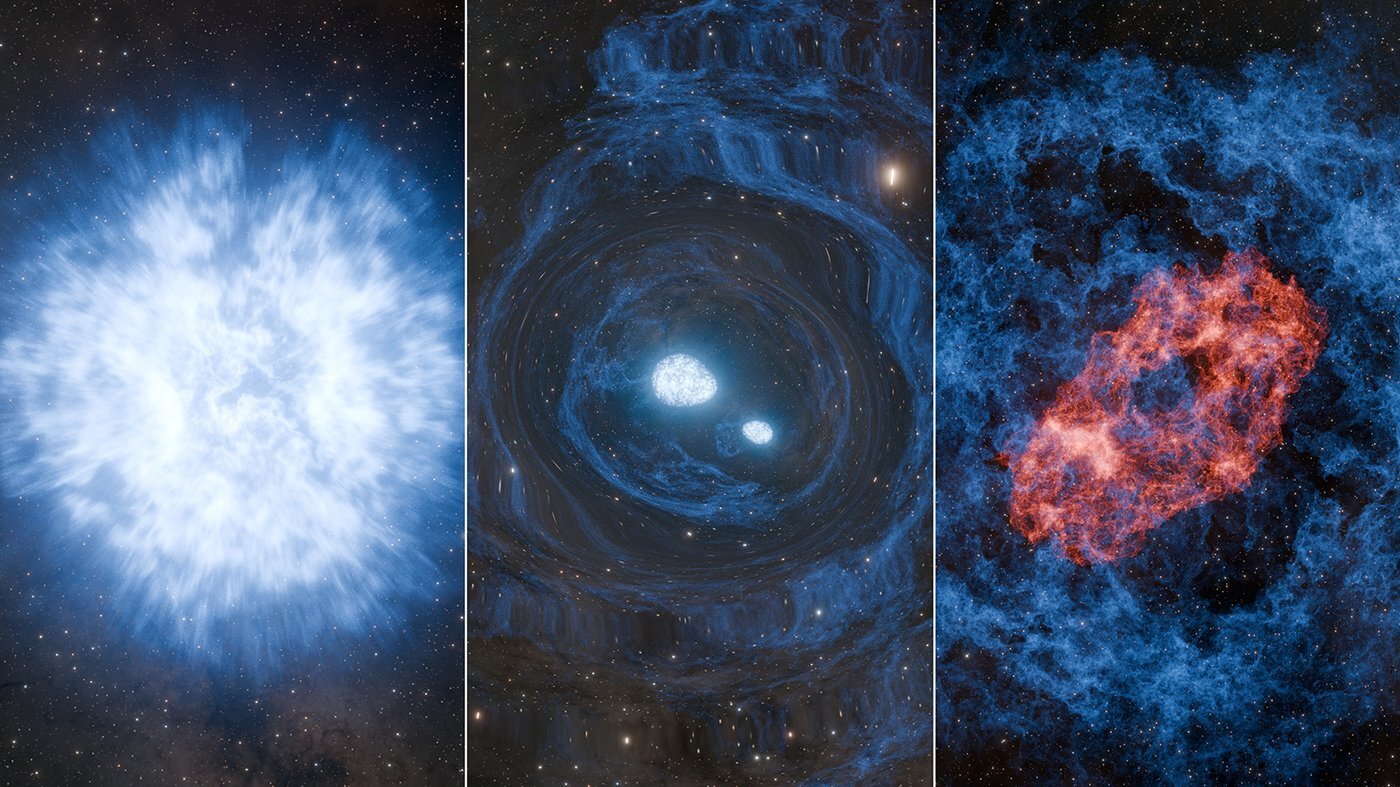
AT2025ulz event
In a recent article published in The Astrophysical Journal Letters, astronomers suggest that the AT2025ulz event recorded this year was a superkilonova. The name sounds a bit sensationalist, but upon closer inspection, it seems quite accurate.
A supernova is an event in which a massive star explodes, shedding its outer layers and leaving behind a neutron star or black hole. Astronomers observe these events regularly. However, a kilonova, or collision between two neutron stars, has only been observed once.
There are many candidates for this event, but only one is unambiguous—GW170817, which took place in 2017. Scientists are confident about this because not only electromagnetic radiation but also electromagnetic waves were recorded at that time.
New explosion
Astronomers now report a possible second case of a kilonova, but the matter is still open. In fact, the situation is much more complicated, as it is believed that the potential kilonova, named AT2025ulz, was the result of a supernova explosion that occurred a few hours earlier, which ultimately blocked the astronomers’ view.
“At first, for about three days, the eruption looked just like the first kilonova in 2017,” says Mansi Kasliwal, professor of astronomy and director of the Palomar Observatory at the California Institute of Technology near San Diego. “Everybody was intensely trying to observe and analyze it, but then it started to look more like a supernova, and some astronomers lost interest. Not us.”
Detection of gravitational waves
The first evidence of a possible rarity appeared on August 18, 2025, when the twin LIGO detectors in Louisiana and Washington, as well as Virgo in Italy, recorded a new gravitational wave signal.
Within minutes, the team that operates gravitational wave detectors (an international collaboration that also includes the organization that operates the KAGRA detector in Japan) sent messages to the astronomical community that gravitational waves had been detected, likely resulting from their extraordinary connections. The message included a rough map of the source’s location.
A few hours later, the Zwicky Transient Facility (ZTF), a surveillance camera at the Palomar Observatory, was the first to detect a rapidly fading red object 1.3 billion light-years away, believed to have originated in the same location as the source of the gravitational waves. The event, initially named ZTF 25abjmnps, was later renamed AT2025ulz by the International Astronomical Union’s Transient Name Server.
Observations confirmed that the flash of light faded quickly and glowed in the red wavelength range — just like GW170817 eight years ago. In the case of GW170817, the red colors came from heavy elements such as gold; these atoms have more electron energy levels than lighter elements, so they block blue light but allow red light to pass through.
Then, a few days after the explosion, AT2025ulz began to brighten again, turning blue and emitting hydrogen in its spectrum—all signs of a supernova rather than a kilonova (namely, a supernova of the “stripped shell with core collapse” type).
Supernovae from distant galaxies are not typically expected to generate enough gravitational waves to be detected by LIGO and Virgo, unlike kilonovae. This has led some astronomers to conclude that AT2025ulz was caused by a typical supernova and not actually related to a gravitational signal.
What could have happened?
Kasliwal says that several clues led her to believe that something unusual had happened. Although AT2025ulz is not similar to the classic kilonova GW170817, it is also not similar to a typical supernova. In addition, LIGO–Virgo gravitational wave data showed that at least one of the neutron stars in the merger was less massive than our Sun, suggesting that one or two small neutron stars may have merged to form a kilonova.
Neutron stars are the remains of massive stars that explode as supernovae. They are believed to be about the size of San Francisco (about 25 kilometers in diameter) and weigh between 1.2 and about three times the mass of our Sun. Some theorists have hypothesized that neutron stars may be even smaller, with a mass less than that of the Sun, but such stars have not yet been observed.
Theorists propose two scenarios to explain how a neutron can be so small. In the first scenario, a rapidly rotating massive star becomes a supernova and then splits into two tiny neutron stars with less than the mass of the Sun in a process called fission.
In the second scenario, called fragmentation, the rapidly rotating star again turns into a supernova, but this time a disk of matter forms around the collapsing star. The uneven matter of the disk merges into a tiny neutron, similar to how planets are formed.
Since LIGO and Virgo have detected at least one neutron star with a mass less than that of the Sun, according to theories proposed by co-author Brian Metzger of Columbia University, it is possible that two newly formed neutron stars could have come close together and collided, exploding as a kilonova.
As the kilonova ejected heavy metals, it initially glowed red, as observed by ZTF and other telescopes. The expanding debris from the initial supernova explosion blocked astronomers’ view of the kilonova. In other words, the supernova could have spawned two twin neutron stars, which then merged to form the kilonova.
According to phys.org

