

The Psyche spacecraft is heading toward its final destination — the iron asteroid Psyche. It recently tested its camera by photographing Earth and the Moon. The distance to them at that moment was 290 million km.
Long-distance shots
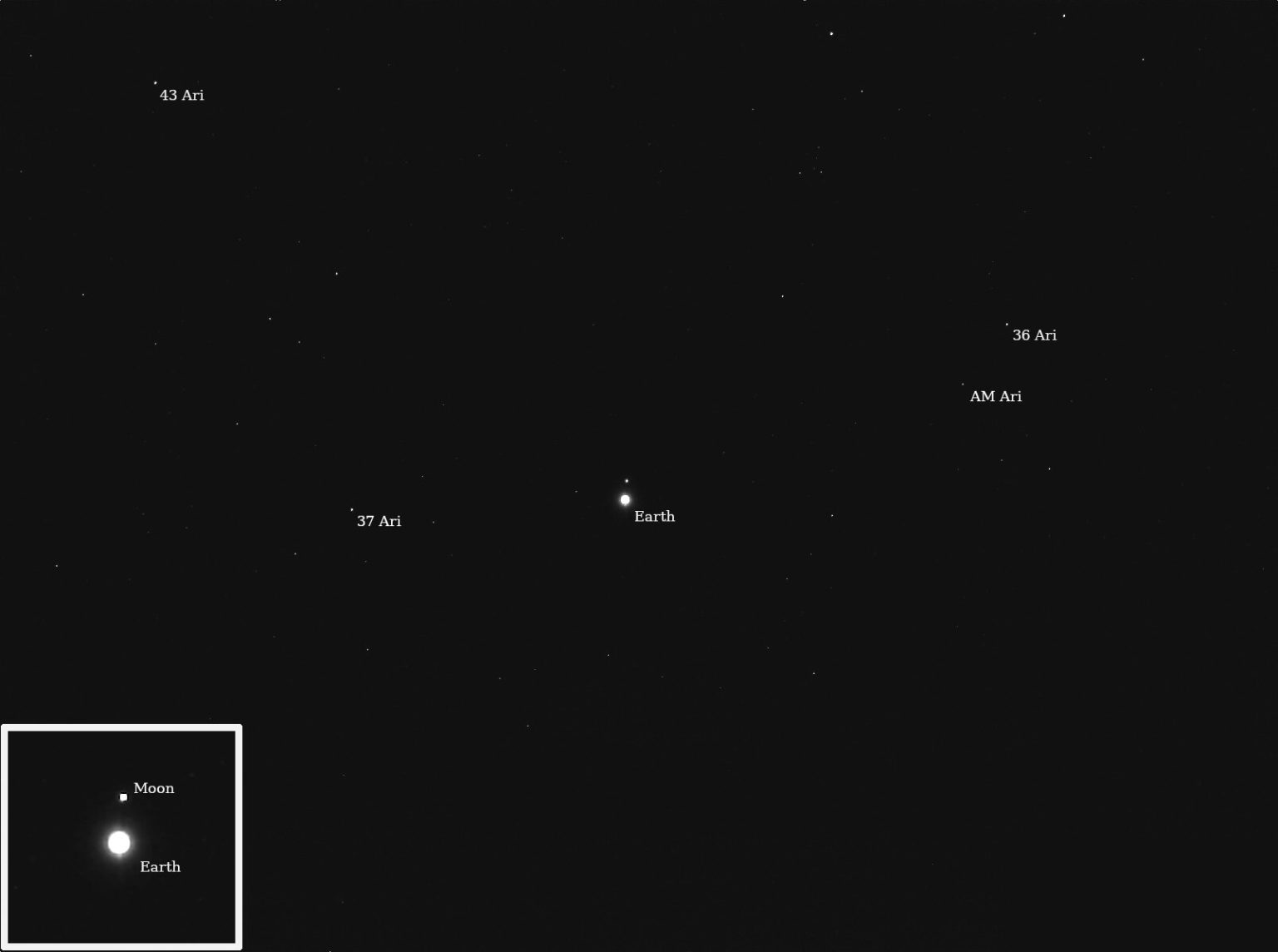
The Psyche spacecraft, heading for the asteroid Psyche, has successfully calibrated its cameras. It did this by looking at the Earth. As a result, scientists obtained an excellent image of our planet and its moon.
According to the schedule for its arrival at the asteroid Psyche in 2029, NASA’s Psyche spacecraft recently looked back toward Earth and took pictures of Earth and the Moon from a distance of about 290 million kilometers. The images were taken during one of the periodic tests of the spacecraft’s scientific instruments conducted by the mission team.
On July 20 and 23, the spacecraft’s dual cameras took several long-exposure (up to 10 seconds) images of two objects that appear as points of light reflecting sunlight among the stars in the constellation Aries.
Multispectral camera check
The Psyche multispectral imager consists of a pair of identical cameras equipped with filters and telescopic lenses for photographing the surface of the asteroid Psyche at different wavelengths of light. The color and shape of a planetary body’s spectrum can reveal details about its composition.
For example, the Moon and the giant asteroid Vesta have similar “irregularities and fluctuations” in their spectra, which scientists could also detect on Psyche. Members of the mission’s scientific team are interested in Psyche because it will help them better understand the formation process of rocky planets with metallic cores, including Earth.
When selecting targets for testing and calibrating the camera, scientists look for bodies that glow with reflected sunlight, such as the asteroid Psyche. They also examine objects whose spectrum is well known to them in order to compare preliminary data from telescopes or spacecraft about these objects with observations from Psyche instruments. Earlier this year, Psyche turned its cameras toward Jupiter and Mars for calibration — each of which has a spectrum that is redder than Earth’s blue tones. This test was also successful.
To determine whether camera performance changes, scientists also compare data from different tests. Thus, when the spacecraft enters orbit around Psyche, scientists can be confident that the device is functioning as expected.
Next major milestone for the vehicle
The camera was not the only device to pass testing at the end of July: the mission team also conducted a series of tests on the spacecraft’s magnetometer and gamma-ray and neutron spectrometer — this is done every six months.
Mission engineers say all systems on the spacecraft are working well. Psyche’s flyby of Mars is scheduled for May 2026, and therefore all planned activities for the flight are being carried out.
This flyby is the next major milestone for the spacecraft as it uses the Red Planet’s gravity as a slingshot to reach the asteroid Psyche. This will be the first of two planned orbits of Psyche around the Solar System and 1.6 billion kilometers since its launch from NASA’s Kennedy Space Center in October 2023.
According to phys.org

