

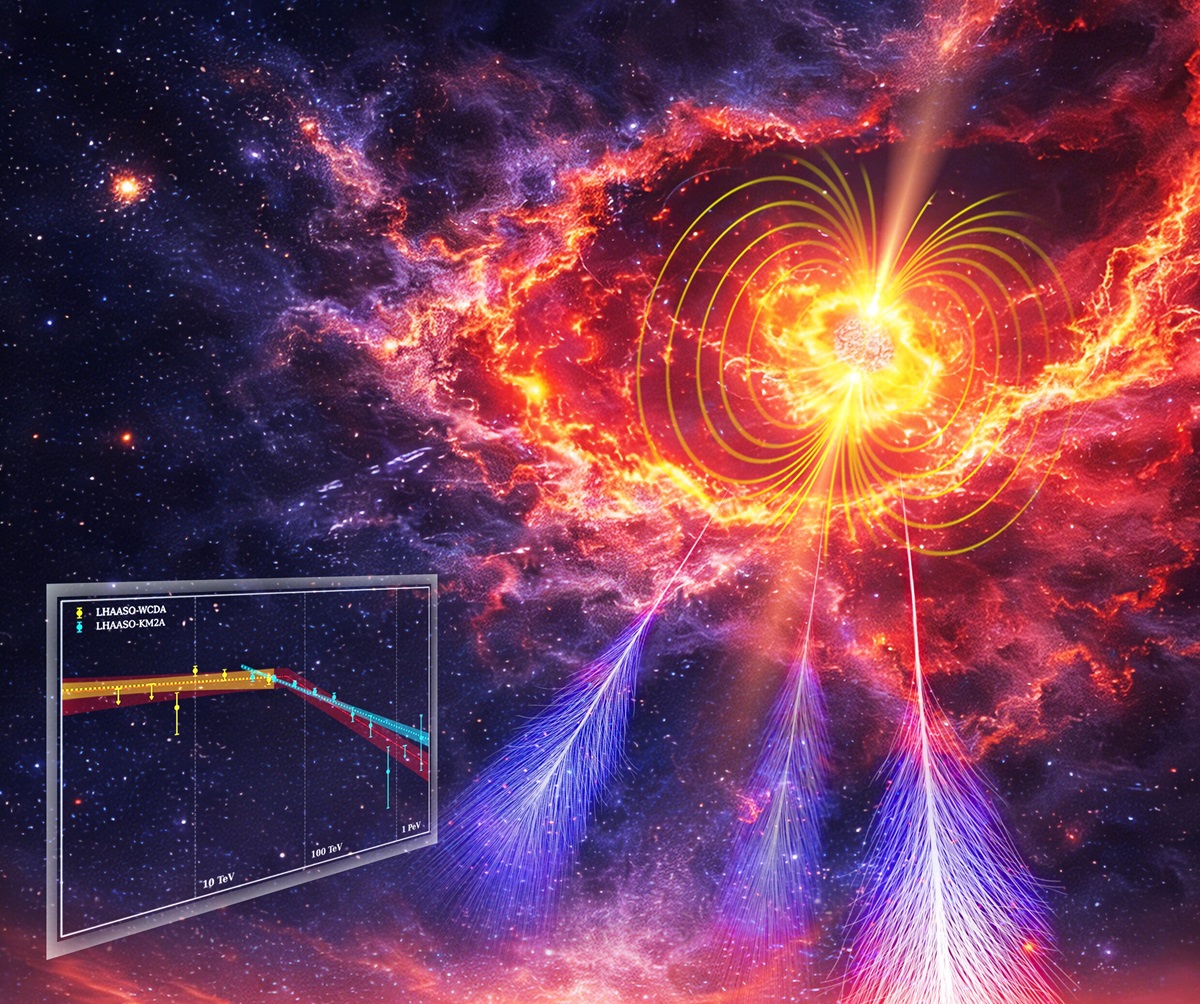
The LHAASO Observatory has detected a particle with an energy of several PeV in the radiation from the pulsar PSR J1849-0001, located in the constellation Aquila. This is the second nebula associated with neutron stars that has been found to act as a powerful cosmic accelerator.
High-energy particle
The journal Nature Astronomy has published a study by Chinese scientists on the pulsar PSR J1849-0001, located in the constellation Aquila. The article described an interesting discovery made using the new radio astronomy observatory, the Large High Altitude Air Shower Observatory (LHAASO).
The main finding of this study is the discovery of a particle with an energy of approximately 2 PeV. This means that the energy of this particle is 10 to 15 times greater than what is needed to move an electron between two points with a potential difference of 1 V.
This means that PSR J1849-0001 and the entire nebula surrounding it can be considered a particle accelerator capable of producing particles with extremely high energies. And this is not the first object of its kind to exhibit such properties.
Pulsar nebulae
A pulsar is an extremely rapidly rotating neutron star with a powerful magnetic field. It is the remnant of a supernova explosion, the result of the collapse of a dead star’s core. Sometimes it is surrounded by the remnants of material shed from the outer layers of the dead star—a pulsar nebula.
Pulsar nebulae are known to emit radiation across a wide range of the spectrum, including the high-frequency range. It is generated by nebular material interacting with magnetic fields and pulsar radiation.
Scientists have long known that this radiation extends into the gamma-ray range, but they believed there was a theoretical energy limit that such systems could impart to particles. They can’t even get within a few PEVs of the border.
However, some time ago, the same LHAASO detector found crab-like radiation in the most famous of the pulsar nebulae, with an energy of more than one PeV—which is 16% of the theoretically possible value.
And here is the latest result. The energy of the particle from the pulsar that has reached us is 27% of the maximum possible. So, perhaps this isn’t the limit yet. Moreover, it’s possible that all pulsar nebulae act as particle accelerators capable of accelerating particles to petaelectronvolt energies.
According to phys.org

