

PUNCH is a system of four small spacecraft designed to study solar activity. Recently, the capabilities of one of them were demonstrated thanks to an image of a powerful coronal mass ejection that spread throughout the Solar System.
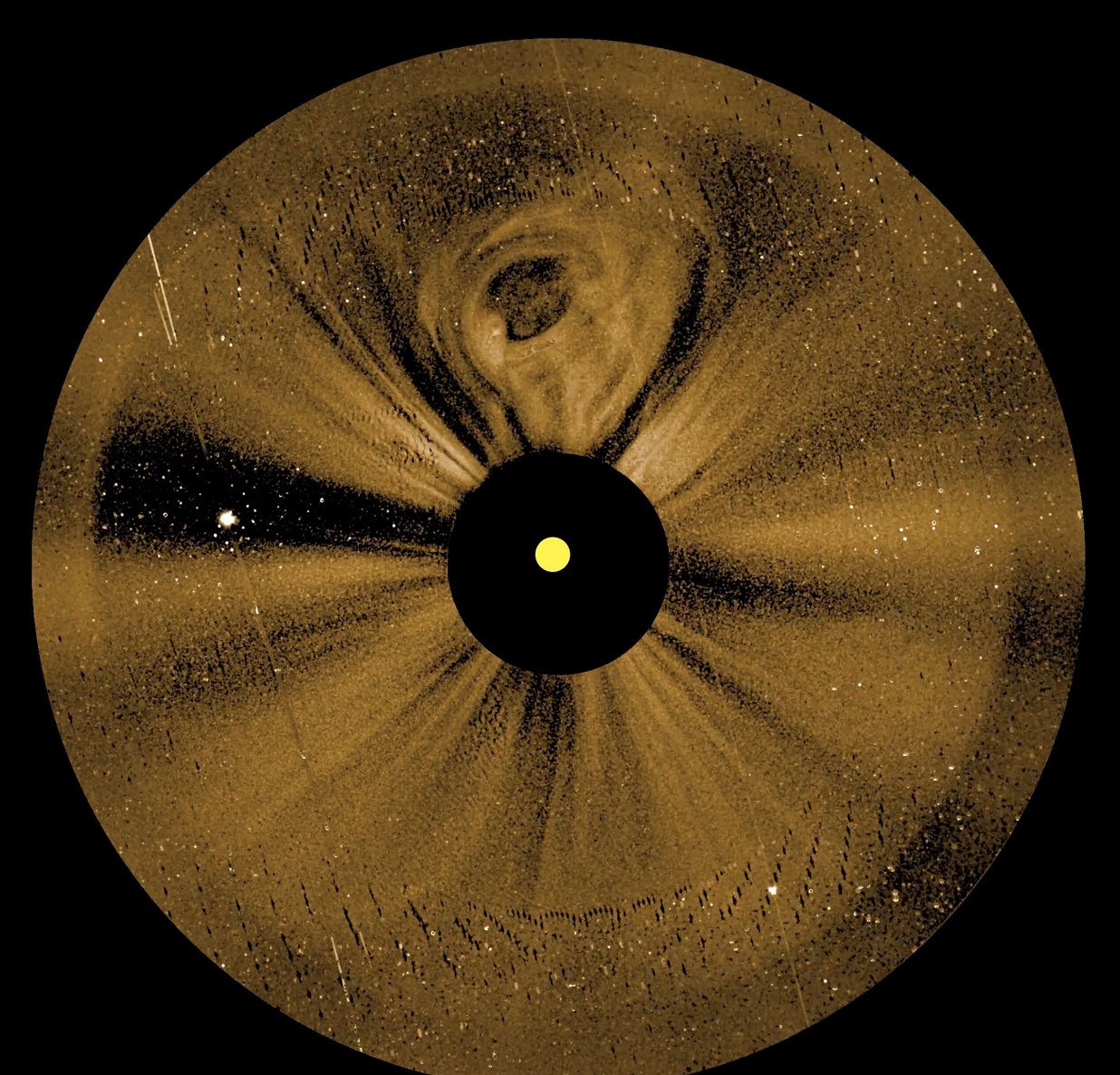
Image of coronal ejection
At the 246th meeting of the American Astronomical Society, recently held in Anchorage, Alaska, representatives of the Southwest Research Institute showed a video of a powerful coronal mass ejection obtained from one of the PUNCH instruments.
Thus, they demonstrated the effectiveness of this system, which has not yet begun to operate at full capacity. Four PUNCH vehicles, each about the size of a suitcase, were launched into space on March 11, and they’re still heading to the orbits where they’ll operate.
The system is designed to track the activity of the Sun. The probes included in its formation will observe our star from points that are sufficiently distant from each other as a single entity in order to obtain an image that would require a single telescope with a diameter of 13,000 km.
Coronal mass ejections and solar wind
Coronal mass ejections are parts of the Sun’s outer layers that are torn off by flares on its surface and then scattered into space. When they interact with Earth, they can cause strong magnetic storms. To date, their behavior after moving away from our star has remained poorly understood.
And it is precisely this gap that the PUNCH mission aims to fill when it becomes fully operational. The current image was obtained using only three of the four cameras, but it is already impressive in its detail.
Experts particularly note PUNCH’s ability to study not only mass ejections, but also the solar wind as a whole. According to them, these are manifestations of the same phenomenon.
According to phys.org

