

The Chandra space telescope has allowed scientists to study the black hole RACS J0320-35, located 12.8 billion light-years away from us. The radiation from this quasar is 2.4 times greater than the Eddington limit. This means that, theoretically, matter can’t fall into it.
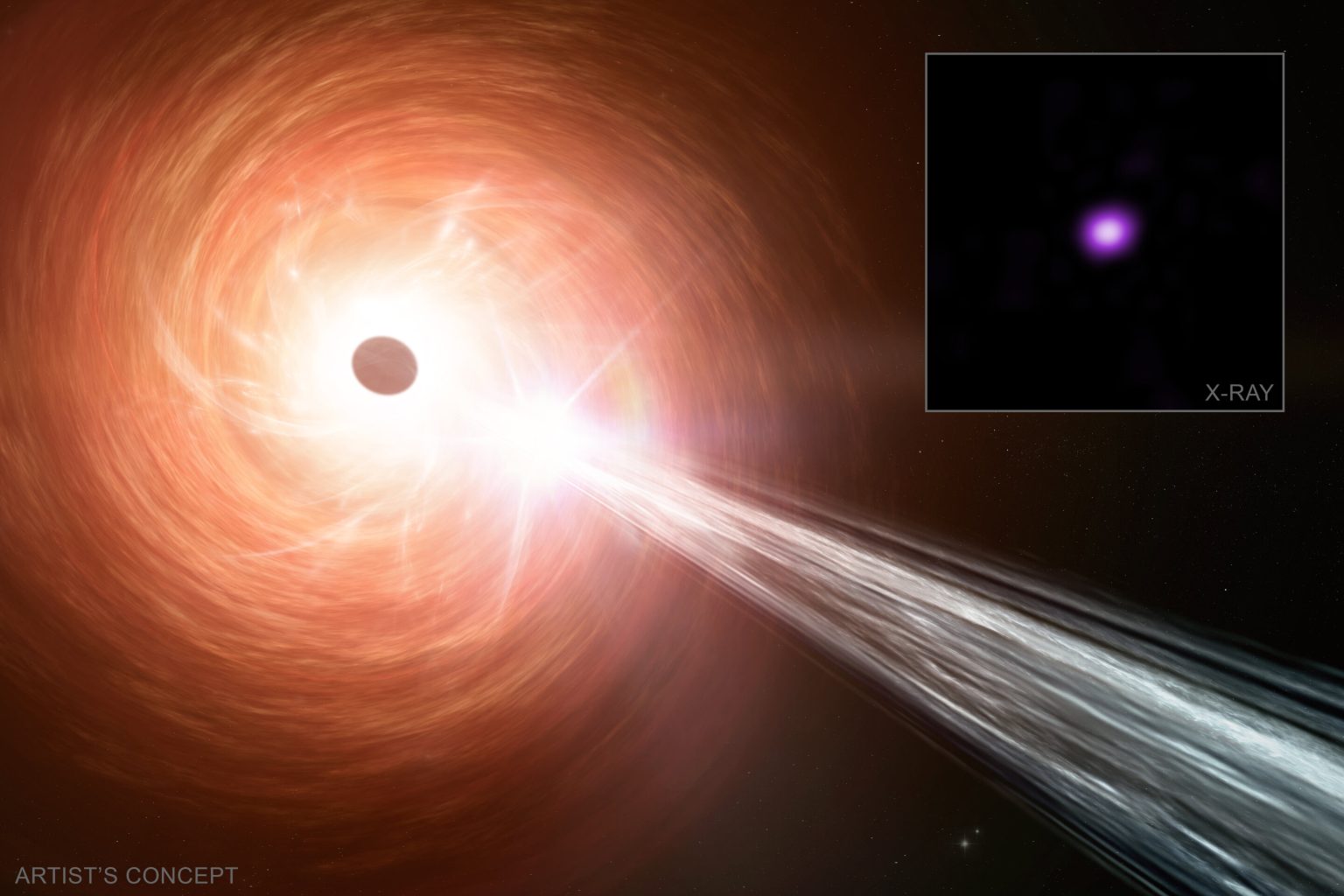
A giant black hole at the beginning of our universe
The black hole weighs about a billion times the mass of the sun and is located about 12.8 billion light-years from Earth, meaning that astronomers are seeing it only 920 million years after the universe began. It is producing more X-rays than any other black hole seen in the first billion years of the universe.
The black hole is powering what scientists call a quasar, an extremely bright object that outshines entire galaxies. The power source of this glowing monster is large amounts of matter funneling around and entering the black hole.
Although the same team discovered it two years ago, it took observations from Chandra in 2023 to discover what sets this quasar, RACS J0320-35, apart. The X-ray data reveal that this black hole appears to be growing at a rate that exceeds the normal limit for these objects.
Eddington limit
When matter is pulled toward a black hole, it is heated and produces intense radiation over a broad spectrum, including X-rays and optical light. This radiation creates pressure on the infalling material. When the rate of infalling matter reaches a critical value, the radiation pressure balances the black hole’s gravity, and matter cannot normally fall inwards any more rapidly. That maximum is referred to as the Eddington limit.
Scientists think that black holes growing more slowly than the Eddington limit need to be born with masses of about 10,000 suns or more, so they can reach a billion solar masses within a billion years after the Big Bang – as has been observed in RACS J0320-35. A black hole with such a high birth mass could directly result from an exotic process: the collapse of a huge cloud of dense gas containing unusually low amounts of elements heavier than helium, conditions that may be extremely rare.
If RACS J0320-35 is indeed growing at a high rate – estimated at 2.4 times the Eddington limit—and has done so for a sustained amount of time, its black hole could have started more conventionally, with a mass less than a hundred suns, caused by the implosion of a massive star.
Chandra unravels scientific mysteries
To figure out how fast this black hole is growing (between 300 and 3,000 suns per year), the researchers compared theoretical models with the X-ray signature, or spectrum, from Chandra, which gives the amounts of X-rays at different energies. They found the Chandra spectrum closely matched what they expected from models of a black hole growing faster than the Eddington limit. Data from optical and infrared light also support the interpretation that this black hole is packing on weight faster than the Eddington limit allows.
“How did the universe create the first generation of black holes?” said co-author Thomas Connor, also of the Center for Astrophysics. “This remains one of the biggest questions in astrophysics, and this one object is helping us chase down the answer.”
Another scientific mystery addressed by this result concerns the cause of jets of particles that move away from some black holes at close to the speed of light, as seen in RACS J0320-35. Jets like this are rare for quasars, which may mean that the rapid rate of growth of the black hole is somehow contributing to the creation of these jets.
The quasar was previously discovered as part of a radio telescope survey using the Australian Square Kilometer Array Pathfinder, combined with optical data from the Dark Energy Camera, an instrument mounted on the Victor M. Blanco 4-meter Telescope at the Cerro Tololo Inter-American Observatory in Chile. The U.S. National Science Foundation National Optical-Infrared Astronomy Research Laboratory’s Gemini-South Telescope on Cerro Pachon, Chile, was used to obtain the accurate distance of RACS J0320-35.
Provided by: phys.org

