

The European Space Agency has announced the successful testing of parachutes for the ExoMars mission. This is an important step towards its flight to Mars.
How to land on Mars
Landing on Mars is a very risky operation. The red planet has an atmosphere, so the spacecraft has to be equipped with heat protection, which makes it heavier. At the same time, the atmosphere of Mars is extremely thin: the pressure at the surface is equivalent to the pressure at an altitude of 30 km above Earth. Because of this, a normal parachute is not sufficient for a soft landing of a large load. To slow down from 21,000 km/h in just six minutes, engineers have to use a complex combination of several large parachutes and brake engines.
It was precisely the problems identified during parachute testing that became one of the main reasons for postponing the launch of the ExoMars mission from 2020 to 2022. In 2021, tests of the updated parachute system were conducted in Sweden and were successful. However, this was followed by Russia’s full-scale invasion of Ukraine, after which ESA severed ties with the aggressor country and refused to use the Russian Kazachok landing platform.
All this brought the mission to the brink of cancellation. Nevertheless, ESA decided to continue developing the project, replacing all Russian components. The new launch date for ExoMars was set for 2028.
The largest extraterrestrial parachute
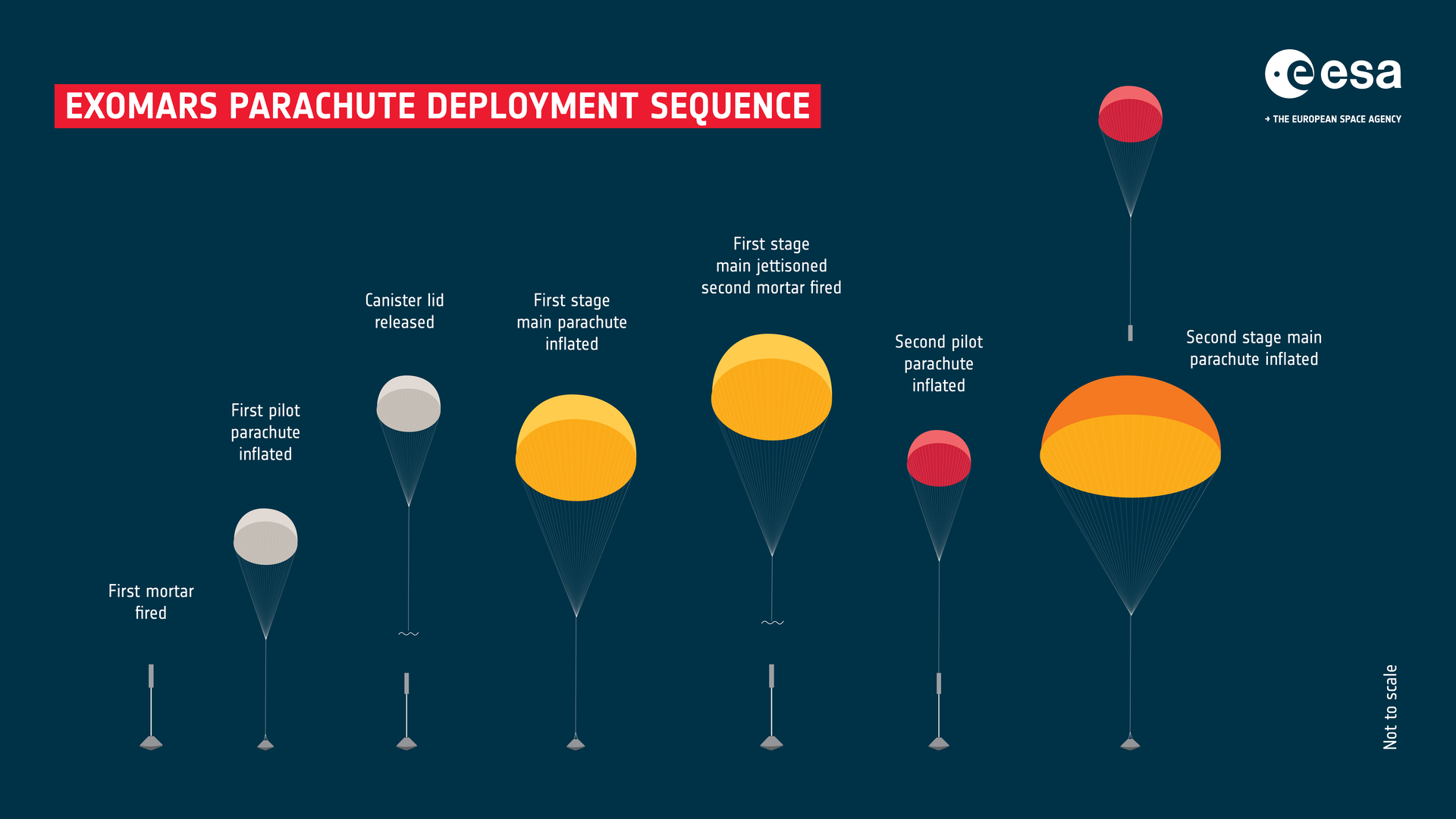
The ExoMars parachute system consists of two drag parachutes and two main parachutes with a total mass of 195 kg. The diameter of their canopies is 15 and 35 m, respectively. The first will open at supersonic speed, the second at subsonic speed. Twenty seconds before ExoMars reaches the surface, the spacecraft will activate its braking engine, which will slow it down to zero.
The design used in the Huygens probe, which landed on Titan in 2005, was taken as the basis for the 15-meter parachute. This three-stage parachute system still holds the record for the most distant landing from Earth in history.
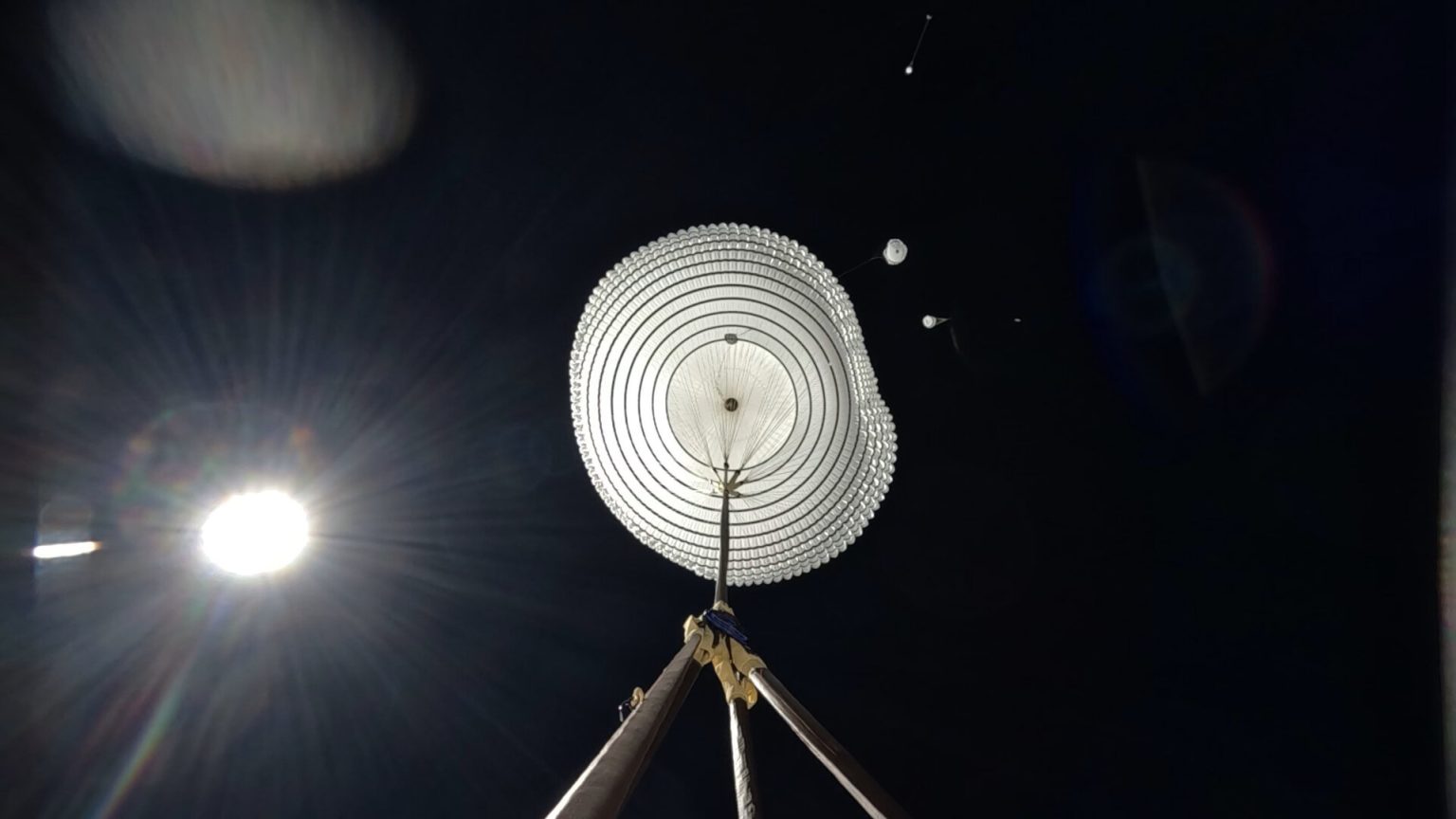
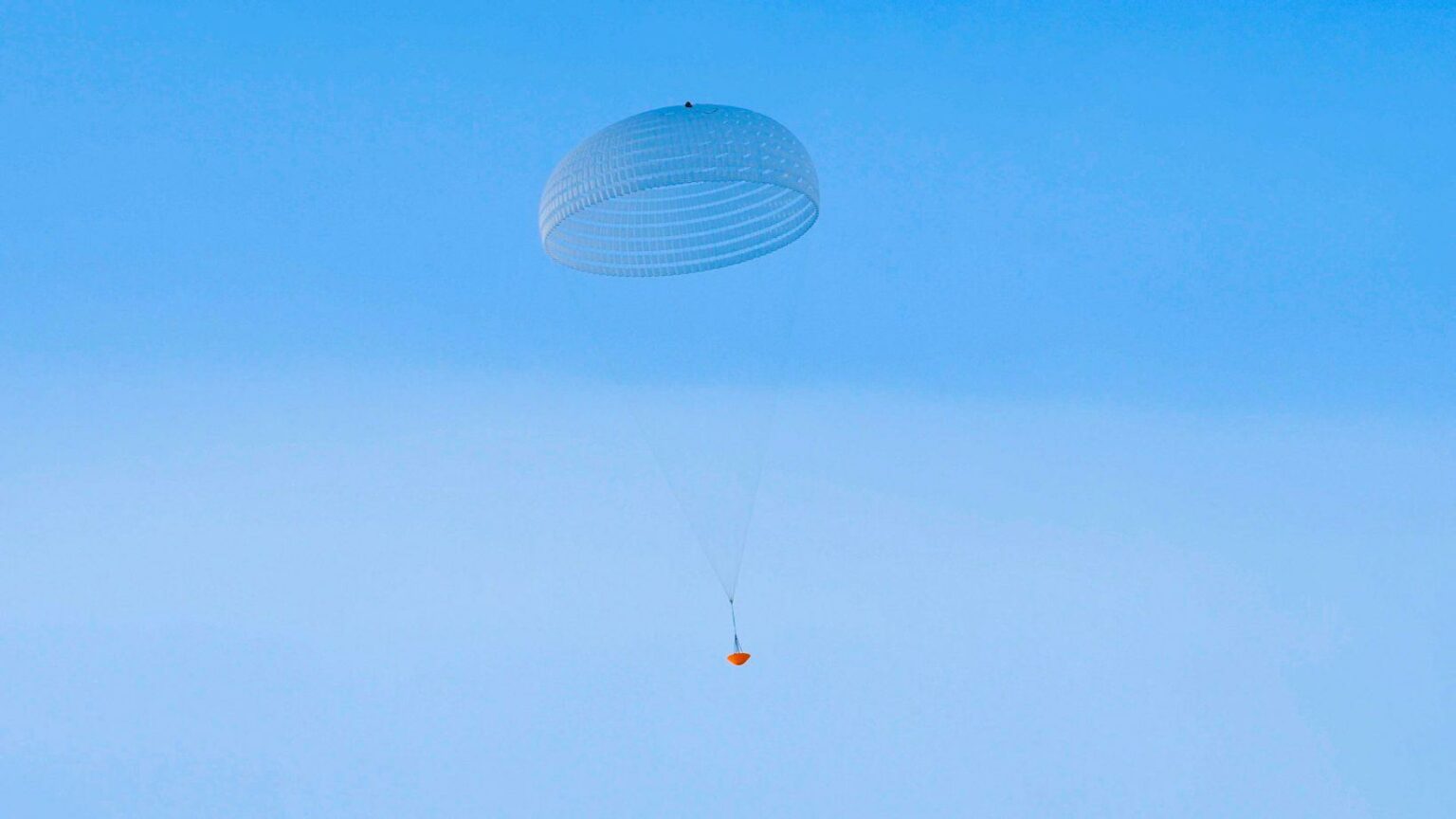
The 35-meter ExoMars parachute is made up of a series of rings with gaps between them. It will be the largest parachute ever used outside Earth. Its surface area exceeds 800 m2, and the length of the slings is 4 km. It takes specialists about three days to fold it into a bag. Like the 15-meter parachute, it is made of very light fabric with a density of about 40 grams per square meter. This is approximately half the density of a sheet of paper.
Successful test
The ExoMars parachute system tests took place on July 7, 2025, at the Esrange test site in Sweden. The prototype of the descent vehicle was lifted to an altitude of 29 km using a helium balloon. In this way, engineers simulated the conditions of the Martian atmosphere.
After ejection, the capsule spent about 20 seconds in free fall, reaching almost the speed of sound, after which the parachutes were deployed one after the other. The test was a success, confirming that ESA has an effective system for landing on Mars.
According to ESA

