

Scientists have discovered a star system consisting of four stars. Two of them are red dwarfs, and the other two are brown dwarfs. Due to their dimness and the distance between the components, it is extremely difficult to determine their motion parameters.
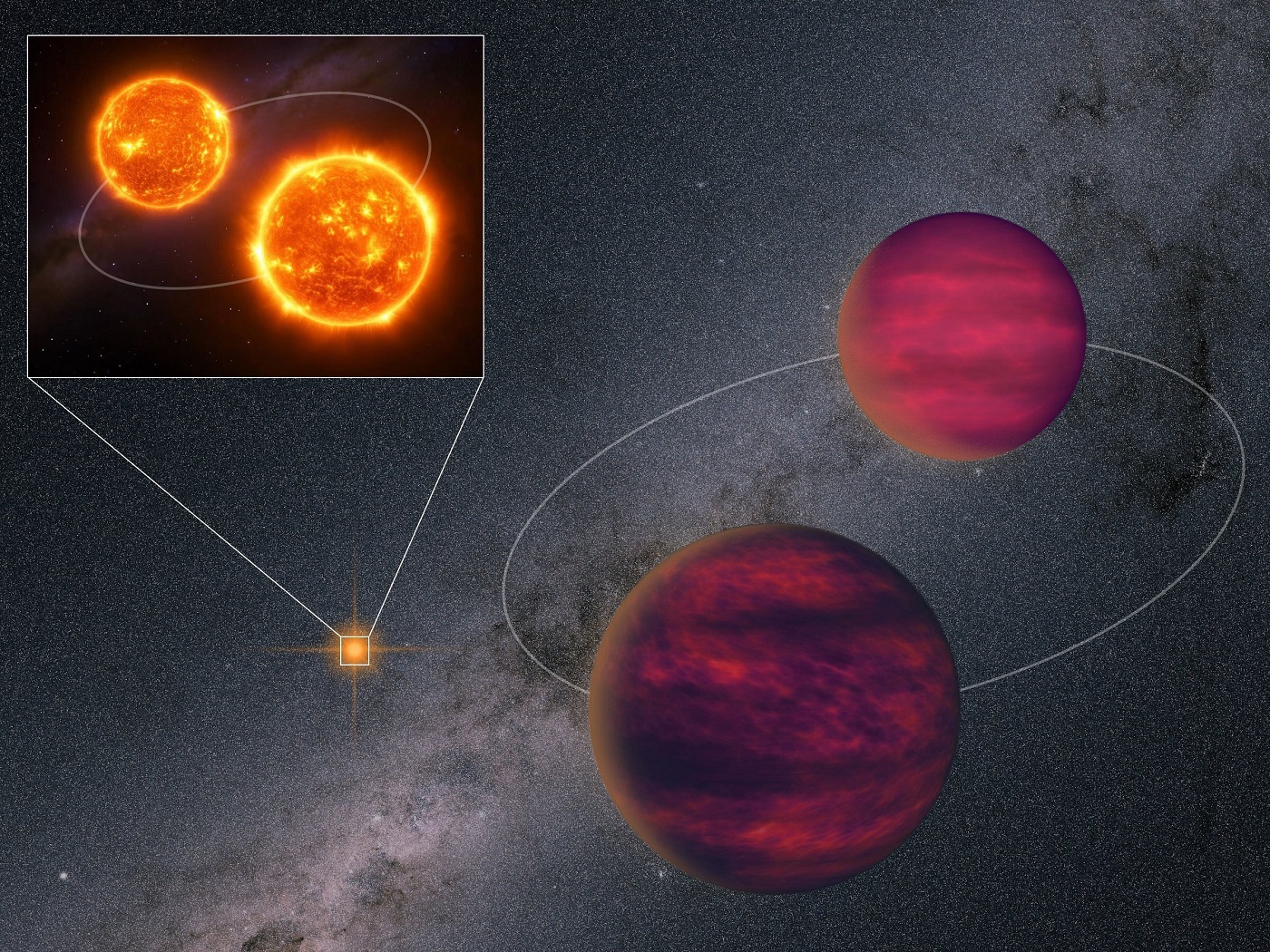
Quadruple system
A group of researchers published a study in the journal Monthly Notices of the Royal Astronomical Society devoted to the discovery of a rather rare star system consisting of four stars. It is located 82 light years away from us in the constellation Antlia.
In general, quadruple star systems are not so rare, although they are not very common. However, this makes its composition unique. It consists of a pair of red dwarfs, around which another pair of brown dwarfs orbits.
The structure of “a pair orbiting around a pair” is more typical of quadruple systems. However, in this case, one of them completes one orbit around the other every 100,000 years.
Problem of movement
The distance between the pairs of components is 1,656 astronomical units. This is 40 times greater than the distance from the Sun to Pluto. With these parameters, the speed and acceleration of the pair of brown dwarfs are very low, and it would be very interesting to find out what they are, as this could confirm or refute the current theory of gravity.
With ordinary stars, it would be possible to rely on massive telescopes. But even a pair of red dwarfs is so faint that in order to see them with the naked eye, they would have to be 1.5 light-years away from us, which is much closer than any star.
Brown dwarfs, on the other hand, emit virtually no radiation in the visible part of the spectrum. They are mainly visible in infrared waves. They are 1,000 times dimmer than the larger pair. Now scientists are thinking about how to see the movement of these objects.
According to phys.org

