

Using data from the Magellan Clay Telescope and the Canada-France-Hawaii Telescope (CFHT), astronomers studied the globular cluster known as NGC 5824. The results of a new study, presented in the article, indicate that the cluster is located within a dark matter halo.
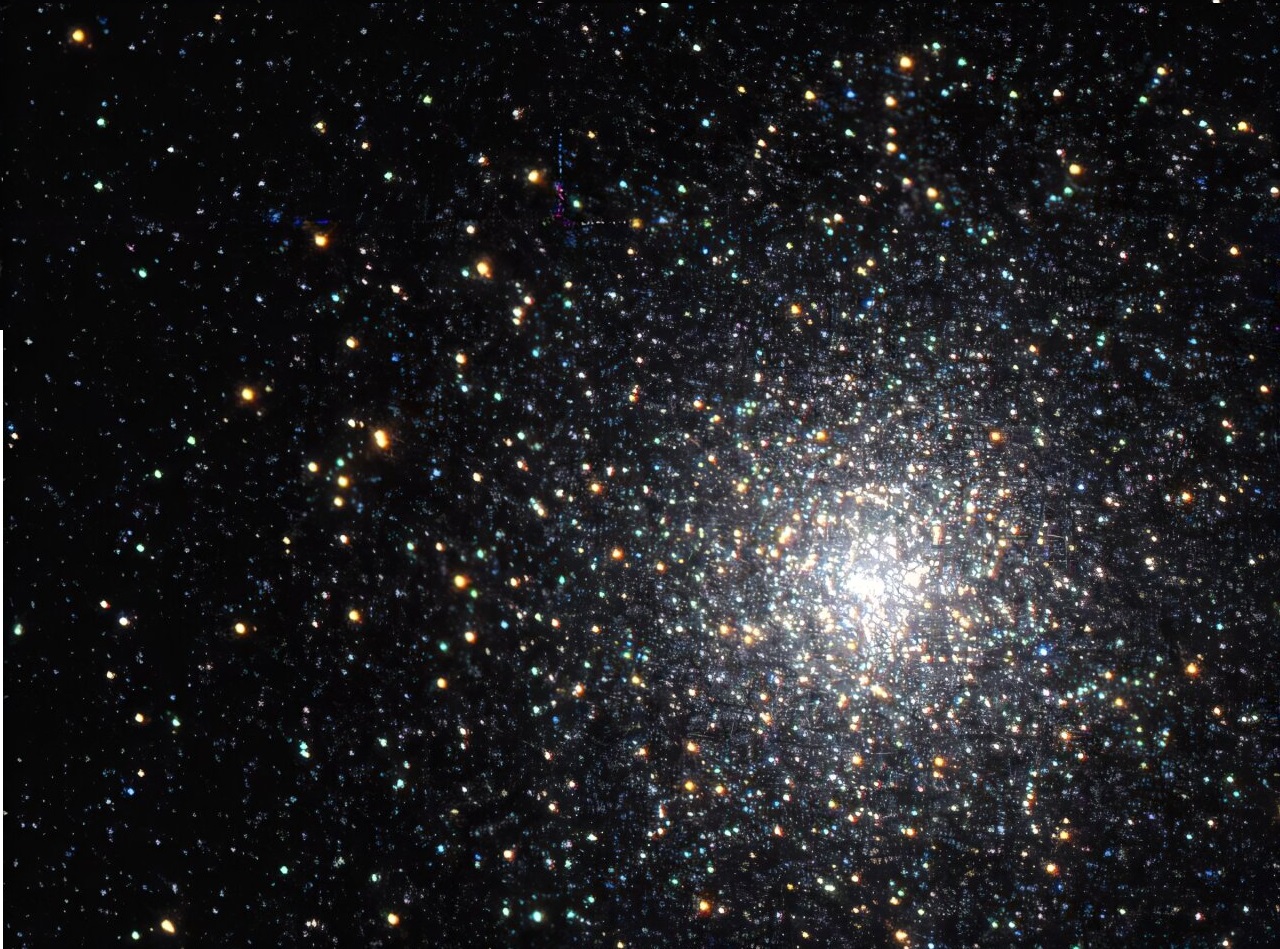
A bright cluster with a diffuse stellar environment
NGC 5824 is an old globular cluster (GC) located approximately 104,000 light-years away in the outer halo of the Milky Way. It has a mass of about 1 million solar masses, is 12.8 billion years old, and is the second brightest globular cluster among the clusters of the outer halo. It is known that NGC 5824 has a diffuse stellar environment that extends beyond its gravitational radius and symmetrically surrounds the cluster.
Given that the origin of the stars in this shell and whether they remain gravitationally bound to the cluster’s center remain unclear, a team of astronomers led by Paula B. Díaz of the University of Chile decided to study NGC 5824 by analyzing data from the Magellan Clay survey of outer halo satellites. The studies were supplemented by data from ESA’s Gaia satellite.
Study of the stellar profile of NGC 5824
Overall, the combination of deep and uniform imaging with high-precision astrometric data enabled Díaz’s team to study the extended stellar profile of NGC 5824. Astronomers determined the membership of stars using color-magnitude diagrams and proper motion constraints, and analyzed the cluster’s luminosity function to estimate its spatial distribution.
The study showed that NGC 5824 is symmetrically extended to at least approximately 20 arcminutes, with an outer surface density profile characterized by a power-law exponent of -2.6. Cumulative luminosity functions confirm the spatial symmetry of the cluster and its extended structure.
A dark matter halo?
According to the authors of the article, the absence of truncation in the density profile of NGC 5824 supports the preliminary hypothesis that it still retains a dark matter component. However, to confirm this hypothesis, we need to obtain kinematic data.
Therefore, Díaz’s team proposes conducting more spectroscopic observations of stars on the outskirts of NGC 5824. Such observations should provide radial velocities that will be critical for determining whether the extended structure is the result of dark matter or other dynamical effects.
According to phys.org

