

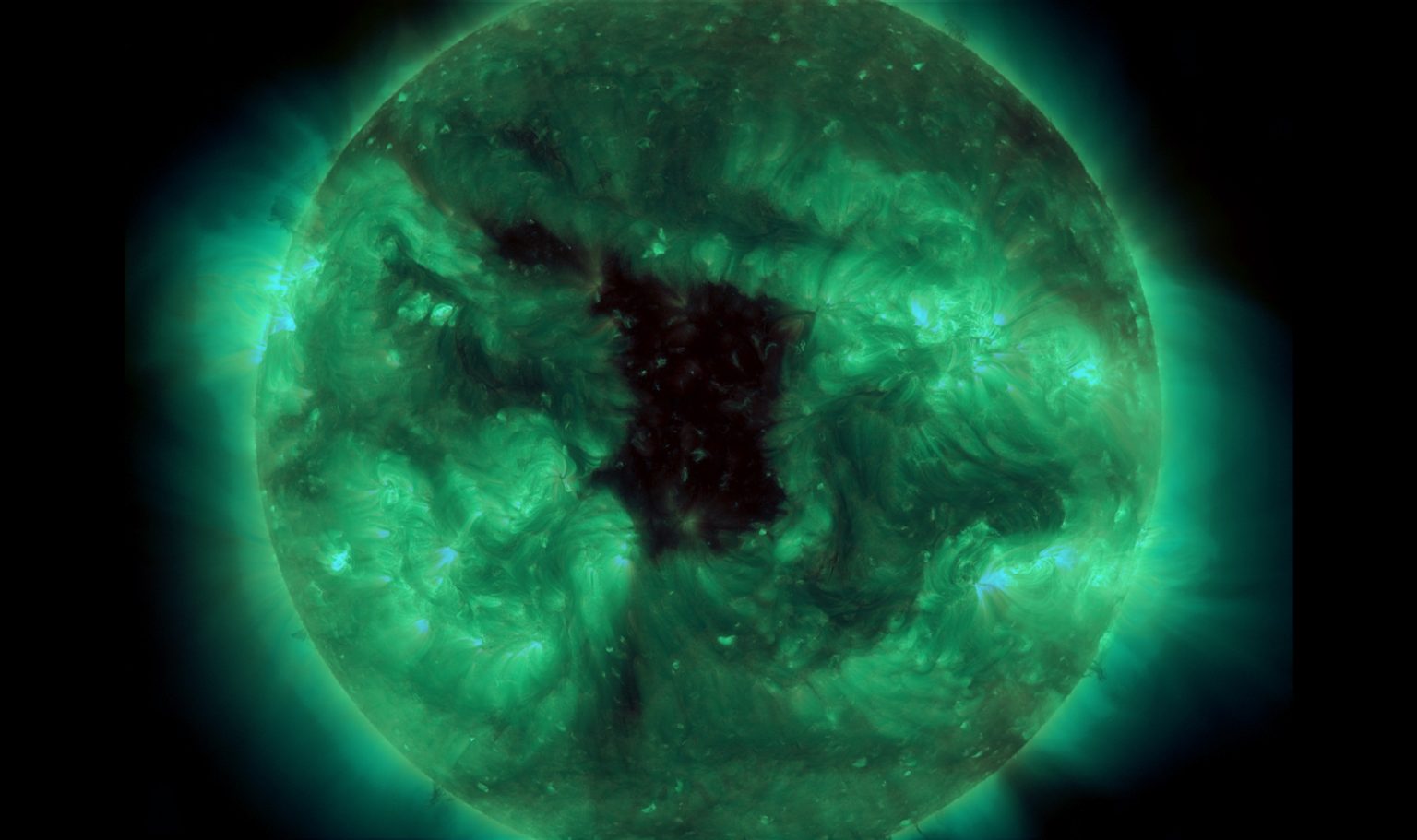
Fast solar winds emanating from the Sun can have a direct impact on Earth, disrupting systems such as GPS, aviation, power grids, as well as satellite and radio communications. A new article by Khagendra Katuwal, a graduate student in astronomy at New Mexico State University, explores the connection between coronal holes and solar wind flows, helping to shed light on how the Sun’s magnetic structure influences space weather.
Magnetic imbalance on the Sun and solar wind formation
His paper, “Unipolarity of the Solar Magnetic Field in Equatorial Coronal Holes,” has been published in The Astrophysical Journal. The results of the study help us better understand the magnetic conditions that lead to the formation of high-speed solar wind streams from coronal holes. Because these fast solar wind streams can disrupt the Earth’s magnetic environment, deepening our understanding of their origins helps scientists make more accurate space weather forecasts.
Katuwal studied 70 coronal holes using data from the Solar Dynamics Observatory—a space telescope designed to study solar activity—in order to better understand the origin of the solar wind. He found that approximately 88% of the coronal holes studied exhibited a significant imbalance in their magnetic fields.
Regions on the Sun with significant magnetic imbalances may be linked to the formation of high-speed solar wind streams. By identifying changing magnetic conditions as a key factor in the formation of the fast solar wind, his work helps improve space weather forecasting models and reduces the technical and economic risks to systems affected by solar activity.
Coronal hole imbalance and changes in space weather
Katuwal began studying coronal holes after taking a course in heliophysics—the physics of the Sun—taught by R.T. James McAteer, associate vice president and professor of astronomy. This course sparked Katuwal’s interest in the Sun, prompting him to contact McAteer about opportunities to participate in solar research projects.
“The biggest unknowns in trying to predict solar wind are in understanding how coronal holes form and how they stay ‘open,’ which means that the magnetic field lines from coronal holes connect out in space,” McAteer said.
“Regions with open field lines are unbalanced. Particles escape more easily, and so the solar wind will be fast and dense. Khagendra has created a set of parameters that now lets us define what we mean when we say ‘unbalanced.'”
Further research into space weather factors
Next, Katuwal plans to use data from the Daniel K. Inouye Solar Telescope—the most powerful solar telescope in the world—to study small-scale features on the Sun and learn more about what causes the instability in these regions.
“Understanding the magnetic structure of coronal holes allows us to connect small-scale magnetic physics on the sun to large-scale space weather effects that impact our technology,” he said. “That connection between fundamental physics and real-world impact strongly motivates me.”
According to phys.org

