

Astrophotographer Emil Andronic has unveiled a unique image of a section of the sky in the Orion constellation, which took him nearly 70 hours to capture. He managed to capture the magical glow of a reflection nebula located near the “head” of the celestial Hunter. The image reveals the impressive and detailed structures of a giant interstellar cloud.
Blue and Red: The nature of cosmic radiation
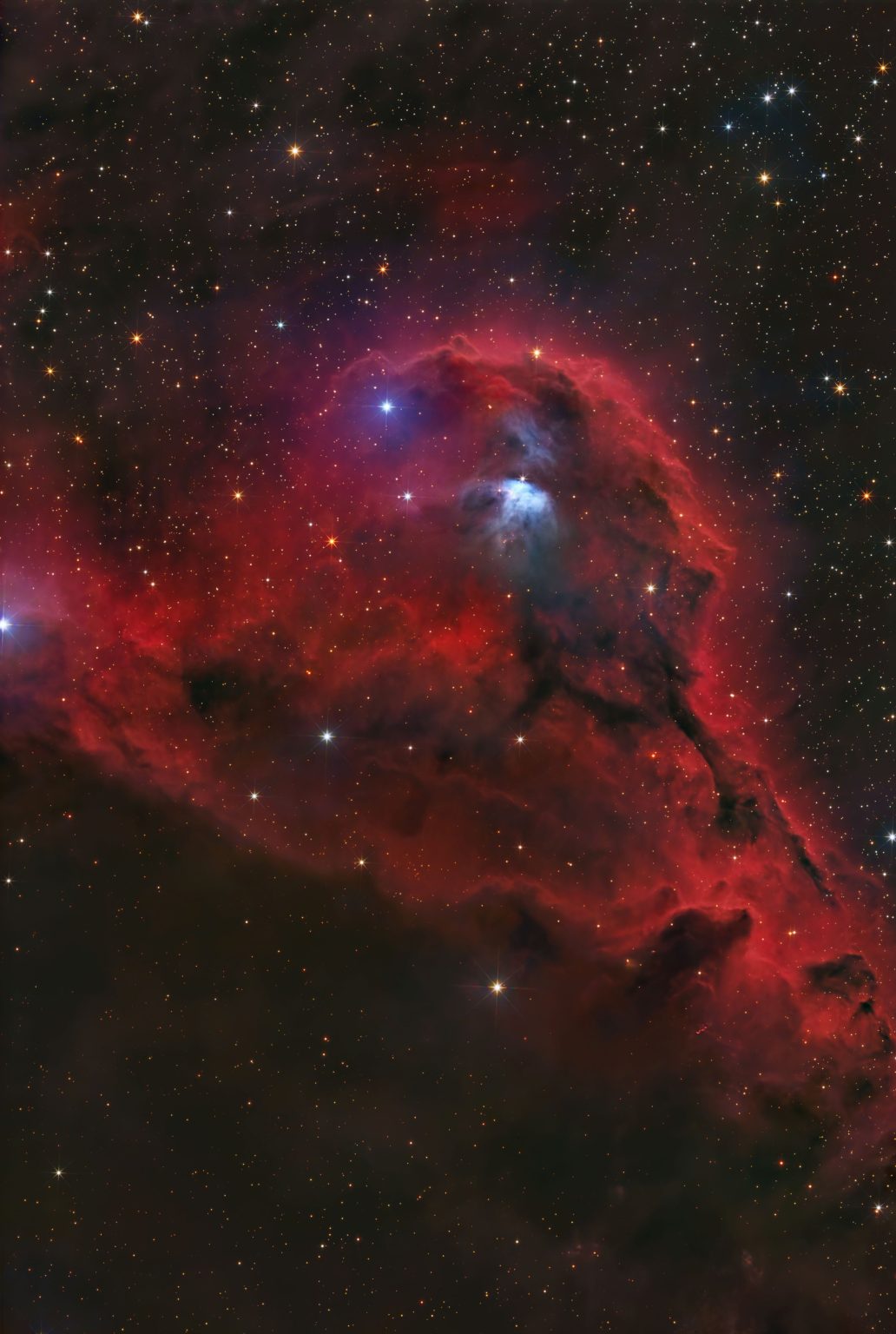
At the center of the composition is a blue reflection nebula, known in catalogs as Cederblad 51 (Ced 51). It appears to glow from within, surrounded by the red clouds of the emission nebula SH 2-264. This picturesque region has been informally named “Orion’s Head” because of its proximity to the bright star λ Orionis, which visually represents the head of the mythical hunter in the sky.
As a reminder, according to NASA’s definition, reflection nebulae are massive clusters of interstellar dust. They do not emit their own visible light but merely scatter the radiation from nearby stars, which usually gives them a characteristic blue hue. In turn, emission nebulae, such as the red clouds surrounding Ced 51, glow with their own light: the ionized gas within them begins to emit radiation when exposed to the intense ultraviolet radiation from hot, young stars.
Hunting for light
It took a long time to get this shot. “Ced 51 is a subject I’ve dreamed of photographing for a very long time, but the conditions were always unfavorable, so I had to switch to something else every time,” commented Emil Andronic.
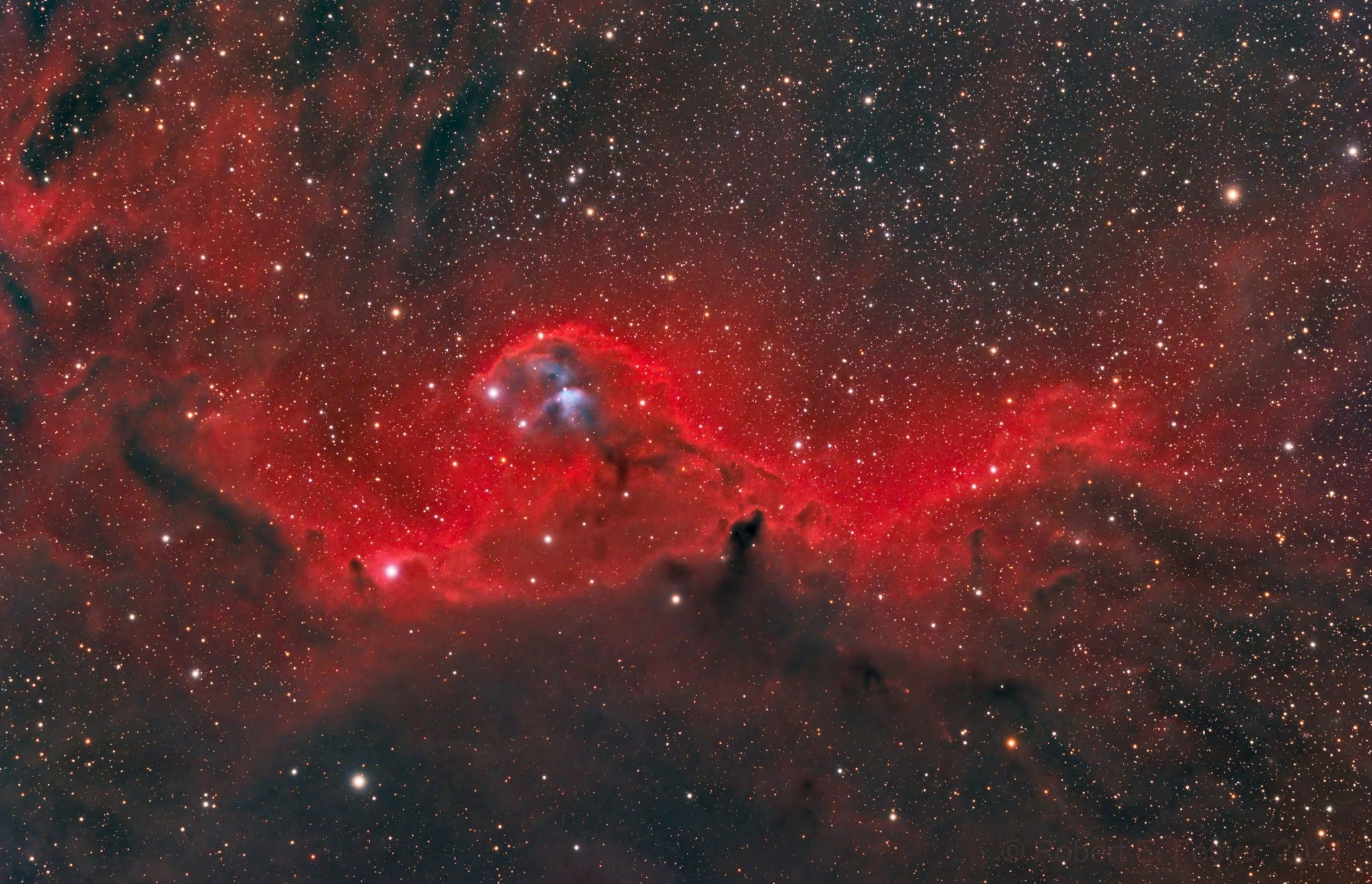
He was only able to carry out his plan in the autumn, when Orion began to rise high above the horizon. The photographer was working in the county of Hertfordshire. The main problem was the proximity to Greater London, with its extreme levels of light pollution. The sky above the metropolis is so brightly lit by city lights that it is extremely difficult to photograph faint celestial objects in color (LRGB format) in the southern sky.
To overcome this obstacle and achieve a clear result, Andronic had to spend an enormous amount of time—the total exposure time was 69 hours and 15 minutes. After the shoot, a rigorous selection process followed to choose the best shots and discard those marred by atmospheric haze or the full moon.
Astrophotographer’s kit
To achieve this level of detail, the photographer used a sophisticated setup: a pair of 200-mm telescopes equipped with specialized cooled astronomical cameras. The data was collected in HaLRGB format. This means that, in addition to the standard red, green, and blue filters used to produce color, a special narrow-band H-alpha filter was used. It transmits only the light emitted by hydrogen, making it possible to highlight the fine structure of the red clouds against the illuminated sky.
The final stage involved carefully combining thousands of individual exposures and processing them artistically. This was done using the professional astronomy software PixInsight, with the finishing touches applied in Adobe Photoshop. The result of this tedious work was an exciting photograph in which a dramatic dance of interstellar dust and gas unfolds against a backdrop of countless multicolored stars.
We previously reported on how the James Webb Space Telescope captured a strikingly detailed image of the Horsehead Nebula.
According to space.com

