

Astronomers have once again used the James Webb Space Telescope (JWST) to observe the exoplanet K2-18b. They have confirmed that its interior is rich in water.
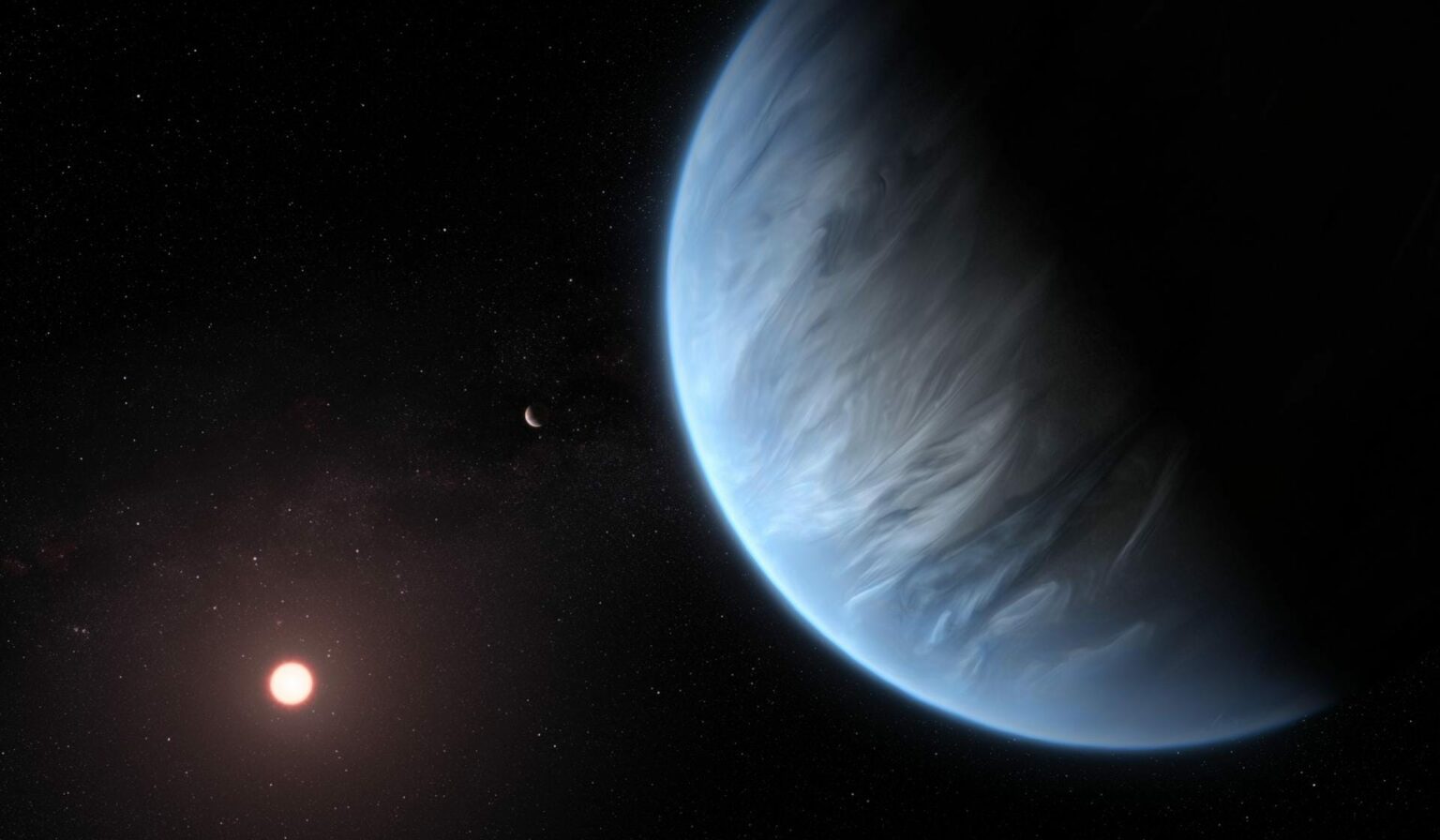
K2-18 b is a mini-Neptune orbiting a red dwarf star 124 light-years from Earth. It gained attention several months ago when a team of scientists from Cambridge announced that analysis of JWST data had revealed large amounts of dimethyl sulfide (DMS) and dimethyl disulfide (DMDS) in its atmosphere. On Earth, these molecules are produced only by living organisms. However, shortly after this sensational announcement, several other groups that had studied the same data stated that their analyses did not confirm these claims.
JWST observations also provided some insight into the composition of its atmosphere. It was found to be rich in hydrogen, containing methane and possibly carbon dioxide. There was also limited evidence of ammonia and water vapor, but further observations were needed to obtain a clearer picture.
The JWST was used again for them. After analyzing the new data it collected, as well as the results of previous observations, scientists gained a more complete understanding of the composition of the atmosphere of K2-18 b. They were unable to detect any signs of dimethyl sulfide and dimethyl disulfide, but at the same time, they were able to confirm that K2-18 b contained large amounts of water.
In particular, JWST detected significant amounts of methane and carbon dioxide in the atmosphere of K2-18 b, but did not detect water vapor. According to scientists, the simultaneous presence of these two gases can be explained either by a massive atmosphere with a metallicity approximately 100 times greater than that of the Sun and a hydrogen content of 10–25%, or by a small atmosphere under which there is an ocean of liquid water.
The planet’s atmosphere also lacks ammonia and carbon monoxide. The authors of the study claim that this is consistent with the presence of a liquid ocean, but it is not definitive proof, and additional observations are needed to complete the picture. The results also show that the absence of water vapor in the atmosphere may indicate its condensation before reaching the altitude at which JWST is capable of detecting it.
Although astronomers have no evidence of life on K2-18 b, they say this cool, water-rich world is a very intriguing object. Further study will help us understand how oceanic mini-Neptunes differ from our Earth.
According to Phys.org

