

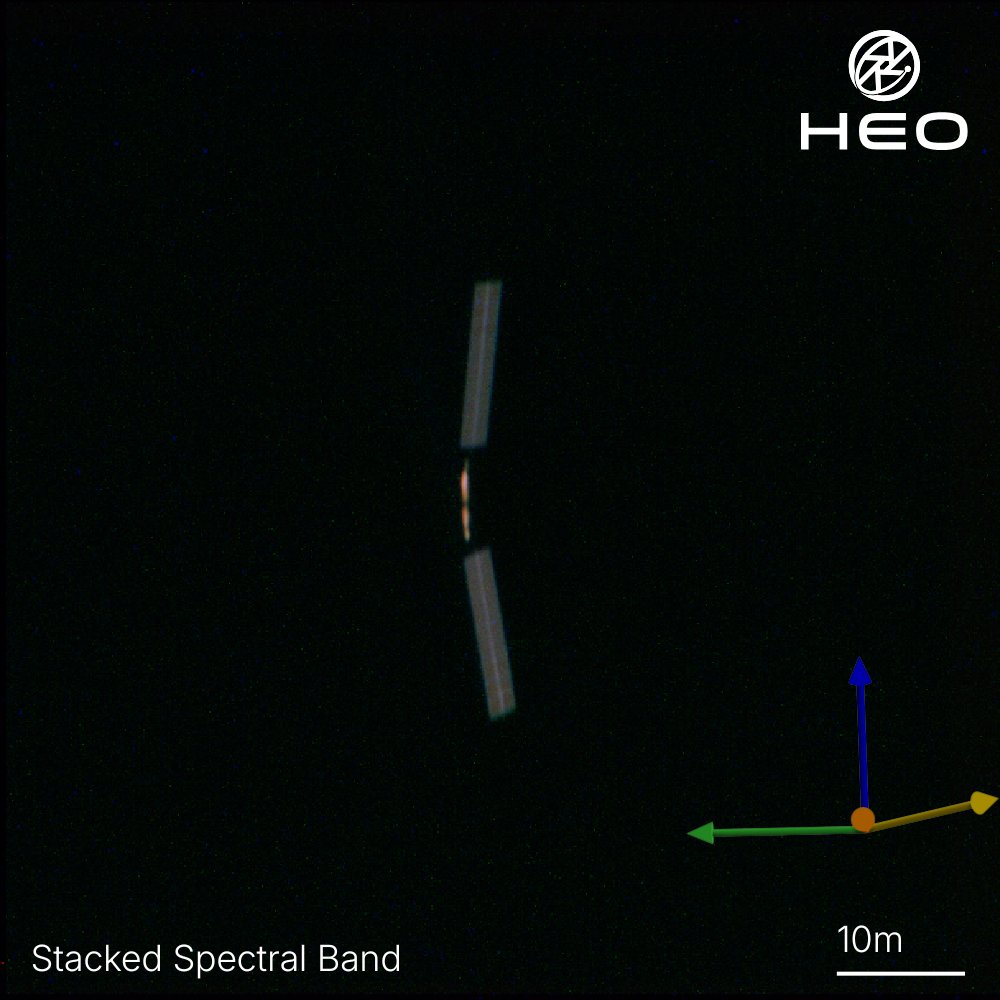
HEO has published an image taken by one of its spacecraft. It shows a satellite from the Starlink constellation.
In recent years, imaging objects in near-Earth orbit has been one of the most rapidly developing segments of the space market. This includes both active spacecraft and space debris. This service is actively used to assess their condition and the risk they pose to other satellites. It is also of considerable interest to military and intelligence agencies.
One of the most prominent players in this new market is the Australian company HEO. It regularly publishes demonstration images designed to promote the growing capabilities of its satellites. They show a wide variety of objects, from a supply spacecraft docked with the ISS to the Chinese Tiangong space station.
On February 4, HEO published a new image taken by its recently acquired Continuum-1 satellite (formerly NewSat-34). Previously, it was used to photograph the Earth’s surface. Now, its main task is to photograph other spacecraft, test new operating modes, and collect data that will be used to train AI models.
The Continuum-1 image shows one of the Starlink group’s satellites. This is the largest satellite constellation in history, currently comprising more than 9,000 active satellites. The photographed satellite belongs to the Starlink V2 mini modification. These satellites weigh about 750 kg and are distinguished by two long solar panels. The Starlink V2 mini was photographed from a distance of 51 km with a resolution of 11 cm/pixel.

