

Scientists are studying deforestation processes across the globe. It is difficult to adequately assess the scale of this process because it often involves the fragmentation of large areas. However, new research based on satellite observations and new statistical methods has made it possible to determine how bad the situation really is.
Forests and satellites
Everyone knows that forests play a crucial role in the Earth’s carbon cycle. It is here that carbon is absorbed from the atmosphere and sequestered. New research based on satellite observations over the past 20 years shows just how bad things really are with their disappearance.
For several decades now, it has been said that the disappearance of forests across the planet is catastrophic. However, measures to preserve and restore them have been ongoing for just as long. So, what is the outcome of this struggle?
It is extremely difficult to answer this question, even with the help of satellites that can observe our entire planet at once. After all, the destruction of forests often occurs through their fragmentation – they are broken up into pieces by human buildings and farms, and this often leads to the extinction of large fauna.
This fragmentation is very difficult to assess because even from orbit, it is difficult to say how functional such an array remains. And it was precisely this task that scientists decided to tackle in their research.
What did the study reveal?
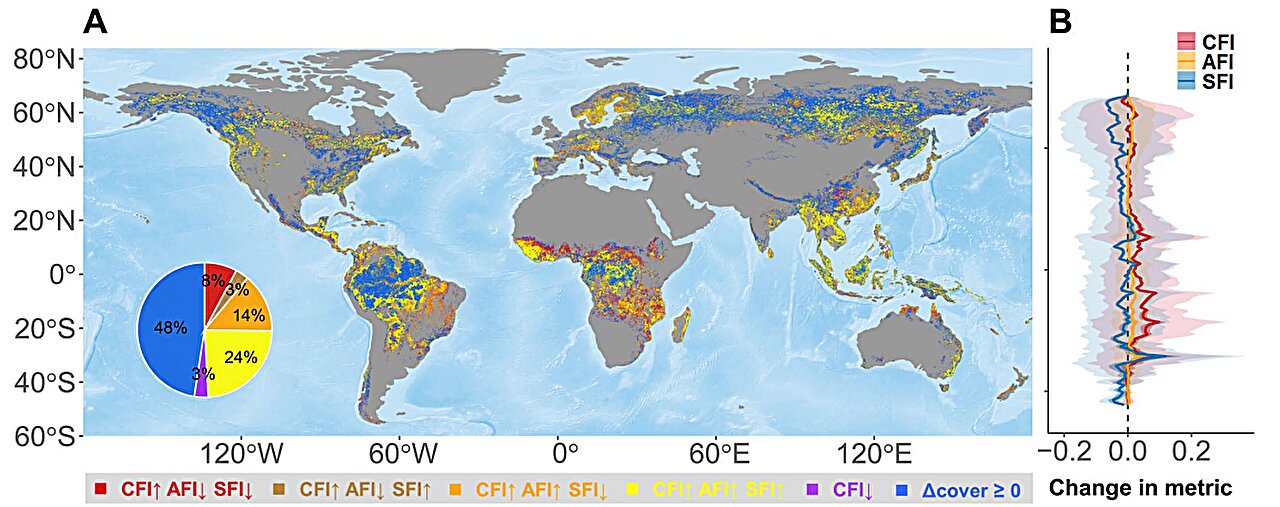
Using high-resolution satellite data, scientists assessed changes in forests around the world between 2000 and 2020. They applied new statistical processing methods that allow for the fragmentation of forests to be taken into account.
The study showed that during the specified period, forest fragmentation increased by 51-60% of the total forest area. At the same time, for the tropical zone, this figure reaches 58-80%, with different metrics giving different results.
Satellite data also made it possible to identify the factors that have the greatest impact on forest fragmentation processes. These were changes in agriculture (37% globally, 61% in the tropics), forestry (34% globally), and, to a lesser extent, forest fires and deforestation caused by commodity production. They also found that protected areas experienced 82% less fragmentation than unprotected areas, largely due to reduced agricultural activity.
All this is particularly interesting given that in 2023, scientists published a report based on satellite data. At that time, it was concluded that the disappearance of forests on our planet had slowed down over the past 20 years. Now, scientists believe that the reason for such discrepancies may be precisely the peculiarities of accounting for fragmentation.
At the same time, they note that factors such as roads remain unassessed in their study. On the other hand, they acknowledge that young forest plantations are not sufficiently taken into account.
Provided by: phys.org

