

The Cassini spacecraft has long since ceased to function and crashed into Saturn. However, some of the information it gathered continues to be used to make new discoveries. This time, scientists have discovered that the rings of the sixth planet do not end where they appear to.
Dust samples
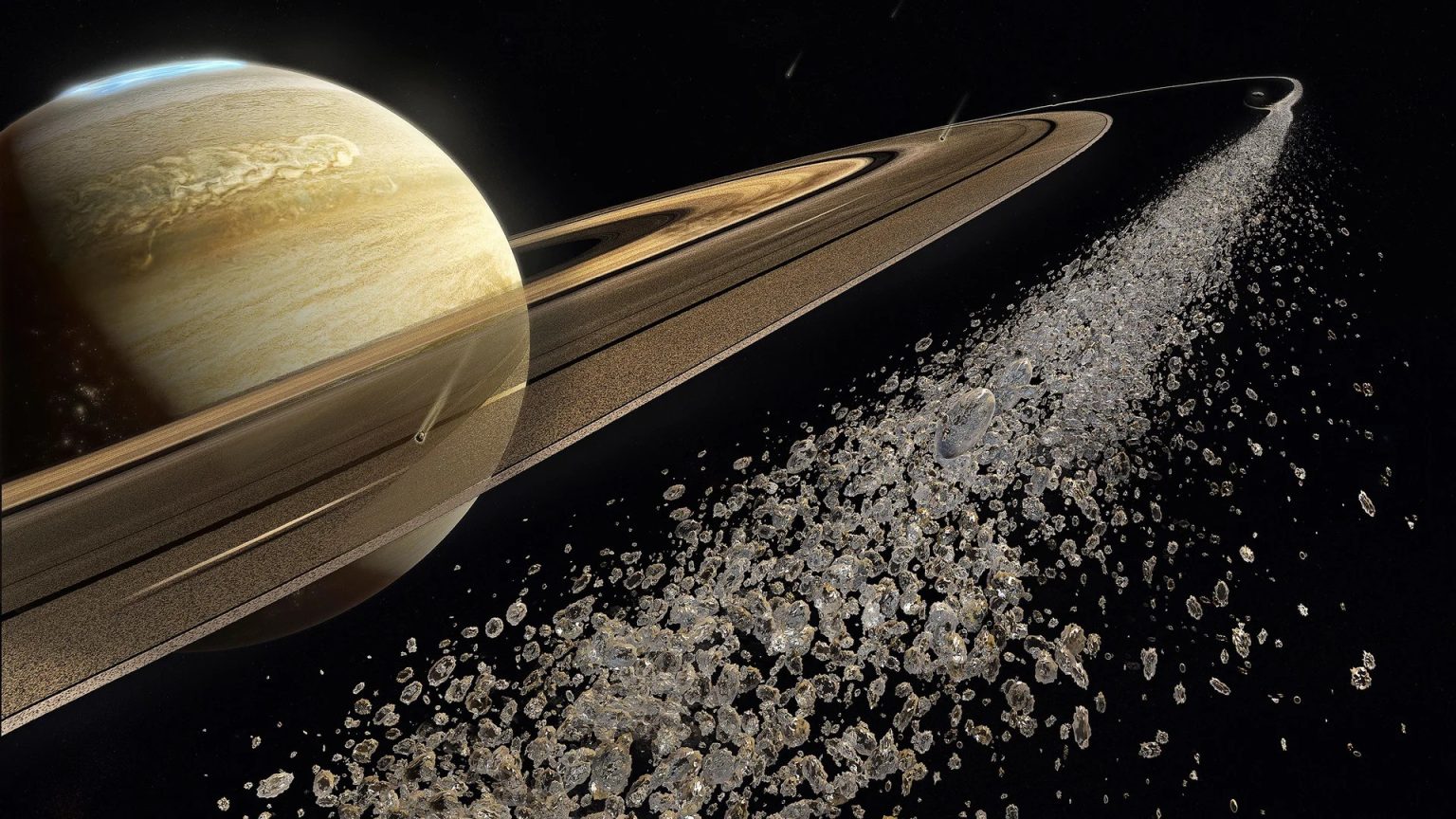
The Cassini probe completed its final orbits, known as Grand Final Orbits (GFOs), in 2017 before plunging into Saturn’s atmosphere. During these orbits, the probe collected dust samples above and below Saturn’s rings for analysis using its Cosmic Dust Analyzer (CDA). Now, researchers have published a new study in The Planetary Science Journal showing that this data indicates that Saturn’s famous rings extend much further above and below the plane of the rings than the thin rings we see through a telescope.
Over 20 orbits, Cassini collected 1,690 analyzed dust spectra. Of these, 155 were clearly identified as mineral (or silicate) particles. The particles were collected at a distance approximately equal to three Saturn radii (RS) above and below the ring plane in approximately equal amounts, forming a “halo.”
After analyzing the composition, the team found that these high-latitude silicates were almost identical in composition to those found near the rings. Particles near and far from the rings consist mainly of magnesium and calcium, similar to cosmic levels. It was also found that the iron content in the dust particles was significantly reduced, which corresponds to the iron composition found near the rings. The authors of the study note that this was recognized as an “impressive similarity in composition.”
“We conclude that, within the limits of the method’s accuracy, these mineral dust grains have identical compositions, indicating that the silicates studied in this research also originate from the main rings, reaching latitudes >3RS relative to the plane of Saturn’s rings,” the authors of the study write.
Mechanism of particle ejection from rings
To determine how this particle distribution arose, the team conducted a series of dynamic simulations. They found that such particles can reach the latitudes where they were detected if they fly out of the rings at a speed of more than 25 km/s and are less than 20 nanometers in size. The team claims that this could happen if particles in the rings are struck by micrometeorites, which are relatively abundant there.
The observed increase in particle density with decreasing distance to the ring plane is consistent with ejection following micrometeorite impacts as the dominant mechanism for particle formation. It is expected that most of the ejected particles will either collide with the main rings again or fall onto Saturn, and only a small fraction is expected to successfully exit the rings.
New questions
According to the researchers, the most likely mechanism is the condensation of fast vapor trails after micrometeorites hit the ring. This would lead to the formation of the nanosilicates observed in the data, as well as the observed depletion of iron.
The researchers also considered an alternative theory, according to which the particles were attracted by gravitational focusing and thus entered Saturn’s system from outside. However, they believe this is less likely, as the dust composition does not match the exogenous dust grains observed by CDA in other parts of Saturn’s system.
Since micrometeorite collisions are a fairly common occurrence, the study raises the question of whether other planets’ ring systems may also extend further out, or whether they may have other effects from dust dynamics that are not easily detected using conventional methods.
According to phys.org

