

Scientists have studied a new odd radio circle called ORC J0356-4216. These unusual giant structures are completely invisible in the visible spectrum. Their origin remains a mystery, but a new study has attempted to explain it.
Odd radio circles
Astronomers from Ruhr University Bochum (Germany) and a number of other scientific institutions have researched a new odd radio circle. It is designated ORC J0356–4216 and was discovered in October 2023 using the South African MeerKAT radio telescope.
In general, it is strange that radio circles have such a strange name. They are completely invisible in the visible range, and they do not look very bright in radio circles either. And these are giant structures stretching across intergalactic space for millions of light-years.
Humanity only learned of their existence a few years ago with the advent of truly powerful radio telescopes. However, scientists still do not have a clear understanding of what these structures actually are and how they came into being.
How these objects are formed
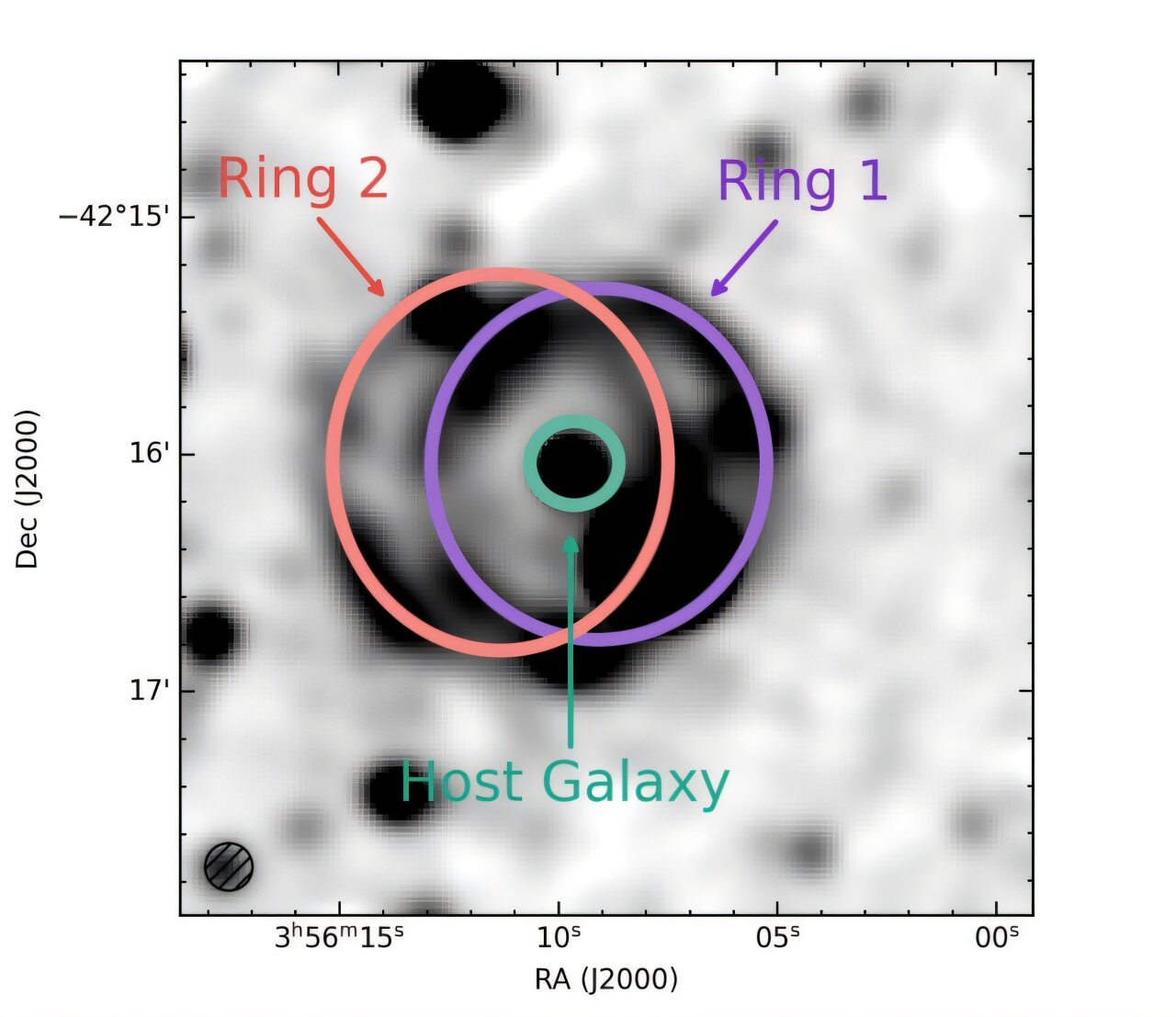
For example, the radio circle ORC J0356-4216 has an angular size of approximately two arcminutes. Given the distance to it, this means that its actual size is 2.18 million km. And in fact, it is not one circle, but two that intersect each other. At the point of intersection is the galaxy WISEA J035609.67-421603.5.
Analyzing the collected data, astronomers found that the ORC J0356-4216 rings have an integrated flux density at a frequency of 943 MHz of 4.07 mJy and 2.82 mJy, while at a frequency of 1.28 GHz, these values are 2.77 mJy and 1.98 mJy. The radio spectra of both rings are steep, with spectral indices of -1.18 and -1.12, and show no significant substructures.
In an attempt to explain the origin of ORC J0356-4216, the authors of the article propose two hypotheses as the most plausible. They suggest that it could be the remnant of a past phase of active galactic nucleus (AGN) activity or the result of a large-scale shock wave, such as those generated by the interaction or merger of galaxy clusters.
За матеріалами: phys.org

