

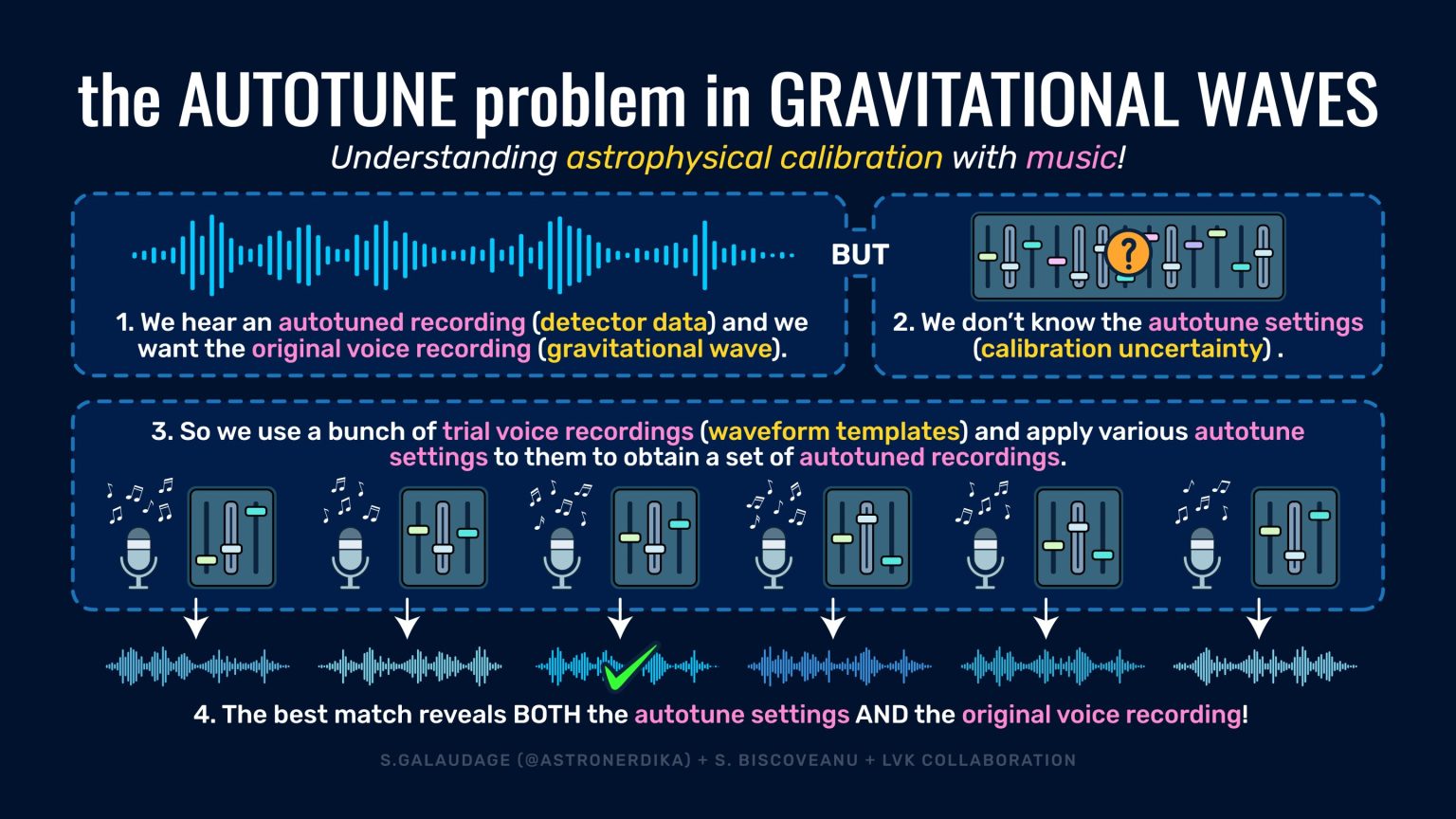
Detectors designed to detect gravitational waves from black hole mergers do not always perform reliably. That is why scientists have developed a system to calibrate these signals. Its operating principle is very similar to the autotune used in sound recording.
Gravitational waves
Gravitational waves are the most remarkable type of signal that modern astronomers are able to detect. It is not an electromagnetic wave, and it is not carried by any particle known to science. It is a vibration of space, radiating out in all directions from the event that caused it.
For this reason, there are still very few detectors capable of detecting them on Earth: LIGO, Virgo, and KAGRA. And the results they produce aren’t always perfect, partly because the level of background noise is constantly changing. It is not surprising that researchers from the United States, Italy, and Japan recently published a study describing a method for determining how a received signal was distorted and for restoring it.
In an article published in the journal Physical Review Letters, they described a technique comparable to digital autotune. The latter is a specific type of software used in professional audio recording. It allows comparing the recorded frequencies with the expected frequencies based on the sheet music, then adjusting them. This way, it is possible to correct minor mistakes made by the performers and achieve an incredibly clean sound.
Signal from the detectors
The only problem is that gravitational waves don’t produce any sound, and they aren’t even electromagnetic oscillations. A large dataset could have been compiled and used to train a neural network, but the scientists realized that this approach could easily lead to getting what they wanted rather than what they needed.
Instead, they took advantage of the fact that there are several detectors, and each one has a chance of picking up the signal. This makes it possible to determine what a gravitational wave would theoretically look like in other systems. This approach was used to study the events GW240925 and GW250207.
Both were detected by the American LIGO system, which consists of two detectors located several thousand kilometers apart. Overall, the signals from both events provided a fairly good picture of them, but in the case of GW240925, one of the detectors was not calibrated, and in the case of GW250207, it simply wasn’t working.
In both cases, the new technology enabled updating the image. Specifically, scientists mention its use specifically for calibrating detectors. The main problem with them is that the level of ambient noise fluctuates significantly over time, making it difficult to quickly determine the appropriate signal-to-noise ratio. But autotune can handle this task.
According to phys.org

