

Comet 12P/Pons-Brooks is very similar to Halley’s Comet. It last approached the Sun in 2024, displaying a series of flares. New radio astronomy research has helped to identify ammonia on it for the first time.
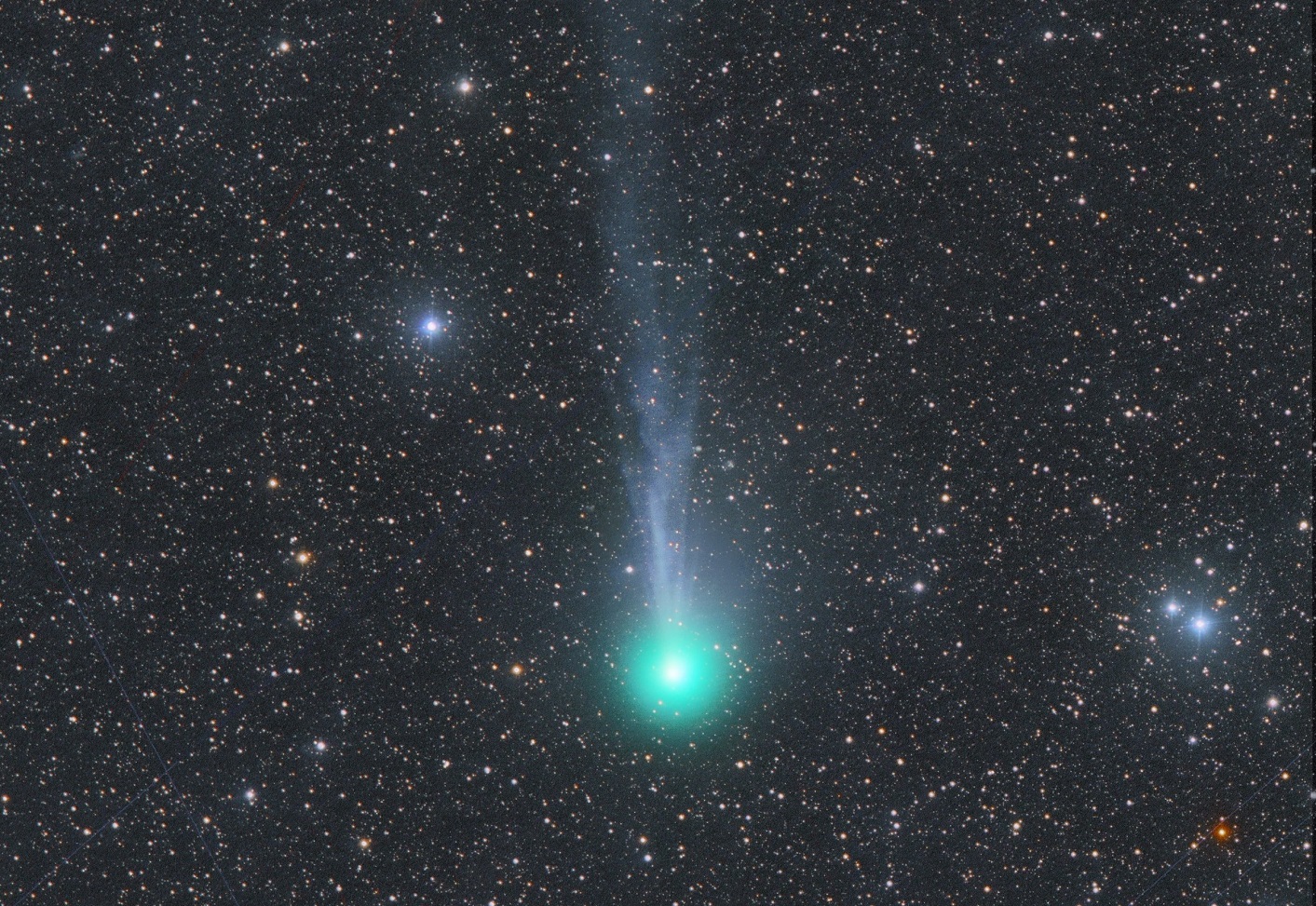
Research on comet 12P/Pons-Brooks
Scientists from the Shanghai Astronomical Observatory of the Chinese Academy of Sciences have published research on comet 12P/Pons-Brooks, conducted using radio waves of different frequencies. Thanks to this research, they determined how much water was released during outbursts and found ammonia on the comet.
Comet 12P/Pons-Brooks was discovered in 1812. Its orbital period is 71 years, which makes it very similar to the famous Halley’s Comet. However, unlike Halley’s Comet, comet Pons-Brooks flares up every time it returns to the Sun.
This was also the case in 2024, when it last occurred. At that time, researchers observed the flares and were even able to hypothesize that a large amount of water was being released during this process. At the same time, radio telescopes were monitoring the comet.
Research results
Researchers conducted a series of radio observations in the L-band and K-band using the Tianma telescope. In the L-band, they detected an 18-centimeter spectral line of hydroxyl (OH) 12P, which is a product of the photodissociation of water vapor. Using radiation transfer modeling, they determined the rate of water formation and the expansion rate of 12P gas before and after several flares.
Observations in the K-band detected ammonia (NH₃) molecules in a Halley-type comet for the first time with a 3σ significance, which is the most distant detection of ammonia in radio waves in a comet. Researchers measured the rate of NH₃ formation and relative abundance during one of 12P’s outburst periods and found that the relative abundance of NH₃ was the highest among comets. NH₃ has a relatively low sublimation temperature.
For short-period comets such as 12P, where more volatile substances such as CO and CO₂ may have been depleted, the high amount of NH₃ and its distribution in the nucleus may explain the frequent outbursts of 12P.
According to phys.org

