

Using the Australian ASKAP radio telescope, scientists have detected a radio transient in space—that is, a source emitting a repeating signal at regular intervals. And in this case, that gap is very wide. Scientists still do not fully understand what it is.
A new radio transient
Scientists used the Australian antenna array, which covers an area of one square kilometer, to detect and study the mysterious radio transient ASKAP J142431.2–612611 in space. An article on this topic was recently posted on the arXiv preprint server.
In general, the term “transients” refers to any non-persistent sources of radiation that astronomers observe in the sky. If they occur in the long-wave range, they are called radio transients. Some of these signals are emitted at regular intervals.
Astronomers have been familiar with periodic radio transients for several decades, such as pulsars. And typically, their emission frequency is measured in seconds and fractions of a second. However, relatively recently, astronomers have begun to detect similar signals, but with a pulsation period measured in minutes and hours.
What is this?
In fact, the Australian antenna array, covering an area of one square kilometer, seems to have been designed specifically to detect radio transients. It has an extremely wide detection range and is capable of measuring the polarization of the signal—that is, the direction of its oscillations.
This feature enabled it to properly examine ASKAP J142431.2–612611. During the 8-day observation period, the signal was found to repeat every 35.79 minutes. The polarization varies from elliptical to nearly linear.
And indeed, scientists still don’t understand what it is. For a transient is just a form of signal, but there should be some object, some cyclic physical process, that generates it. However, the scientists have a good candidate for the role.
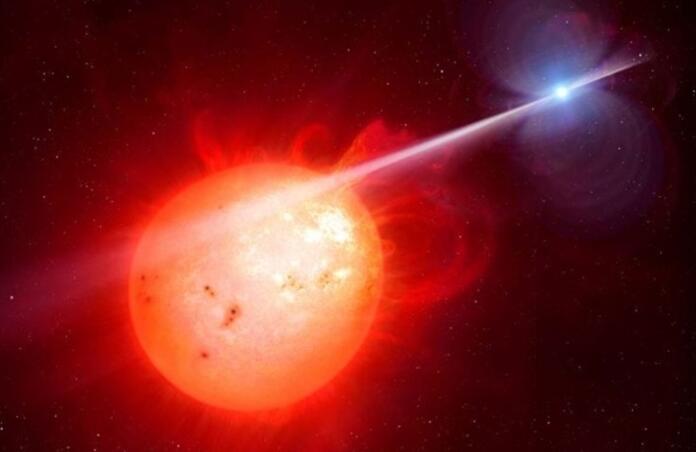
The signal is most likely coming from a binary system containing a white dwarf. Matter from the second star falls onto it, causing periodic flares. However, this version still requires further verification.
According to phys.org

