

An international team of astronomers used the Zwicky Transient Facility (ZTF) telescope and the Transiting Exoplanet Survey Satellite (TESS) to study a binary system known as ZTF J0007+4804. As a result, they discovered that ZTF J0007+4804 is the first system consisting of a hot subdwarf and a white dwarf to generate dwarf nova outbursts.
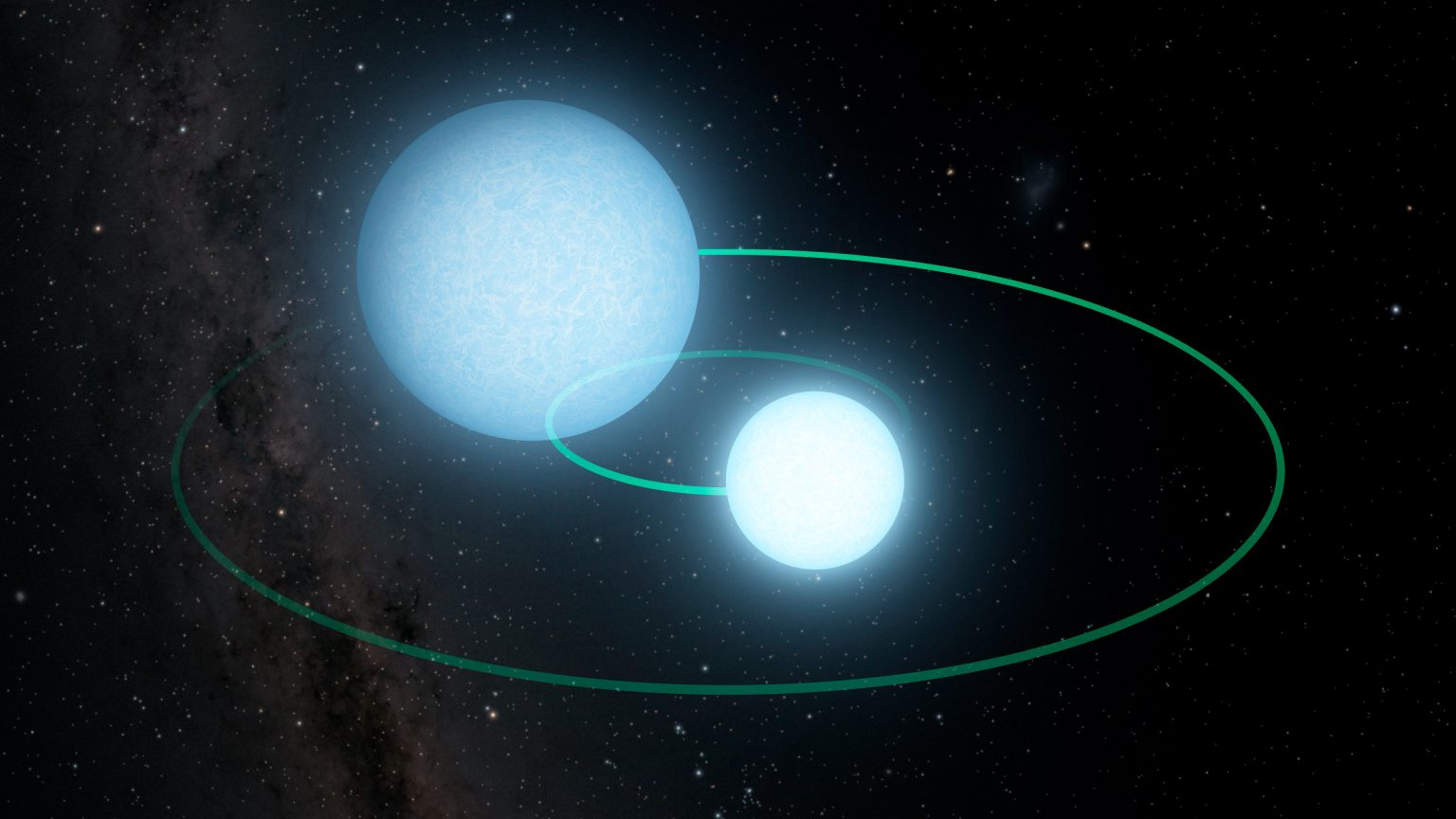
Binary system with a subdwarf
The object ZTF J000742.62+480414.51 (abbreviated as ZTF J0007+4804) was first described in 2019 as a potential subdwarf. Three years later, it was reclassified as a potential ellipsoidal binary system consisting of a hot subdwarf and a white dwarf (WD), with an orbital period of about 1.8 hours.
Now, a new study based on data from ZTF and TESS, conducted by a team of astronomers led by Eric Stringer of the University of Hamburg in Germany, has provided further insights into the properties of ZTF J0007+4804, confirming its nature as a hot binary system with a subdwarf.
Observation using telescopes
The system was observed as part of the ZTF public survey in the g and r bands with a 30-second exposure; images were taken from May 2018 to February 2024, yielding a total of 2,249 data points. Astronomers used 120-second interval data from TESS. The satellite observed ZTF J0007+4804 (TIC 201736330) in sectors 17, 57, and 84 between October 2019 and October 2024, collecting a total of 47,104 data points.
The study revealed that the ZTF J0007+4804 system consists of an accreting white dwarf and a hot B-type subdwarf acting as a donor. The subdwarf’s effective temperature is 23,500 K, and its mass is about 0.42 solar masses, while the white dwarf is only slightly more massive—its mass is estimated at 0.48 solar masses. The system’s orbital period is calculated to be approximately 1.81 hours.
Outbursts of dwarf novae and the dynamics of the system
In addition, the object ZTF J0007+4804 was found to exhibit dwarf nova (DN) outbursts. In the case of ZTF J0007+4804, these DN outbursts belong to the SU UMa type, with a recurrence period of about nine days. Astronomers explained that this subtype is characterized by the presence of superflares between regular flares, which occur less frequently than usual and last from one to two weeks.
The researchers emphasized that ZTF J0007+4804 is the first known hot subdwarf–white dwarf system to exhibit periodic dwarf nova outbursts. It is also the fourth known subdwarf–white dwarf binary system to experience Roche point overflow.
What does the future hold for the ZTF J0007+4804 system?
Based on the collected data, the authors estimate that the mass transfer rate in the ZTF J0007+4804 system is 1.6×10^(−11) solar masses per year. They predict that in about 226 million years, the systems will merge as a result of gravitational wave radiation, which will likely result in the formation of a single massive hydrogen-depleted white dwarf. However, they do not rule out the possibility of a thermonuclear explosion.
According to phys.org

