

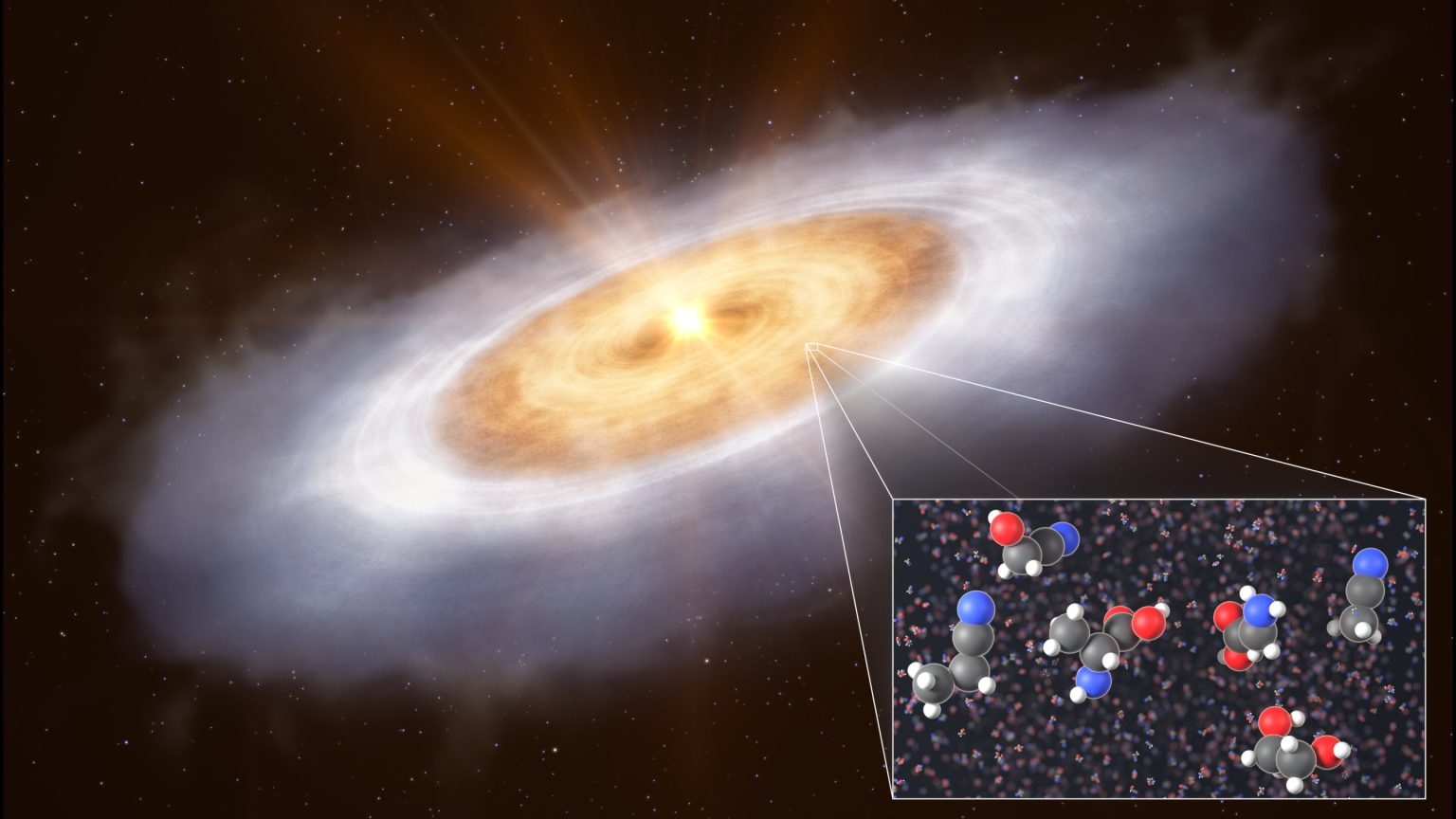
The star V883 Orionis is a young star surrounded by a protoplanetary disk. Astronomers have found ethylene glycol and glycol nitrile in its composition. These are fairly complex organic molecules, indicating that the early stages of the chemical evolution of life occur even before planets begin to form.
Complex organic molecules in space
Using the Atacama Large Millimeter/submillimeter Array (ALMA), a team of astronomers led by Abubakar Fadul of the Max Planck Institute for Astronomy (MPIA) has discovered complex organic molecules, including the first tentative detection of ethylene glycol and glyconitrile, in the protoplanetary disk of the protostar V883 Orionis.
These compounds are considered to be the precursors of the building blocks of life. A comparison of different cosmic environments shows that the number and complexity of such molecules increase from star-forming regions to fully developed planetary systems. This indicates that the seeds of life are gathered in space and widely distributed.
Astronomers have previously detected complex organic molecules (COMs) in various locations associated with the formation of planets and stars. COMs are molecules containing more than five atoms, at least one of which is a carbon atom. Many are considered building blocks of life, such as amino acids and nucleic acids or their precursors.
Organics in the V883 system
The discovery of 17 COMs in the protoplanetary disk system V883 Orionis, including ethylene glycol and glyconitrile, provides a long-awaited piece of the puzzle in the evolution of such molecules between the stages preceding and following the formation of stars and their planet-forming disks. Glyconitrile is a precursor of the amino acids glycine and alanine, as well as the nucleobase adenine.
The transition from a cold protostar to a young star surrounded by a disk of dust and gas is accompanied by a turbulent phase of shock gas, intense radiation, and rapid gas ejection.
Such energetic processes can destroy most of the complex chemistry assembled in earlier stages. Therefore, scientists have developed a so-called reboot scenario, in which most of the chemical compounds necessary for the evolution of life should be reproduced in circumstellar disks during the formation of comets, asteroids, and planets.
The current results indicate that protoplanetary disks inherit complex molecules from previous stages and that the formation of complex molecules may continue during the protoplanetary disk stage. Indeed, the period between the energetic phase of the protostar and the formation of the protoplanetary disk would have been too short for COMs to form in quantities that could be detected.
Prevalence of organic substances
As a result, the conditions that determine biological processes may be widespread rather than limited to individual planetary systems.
Astronomers have discovered simple organic molecules, such as methanol, in dense regions of dust and gas that existed before the formation of stars. Under favorable conditions, they can even contain complex compounds containing ethylene glycol, one of the types recently discovered in V883 Orionis.
More complex substances that are important for biology, such as amino acids, sugars, and nucleotides, which make up DNA and RNA, are present in asteroids, meteorites, and comets in the Solar System.
Molecules hidden in ice
The chemical reactions that synthesize these COMs occur under cold conditions, primarily on icy dust grains, which subsequently condense to form larger objects. Hidden in these mixtures of rock, dust, and ice, they usually remain undetected. Access to these molecules is only possible by extracting them using space probes or external heating that evaporates ice.
In the Solar System, the Sun heats comets, resulting in striking tails of gas and dust, or comas, which are essentially gas shells surrounding the comets’ nuclei. Thus, spectroscopy — the decomposition of light into the colors of the rainbow — can capture the radiation of released molecules. These spectral fingerprints help astronomers identify molecules previously buried in ice.
A similar heating process occurs in the V883 Orionis system. The central star is still growing, accumulating gas from the surrounding disk until a thermonuclear fire ignites in its core. During these periods, the rising gas is heated and produces intense bursts of radiation.
The ALMA radio interferometer allowed astronomers to precisely identify the V883 Orionis system and search for faint spectral signals, which ultimately led to the discovery of complex organic molecules such as ethylene glycol and glyconitrile.
According to phys.org

