

Astrophysicists have studied the Markarian 501 galaxy. It contains not one, but supermassive black hole binaries at its center, which are located an unprecedentedly close distance from one another. Their orbital period is only 121 Earth days, and this period is rapidly decreasing.
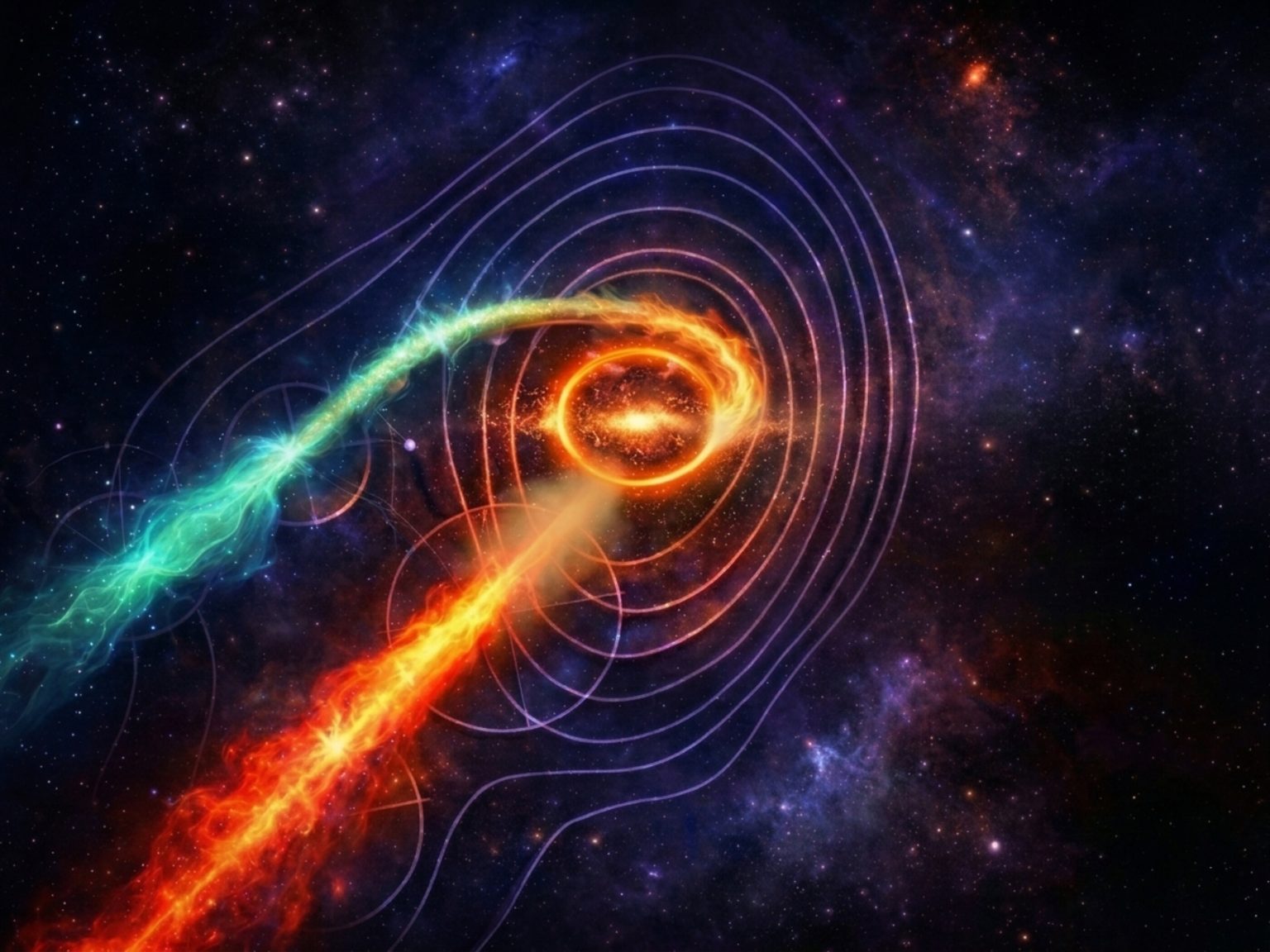
Formation of supermassive black holes
Supermassive black holes at the centers of galaxies are one of the most active areas of research in astronomy. To accumulate their enormous masses, they must merge with one another. A research team led by Silke Britzen of the Max Planck Institute for Radio Astronomy (MPIfR) in Bonn has found direct evidence of supoermassive black hole binaries in the galaxy Markarian 501, orbiting each other at a very close distance. This may be the first time that a pair of galaxies on the verge of merging has been detected. This provides a unique opportunity to better understand the central process of galactic evolution.
Research findings indicate that at the center of nearly every large galaxy lies a supermassive black hole, whose mass is millions or even billions of times greater than that of our Sun. It remains unclear exactly how they achieve such enormous masses. The accumulation (accretion) of gas from the surrounding space alone would take far too long, so they likely have to merge with other massive black holes. Galaxy collisions are observed throughout the Universe. Therefore, it is highly likely that the supermassive black holes at the centers of these colliding galaxies are also merging, first orbiting each other more and more closely, and eventually merging into a single black hole.
Two powerful particle jets in the galaxy Markarian 501
However, theoretical models are not yet able to accurately describe this final phase. The situation is further complicated by the fact that, to date, no pair of massive black holes in close proximity has been reliably detected, despite the fact that galaxy collisions are a common occurrence on cosmic timescales. A recent study of the galaxy Markarian 501 (Mrk 501) in the constellation Hercules has changed the situation.
The black hole at the center of the galaxy Markarian 501 ejects a powerful jet of particles into space at a speed close to the speed of light. As part of the study, the team analyzed high-resolution observational data of this region. This data covers a range of radio frequencies, and over the course of roughly 23 years, it was collected over a period of several dozen days. These long-term data reveal not only one jet, but another as well. This is the first direct image of such a system at the center of a galaxy and clear evidence of the existence of a second supermassive black hole. “We searched for it for so long, and then it came as a complete surprise that we could not only see a second jet, but even track its movement,” says Britzen.
Close dance of black holes
The first jet is directed toward Earth, hence it appears particularly bright to us and has been known for a long time. The second jet was oriented differently, which made it harder to detect. Over the course of several weeks, astronomers observed significant changes: the second jet originates behind the larger black hole and moves counterclockwise around it. This process is repeated.
On one of the observation days in June 2022, the radiation emanating from the system reached us via such a distorted path that it appeared ring-shaped—a so-called Einstein ring. The most likely explanation is that the system was perfectly aligned with us. Gravitational lensing by a known black hole in the foreground has distorted the light from a second jet located behind it.
By analyzing the changes over time and the repeating patterns in the jets’ brightness, the scientists were able to conclude that these two black holes orbit each other with a period of approximately 121 days. The distance between them is approximately 250 to 540 times greater than the distance between Earth and the Sun—which is very small for such extreme objects, whose masses range from 100 million to a billion times that of the Sun. Depending on their actual mass, the distance between them could decrease so rapidly that they might merge in as little as 100 years.
Relation to gravitational waves
Because of the great distance between Markarian 501 and Earth, even the most advanced observational techniques cannot resolve these two black holes as separate objects. Even the Event Horizon Telescope (EHT), which provided us with the first images of black holes in 2019 and 2022, does not have sufficient power to do this. For this reason, it is impossible to observe the increasingly tight orbit of the binary system in Markarian 501 directly. Nevertheless, scientists expect to find clear evidence of a steady decrease in the distance between the two black holes: the system should emit gravitational waves at very low frequencies, which can be detected using pulsar timing arrays (PTAs).
Systems containing supermassive black hole binaries (SMBHBs) are already considered a likely explanation for the observed gravitational wave background, evidence of which was discovered in 2023 using the European Pulsar Timing Array (PTA) and other observatories. The Markarian 501 system is the leading candidate for linking the gravitational wave radiation measured via PTA to a specific supermassive black hole binary. “If gravitational waves are detected, we may even see their frequency steadily rise as the two giants spiral toward collision, offering a rare chance to watch a supermassive black hole merger unfold,” notes study co-author Héctor Olivares.
According to phys.org

