

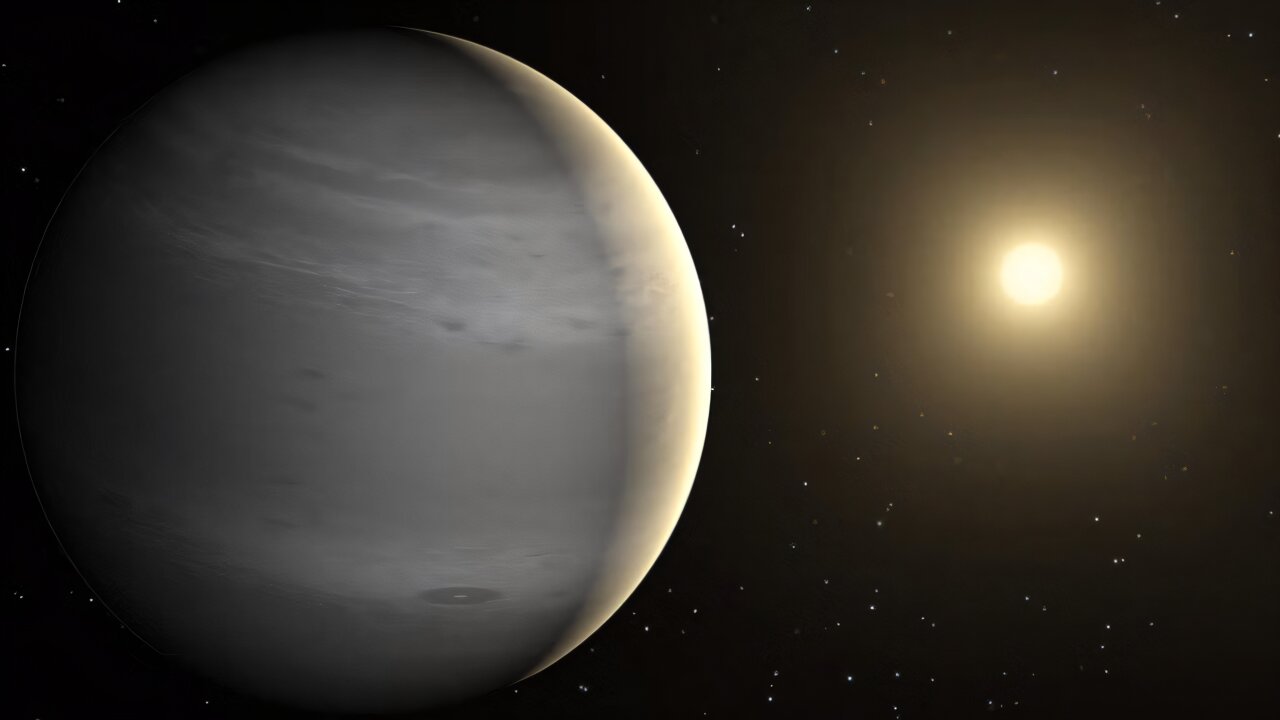
A planet roughly the size of Saturn, but with temperatures more similar to Earth’s, has an atmosphere rich in methane, according to a new study using NASA’s James Webb Space Telescope.
Discovery of a new giant exoplanet
Unlike the gas giants of the Solar System—Jupiter and Saturn—which are located far from the Sun and are therefore extremely cold, and the so-called “hot Jupiters”—giant planets outside the Solar System that are hot due to their proximity to the stars they orbit—this planet is one of them, and its atmosphere has been analyzed.
According to the research team, new details about the planet’s atmospheric composition will help refine models of planetary formation and evolution and improve astronomers’ understanding of how Earth’s atmosphere works.
An article describing research led by astronomers from Pennsylvania State University and NASA’s Jet Propulsion Laboratory (JPL) at the California Institute of Technology was published in The Astronomical Journal.
TOI-199b is a moderate-sized giant, similar in size to Saturn
Since the discovery of the first exoplanet in 1992 by a team at Pennsylvania State University that included Aleksander Wolszczan, astronomers have discovered thousands of exoplanets. However, only a few large, temperate exoplanets are known, and this is the first time we have been able to study the atmosphere of one of them in detail.
The planet, known as TOI-199b, orbits a star located more than 330 light-years from Earth approximately every 100 days. Its temperature is about 175 degrees Fahrenheit, which is still hot by human standards, but not much hotter than the highest recorded temperatures on Earth, which are around 134 degrees. It is significantly cooler than the hot Jupiters, which can reach temperatures of thousands of degrees, and the cold gas giants of the Solar System, whose temperatures are hundreds of degrees below zero.
Instruments for studying the atmospheres of other planets
To characterize the atmosphere of an exoplanet, astronomers use a technique called transmission spectroscopy to analyze the light from the star as it passes through the planet’s atmosphere. For this to work, the planet’s orbit must be such that it passes between its star and the telescope.
The James Webb instruments break down starlight into its constituent wavelengths, just as a prism can break down ordinary white light into the colors of the rainbow.
“As a planet passes in front of its star, some of the star’s light passes through the planet’s atmosphere where it interacts with the elements and molecules in the atmosphere,” said Aaron Bello-Arufe, a postdoctoral researcher at JPL and the paper’s lead author. Specific elements will absorb specific wavelengths of light, creating a reflection in the light spectrum that the James Webb Space Telescope detects, which reflects the composition of the atmosphere.
The transit spectrum is compared with baseline measurements of the star’s light obtained over approximately 20 consecutive hours of observation by the James Webb Space Telescope. The transit itself lasts about seven hours, which is significantly longer than transits of hot Jupiters, which can last an hour or less.
The researchers explained that the differences between the baseline and transit spectra reveal which wavelengths of light are absorbed by the planet’s atmosphere and are used to identify the elements and molecules that make up the atmosphere.
Signature of methane and other possible gases
“When we compared the spectra during the transit to the baseline, we saw that the atmosphere blocked the wavelengths of starlight absorbed by methane,” Bello-Arufe. “Models for the composition of temperate, gas-giant exoplanets had predicted that they would contain methane, so it is good to get confirmation that our theories are accurate.”
In addition to methane, the team’s observations suggest that the atmosphere also contains ammonia and carbon dioxide.
Consequences of planetary science
Scientists say that a more complete picture of the atmosphere of a temperate gas giant could be used to improve our models and potentially lead to a better understanding of how planets and their atmospheres—including Earth’s—form and evolve.
The success of the first study of the atmosphere of this temperate giant also gives astronomers the confidence to allocate more resources and time to observations aimed at studying other similar planets. This will allow us to determine whether this planet is unique or if there are common characteristics shared by this type of planet.
According to phys.org

