

TOI-7019 b is a recently discovered brown dwarf orbiting a star that is 12 billion years old. It is interesting because it has a high density and contains few metals.
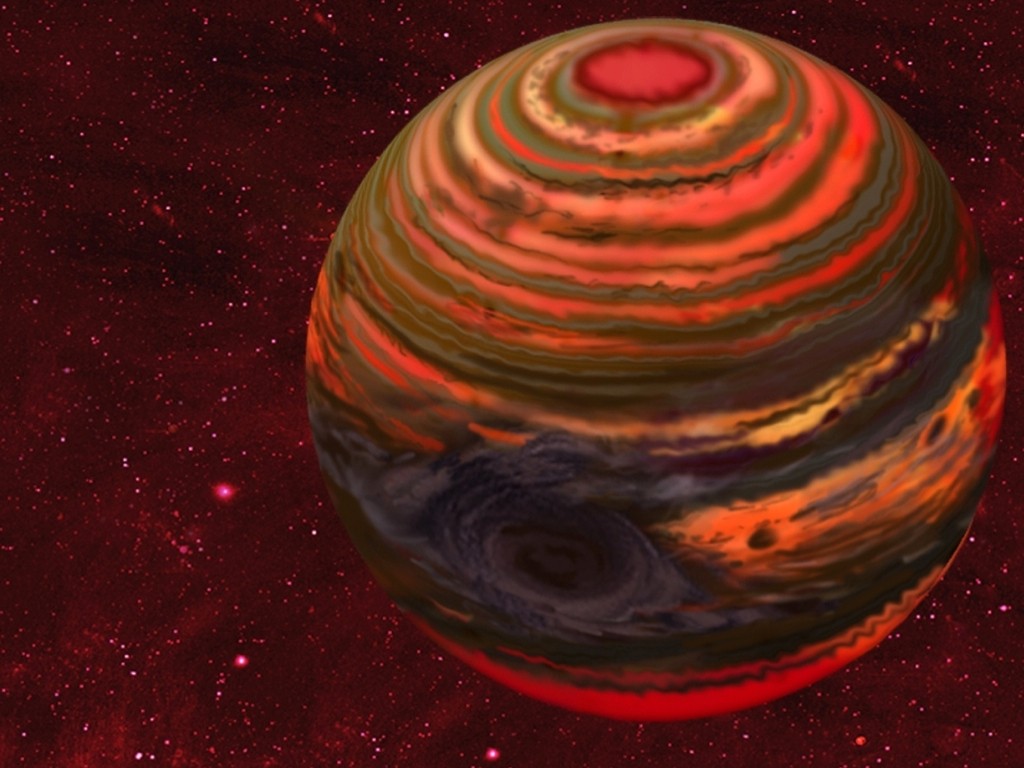
Ancient brown dwarf
Astronomers from the Harvard-Smithsonian Center for Astrophysics have discovered an ancient brown dwarf with a mass 60 times greater than Jupiter’s. An article about this discovery has been posted on the arXiv preprint server. The object has been named TOI-7019 b.
In general, astronomers have already seen many such objects that occupy an intermediate position between planets and stars. Therefore, TOI-7019 b itself would not be very interesting if it did not orbit around a rather interesting star that belongs to the so-called thick disk of the Milky Way.
This is the oldest part of our galaxy. The stars that comprise it appeared in the first billion years of the universe’s existence. Specifically, TOI-7019, around which the brown dwarf orbits, formed 12 billion years ago, so it is of a similar age.
Strange parameters
The star TOI-7019 and its small companion have been observed by the TESS satellite for quite some time, thanks to which we know enough about them. The star itself is the size of the Sun but only 78% of its mass. Its surface temperature is 5800 K.
These are rather unusual parameters, caused precisely by the fact that TOI-7019 belongs to one of the first generations of stars, which means that its metallicity, i.e., elements heavier than hydrogen and helium, is significantly different from that of younger stars such as our sun.
Accordingly, the brown dwarf TOI-7019 b should also have its own characteristics. Studies have shown that it is located at a distance of 0.25 AU from the star and completes one orbit around it in 48.26 Earth days. At the same time, the brown dwarf has a temperature of 479 K, which means it is quite hot.
But its size and density are the most interesting features. With a mass 61.3 times greater than Jupiter’s, its density is 141.7 g/cm³, while its radius is only 82% of Jupiter’s. At the same time, according to scientists’ calculations, it should be about 12.3% smaller, but the reasons for this discrepancy have not yet been established.
Now scientists are waiting for TOI-7019 b to be studied using a spectrograph. It will help reveal the chemical composition of the brown dwarf. And astronomers expect to find many interesting things there.
According to phys.org

