

Scientists are studying the binary system KIC 5623923, which is contact, meaning that its two components touch each other, but it turns out to be even more surprising than you might think. Its main component is a pulsating variable of the Delta Scuti type.
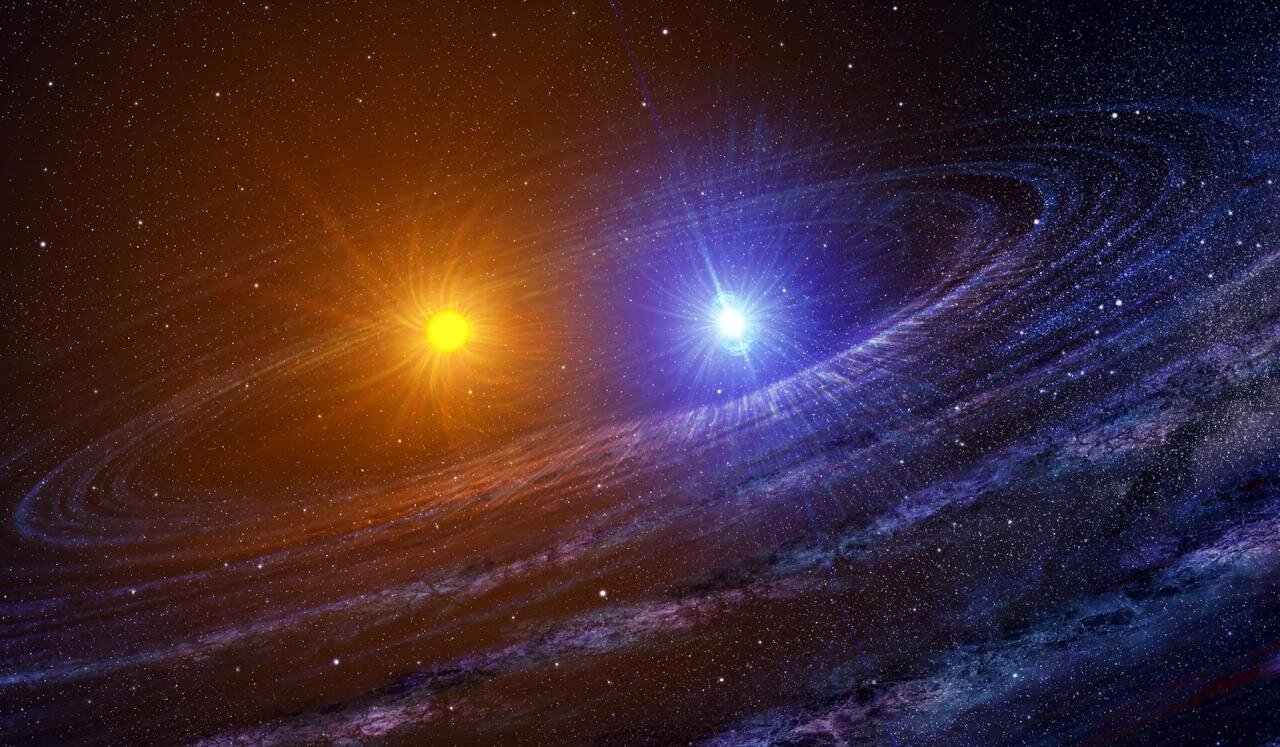
Pulsating contact binary system
Using NASA’s Kepler space telescope, Chinese astronomers observed a binary star system known as KIC 5623923. As a result, they have discovered that the system under study is a dim eclipsing binary system undergoing Delta Scuti-type pulsations. The new results were published on November 24 on the arXiv preprint server.
Delta Scuti stars are pulsating variables with spectral classes ranging from A to F, named after the variable Delta Scuti. They exhibit radial and non-radial pulsations with periods ranging from 20 minutes to eight hours. Studying the behavior of Delta Scuti pulsations can help us deepen our knowledge of the internal structure of stars.
KIC 5623923 was initially classified in 2014 as a Delta Scuti star in a contact binary system, exhibiting pulsations with a period of approximately 50 minutes. Since these pulsations are not clearly visible during secondary eclipses, it is believed that the secondary star in the system is a possible source of variability.
A team of astronomers led by Tao-Zhi Yang from Xi’an Jiaotong University in China decided to take a closer look at KIC 5623923, studying the pulsating behavior of the system using the Kepler telescope. A detailed analysis of the changes in the luminosity of KIC 5623923 was carried out using high-precision time series data from the Kepler mission.
Disclosure of system properties
Based on the collected data, the team discovered 41 significant frequencies of KIC 5623923, including the orbital frequency and several pulsation frequencies. It turned out that most of the pulsation frequencies are in the range of 20.0-35.0 per day, seven of which are identified as independent p-modes.
It was noted that three frequency groups form structures similar to quintets, but the strongest frequency does not. The orbital period of the system was measured as 1.21 days. Based on the short orbital period and the observed morphology of the light curve, the researchers concluded that KIC 5623923 is a tidally locked system.
In addition, observations have shown that KIC 5623923 has an apparent brightness of about 16.5 mAh. The effective temperatures of the primary and secondary stars are 8348 and 4753 K, respectively, while the luminosities of these objects were measured at 22.4 and 2.29 solar luminosities, respectively.
Pulsations of the main star
Summarizing the results, the authors of the study concluded that KIC 5623923 is a dim eclipsing binary star with Delta Scuti-type pulsations. The data obtained place the primary star in the classic pulsation instability band. Thus, the pulsations most likely originated from the primary star, rather than the secondary star, as previously thought.
Astronomers added that measurements of the radial velocity of KIC 5623923 are necessary to determine the absolute parameters of the system, such as the masses and surface gravities of the two stars.
According to phys.org

