

The dwarf planet Quaoar, located far beyond Neptune’s orbit, is known for having a moon and two rings. However, observations made in June 2025 showed that something eclipsed a distant star near it at an unexpected moment. Scientists are unsure whether it is a ring or another moon.
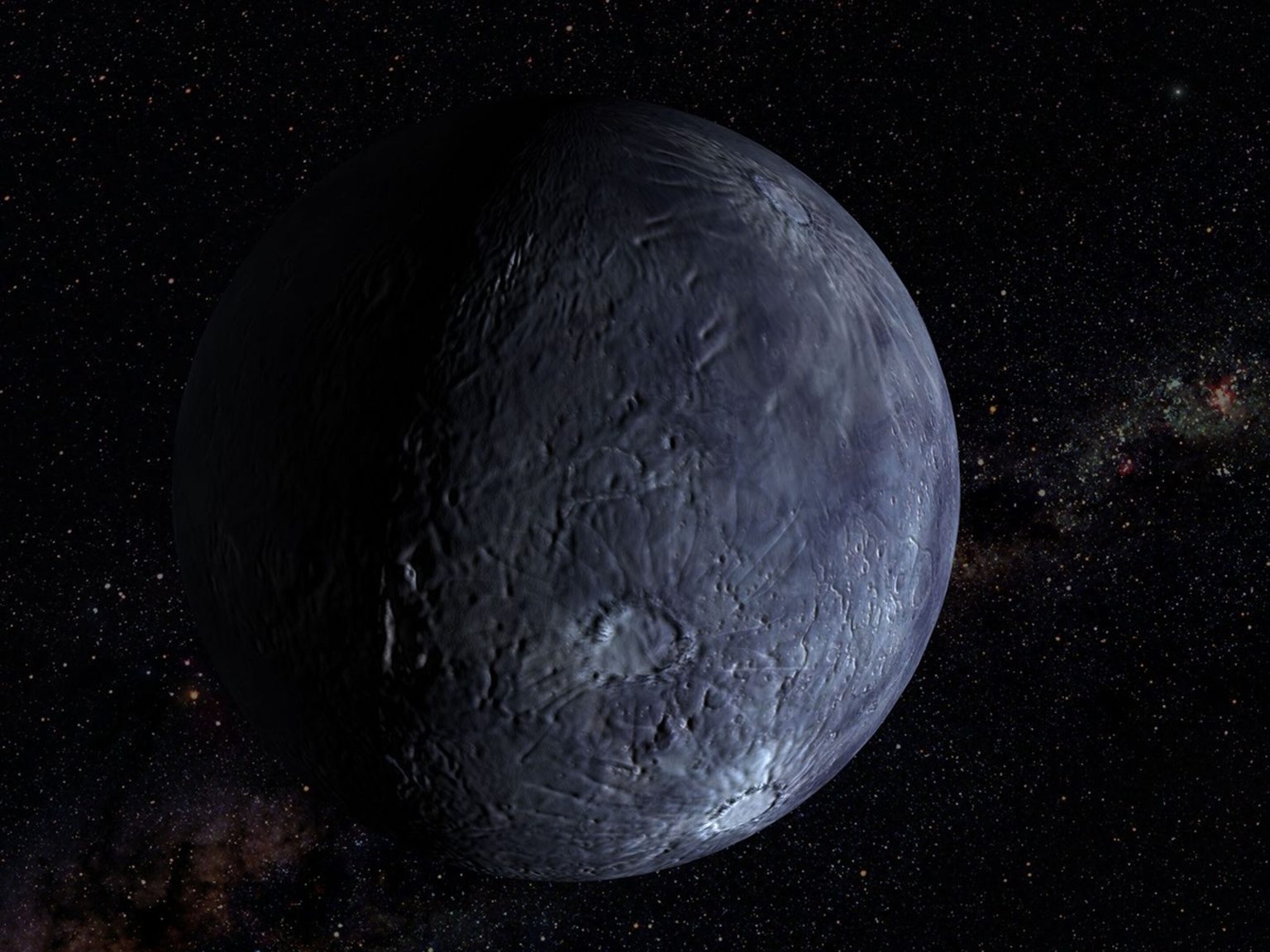
New observations of Quaoar
The dwarf planet Quaoar may have another moon or ring. Scientists came to this conclusion based on observations made on June 25 this year. This makes it one of the most interesting objects beyond Neptune’s orbit.
Quaoar has a radius of 545 km and orbits the Sun once every 286 Earth years. It was discovered in 2002 and named after the creator god from the mythology of the North American Tongva people. In 2006, a fairly large natural satellite, Wayvot, was found orbiting it, named after the sky god from the same mythology. It orbits the dwarf planet at a distance.
In 2023, two rings were discovered in Quaoar. They are located beyond the Roche limit – the distance at which the planet’s gravity tears objects apart. This is very strange, because if they were not created by the destruction of a body, how could they have been formed in the first place?
Natural satellite or ring?
In fact, scientists were planning to observe the already known Quaoar rings using the James Webb Space Telescope when they discovered that something was obscuring the star prematurely, the coverage of which should have helped solve an already known mystery. But instead, astronomers found a new mystery.
Because something blocked this star for 1.23 seconds. For such observations, this is really significant and indicates that Quaoar has a previously unknown moon or ring. Scientists are leaning toward the former option.
This is clearly indicated by the sharp and distinct disappearance of the star. In addition, James Webb had already searched for a third ring in Quaoar and ruled out its existence. But another natural satellite fits perfectly into the overall picture of this unusual dwarf planet.
Provided by: phys.org

