

Deep inside the Earth, at the boundary between the mantle and the outer core, there are so-called ultra-low velocity zones – areas that seem to be unaffected by the fiery chaos raging in the depths. Now, scientists claim to have unraveled their mystery.
Ultra-low speed zones
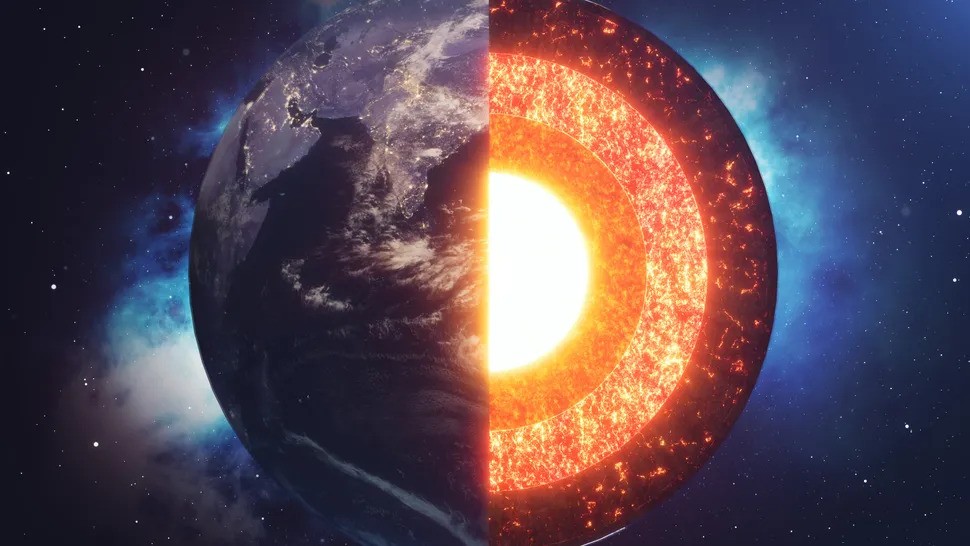
At the very center of our planet is a solid inner core. Between it and the crust, matter is in a very hot and liquid state and is divided into two layers: the outer core and the mantle above it. Recently, the journal Nature Communications published a study by scientists from the Institute of Earth Sciences of the Chinese Academy of Sciences, in which they attempted to unravel one of the mysteries lurking at the point of their collision.
The fact is that the 300-kilometer layer at the boundary between the outer core and the mantle, i.e., at a depth of 2,900 km, has a complex structure. Complex processes of mass and heat exchange take place there, but at the same time, there are relatively small areas of up to 100 km in size that are characterized by extremely low seismic activity and high density.
They are called ultra-low velocity zones. It is believed that they have a significant impact on the processes occurring in this boundary layer, but scientists still do not understand where they come from.
Thermal insulation materials
Researchers have tackled this mystery in their latest work. They used ultra-fast optical spectroscopy in combination with diamond cells with a high-pressure and high-temperature anvil. This allowed them to study the properties of the iron-rich magnesiowüstite, which may make up the low-velocity zones.
Usually, minerals rich in metal have high thermal conductivity; they are like natural radiators for heating systems, but in magnesiowüstite, this indicator turned out to be extremely low. Simply put, it is a good heat insulator.
Scientists now understand that ultra-low velocity zones are actually pieces of heavy thermal insulation floating in viscous, molten material and altering the flows within it. Further research will reveal how this occurs.
Provided by: phys.org

