

Dwarf galaxies appear to be places where it is relatively easy to find black holes due to their size. However, in reality, they turn out to be wandering, that is, they change their position relative to the main mass of stars much more significantly than in the Milky Way.
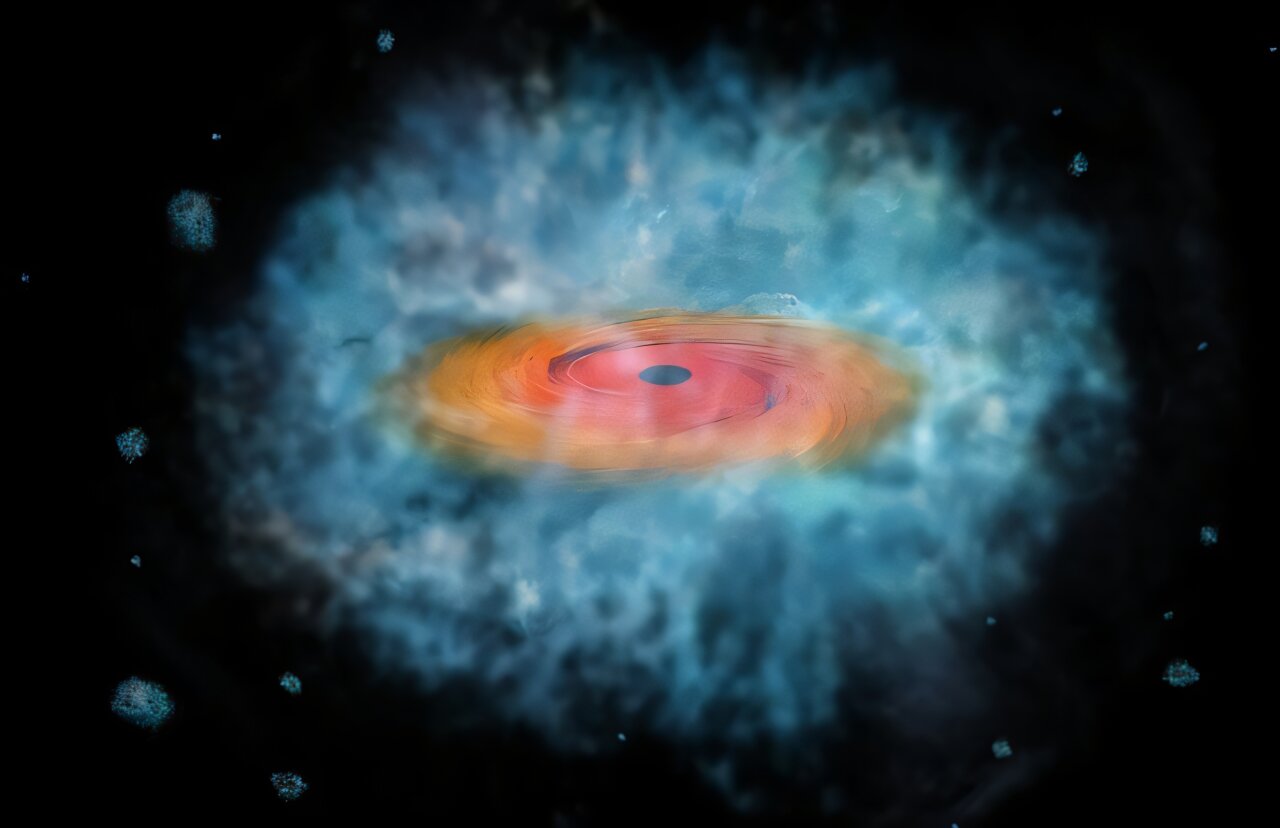
Complexity of searching for “wandering” black holes
Tracking black holes at the center of dwarf galaxies has proven to be a difficult task. This is partly because they tend to “wander” and are not located at the center of the galaxy. There are many galaxies that may contain such a black hole, but until now we have not had enough data to confirm their existence.
In a new paper, Megan Sturm of Montana State University and her colleagues analyzed additional data from the Chandra and Hubble telescopes on 12 potential candidates for active galactic nuclei (AGN). They were able to confirm only three of them, highlighting the difficulty of identifying these massive travelers.
How did “wandering” black holes form?
Why is it important to find black holes at the center of galaxies? Early black holes could have formed the “seeds” of galaxies. However, large galaxies, such as our Milky Way, have undergone multiple mergers, obscuring the history of the development of the supermassive black hole at their center. On the other hand, dwarf galaxies have not undergone as many changes, so their black holes are more similar to what they looked like at the beginning of the Universe, allowing astronomers to place more constraints on the formation of these galactic embryos.
The process by which they “wander” is also interesting. Some simulations of dwarf galaxies suggest that up to 50% of their central black holes may be displaced from the center. This could be caused either by mergers (which happen even for some smaller dwarf galaxies), resulting in the black hole being gravitationally pushed out of the center, or possibly by their own formation process.
They could have formed in gas clouds that were not initially located at the center of the galaxy, and the gas and dust around them either did not have time to adapt to their gravitational pull or got stuck in an unstable gravitational dance where the black hole would never truly be at the center of the galaxy.
Identification of black holes in dwarf galaxies
To try to find these elusive giants, the authors analyzed data from the Chandra and Hubble telescopes on 12 dwarf galaxies discovered using the Very Large Array telescope. They were “selected by radio signals” from a list of 111 dwarf galaxies because they had radio signals typical of accreting black holes, but which could still have been created by standard star formation. The authors wanted to find out the cause of these signals and confirm or refute the existence of these black holes.
Of the 12 objects, they were able to fully confirm only three, using “multi-wavelength evidence” from strong signals in the radio band (VLA), X-ray band (Chandra), and optical band (Hubble), although even with these confirmations, not all objects were particularly bright in all three bands. One (known as ID 26 in its classification in the larger list of AGN candidates) was the only one confirmed as bright in all three bands. Another (ID 82) was only visible in the X-ray range, meaning that its optical light is probably obscured by gas and dust, although other studies have detected “coronal” lines indicating that it was a black accretion hole. ID 83, on the other hand, was very bright in X-rays and had optical wavelengths consistent with a black hole.
Unconfirmed and false sources
There were two “imposters” in the dataset, and although at first they looked as if they could also be AGNs, the authors found other reasons for their brightness. ID 64 had a very bright optical source offset from the center of its galaxy, but after studying the galaxy’s redshift compared to the optical source using data from the Palomar Observatory, the authors realized that the source of the optical radiation was actually a background galaxy that coincided with a dwarf galaxy. In essence, the AGN of the background galaxy gave the impression that it was “wandering” in the foreground galaxy, even though it is billions of years older and therefore farther away.
Another false alarm was ID 92. Data from the Hubble telescope showed that the radio signal coming from this galaxy coincided with a very active star-forming region. Further analysis of the data allowed the authors to conclude that the radio source probably originated from a “superstar cluster” rather than an AGN.
This still left seven other radio sources that were not detected in either the X-ray or optical ranges, and for which there was no clear explanation. However, the lack of scientific confirmation sometimes leads to the emergence of new theories, and this is exactly what happened in this case. The authors believe that three of the “ghost” candidates are actually background sources, mainly because they are very far from the centers of their galaxies. One particular ghost object (ID 65) may be the source of a fast radio burst (FRB), the origin of which remains a subject of debate.
These theories will remain unresolved until a more powerful telescope, such as the James Webb Space Telescope, becomes available. A decision will soon be made on how to spend the telescope’s fifth year of observation time, and it is not yet known whether the team from Montana State University has submitted a proposal to track these elusive travelers. Even if they didn’t, at least the latest article is a step toward catching up with some of these interesting connections to the early Universe.
According to phys.org

