

IC 418, or the Spirograph, is a planetary nebula, the shell left behind after a star turned into a white dwarf. Scientists studied it and discovered what it was like before it acquired its modern appearance.
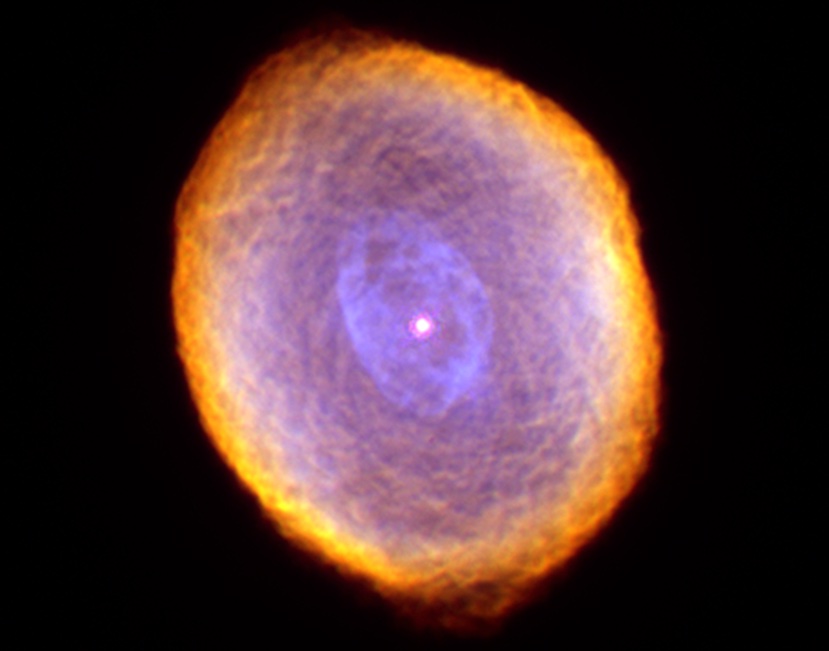
Spirograph Nebula
The Astrophysical Journal Letters has published a study of the IC 418 nebula, also known as the Spirograph. Scientists conducted spectrometry on it and determined the rate of expansion. It was carried out by a group of astronomers led by Albert A. Zijlstra from the University of Manchester (UK), which provided more information about the evolutionary state of this nebula.
The Spirograph is a planetary nebula. That is, these are the remnants of the shells of a star that once survived the red giant stage, shed them, and became a red dwarf. It is located 4,400 light-years away from us in the constellation Lepus. The temperature of the central star is still very high, at 37,000 K.
According to previous studies, this planetary nebula has been expanding for about 1,200 years, making it one of the youngest. However, new data has made it possible to trace the events that have occurred over the past 130 years.
Unusual star
What is interesting about the Spirograph Nebula is that it is rich in carbon: its central star evolved from a carbon star A, which was located on the asymptotic giant branch. The mass of the white dwarf is now 0.57 solar masses, while the mass of its predecessor is estimated at 1.25-1.55 solar masses.
The study showed an age-related, linear increase in the strength of oxygen emission lines relative to beta-hydrogen lines over the last 130 years. This 2.5-fold increase was a consequence of the central star’s temperature rise.
Particularly interesting is the fact that the star that gave birth to the nebula was carbon-based. Their evolution after transitioning to the white dwarf stage remains poorly understood.
According to phys.org

