

Most modern electronics, including those used in space technology, are crystals that are usually produced using methods that are not very accurate. However, engineers have recently developed a way to literally draw with them using a laser.
Crystal drawing
A team of researchers from Michigan State University recently published the results of a study in which they learned how to draw with crystals. At first glance, such a statement may not seem particularly sensational. Anyone can draw with a crystal by taking a piece of ice and dragging it across a concrete wall.
However, we are talking about the opposite process—a pattern whose material crystallizes exactly where it is needed. Thin layers of crystals are used almost everywhere in modern electronics, both in space and right here at home.
However, obtaining such layers or even larger crystals is not a very accurate process. Usually, this involves either crystallization from solutions or from the gas phase. But now, it seems that engineers have come up with another method.
Lasers
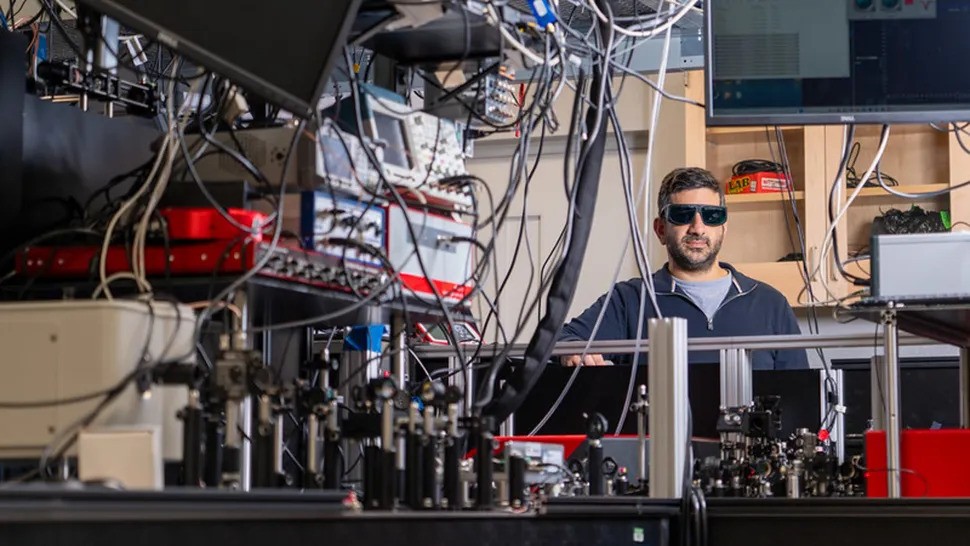
Actually, the solution is not that surprising. It is well known that material melted by a laser crystallizes instantly when cooled. In their experiment, the researchers worked with gold nanoparticles. Using a coherent radiation beam with a wavelength of 660 nm, they not only melted the nanoparticles, but also transferred them to the desired location.
It was transferred in a reaction chamber filled with the lead halide perovskite precursor solution over a glass substrate of borosilicate, onto which the crystal was “drawn.” This research is so important because the process is as close as possible to that used in the creation of solar panels.
Of course, it is still too early to talk about the practical application of “drawing.” However, it is quite possible that it will be used to create ultra-precise circuits that will function like microelectronics.
According to www.space.com

