

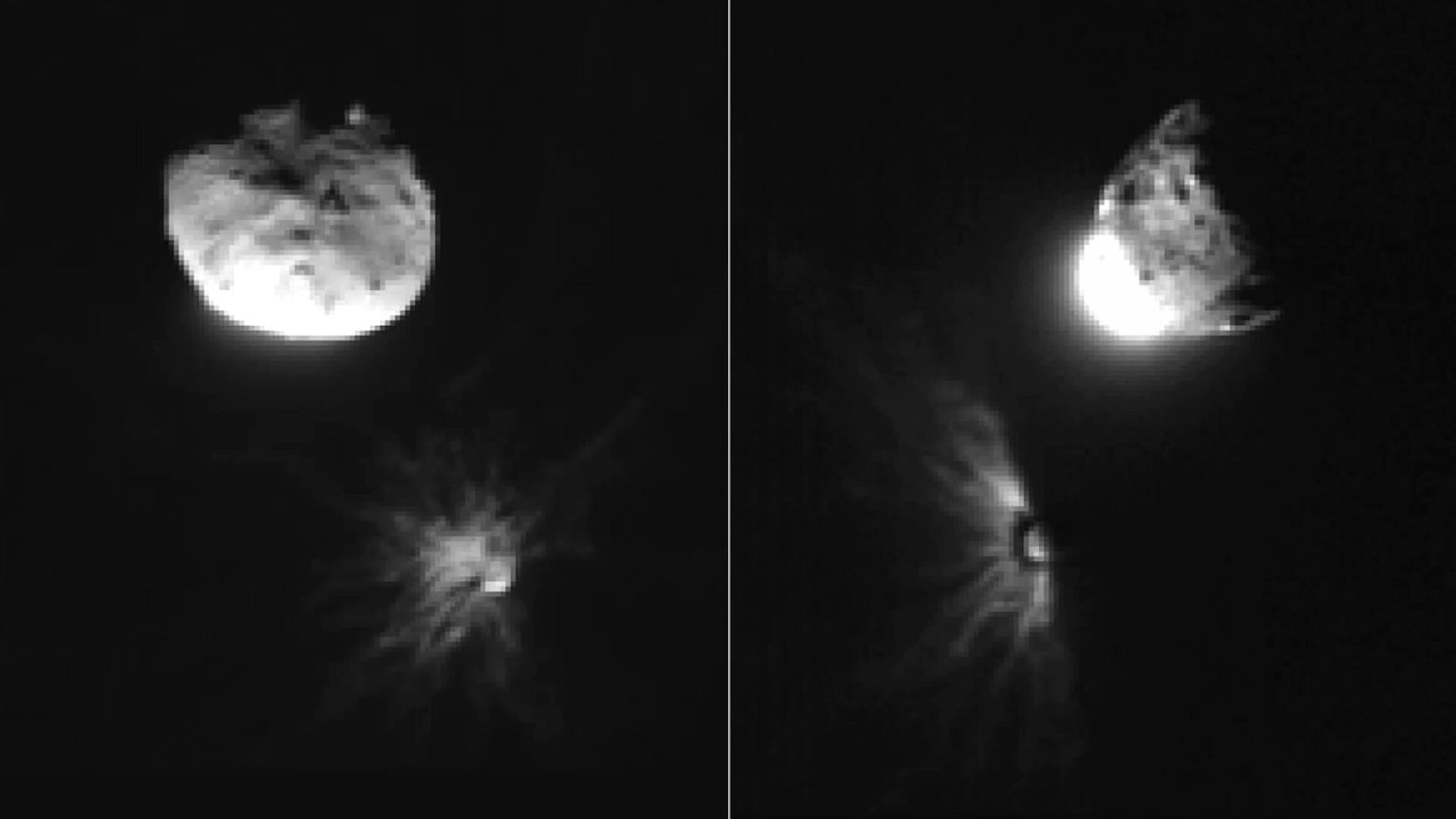
Scientists studied the cloud of debris left behind after the DART spacecraft collided with the asteroid Dimorphos in 2022. It is known that their mass greatly exceeded the mass of the probe.
Successful LICIACube mission
On September 11, 2022, engineers at the flight control center in Turin, Italy, sent a radio signal into deep space. Its destination was NASA’s DART (Double Asteroid Redirection Test) spacecraft, which was flying to an asteroid more than 5 million miles away. This message prompted the spacecraft to execute a series of pre-programmed commands, which caused a small satellite the size of a shoebox, provided by the Italian Space Agency (ASI) and named LICIACube, to detach from DART.
Fifteen days later, when DART’s journey ended in a deliberate head-on collision with the near-Earth asteroid Dimorphos, LICIACube flew past the asteroid to take a series of photographs, giving researchers the opportunity to observe the world’s first demonstration of asteroid deflection.
The impact of the “rubble-pile”
After analyzing LICIACube images, NASA and ASI scientists reported in The Planetary Science Journal that the collision with the asteroid ejected approximately 35.3 million pounds (16 million kilograms) of dust and rocks, refining preliminary estimates using ground-based and space-based data.
Although the debris that flew off the asteroid accounted for less than 0.5% of its total mass, it was still 30,000 times greater than the mass of the spacecraft. The impact of the debris on Dimorphos’ trajectory was dramatic: shortly after the collision, the DART team determined that the flying debris had given Dimorphos a momentum several times greater than the impact of the spacecraft.
An important conclusion from the DART mission is that a small, lightweight spacecraft can dramatically alter the trajectory of an asteroid similar in size and composition to Dimorphos, a “rubble-pile” asteroid — that is, a loose, porous cluster of rocky materials weakly bound together by gravity.
“We assume that many asteroids approaching Earth have a structure similar to that of Dimorphos,” said Dave Glenar, a planetary scientist at the University of Maryland in Baltimore County who participated in the study. Therefore, this additional push from the debris cloud is an extremely important factor that should be taken into account when designing future spacecraft to deflect asteroids away from Earth.
Change in Dimorphos’ orbit
NASA chose Dimorphos, which poses no threat to Earth, as the mission target because of its connection to another, larger asteroid named Didymos. Dimorphos orbits Didymos in a binary asteroid system, similar to how the Moon orbits Earth. Importantly, the position of the pair relative to Earth allowed astronomers to measure the duration of the moon’s orbit before and after the collision.
Ground-based and space-based observations showed that DART shortened Dimorphos’ orbit by 33 minutes. But these observations, made from a distance of 6.8 million miles (10.9 million kilometers), were too far away to support a detailed study of the debris from the impact. That was LICIACube’s task.
Study of the debris cloud in the image
The research team studied a series of 18 LICIAcube images. The first images in the sequence showed a direct approach to LICIACube. From this angle, the cloud was brightly lit by direct sunlight. As the spacecraft flew past the asteroid, its camera rotated so that the cloud remained in view.
When LICIACube looked back at the asteroid, sunlight was shining through a thick cloud of debris, and the brightness of the trail faded. This indicated that the trail consisted mainly of large particles — about a millimeter in diameter or larger — which reflect less light than small dust grains.
Hidden material in a dense cloud
Since the inner parts of the cloud were so dense that they completely obscured the view, scientists used models to estimate the number of particles hidden from view. Data on other asteroids composed of debris, including fragments of Bennu, delivered to Earth in 2023 by NASA’s OSIRIS-REx spacecraft, as well as laboratory experiments, helped refine the estimate.
“We calculated that this hidden material accounted for almost 45% of the total mass of the cloud,” said Timothy Stubbs, a NASA planetary scientist who participated in the study.
Although DART demonstrated that a high-speed collision with a spacecraft can alter an asteroid’s trajectory, Stubbs and his colleagues point out that different types of asteroids, such as those composed of stronger, denser material, may respond differently to an impact similar to DART’s.
According to phys.org

