

Scientists have obtained the first image of a pair of black holes orbiting around a common center of mass. We are talking about the quasar OJ287, which is one of the brightest objects in the sky. Scientists were able to study it using radar.
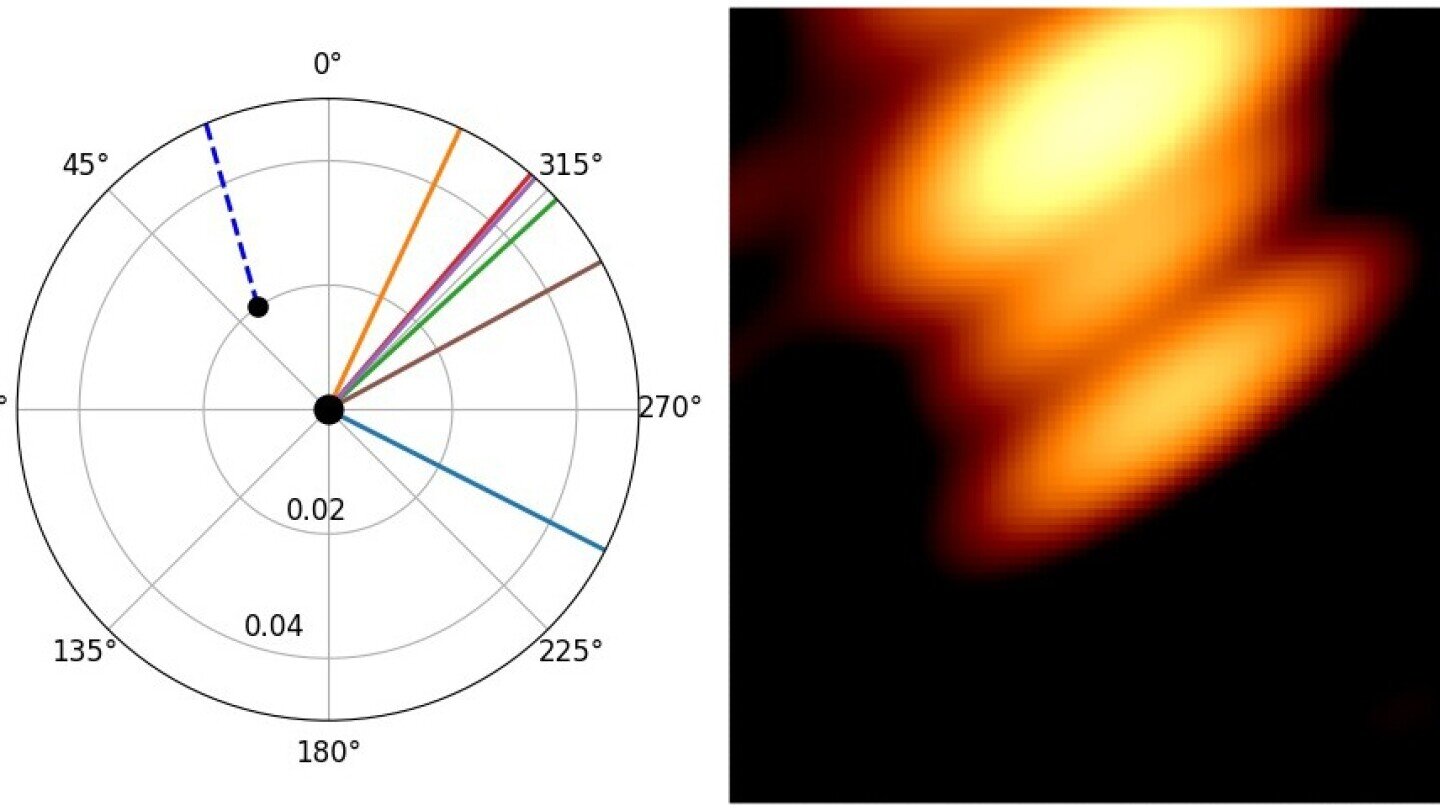
Quasar OJ287
An international team of researchers has managed to get an image of two black holes circling each other in the center of a quasar called OJ287. Quasars are bright galactic cores whose light is produced when a supermassive black hole at the center of a galaxy absorbs cosmic gas and dust around it. Previously, astronomers were able to obtain an image of a black hole in the center of the Milky Way and in a neighboring galaxy called Messier 87.
“Quasar OJ287 is so bright that even amateur astronomers with private telescopes can detect it. What is special about OJ287 is that it has been thought to harbor not one but two black holes circling each other in a 12-year orbit, which produces an easily recognizable pattern of light variations in the same period,” says first author of the research article Mauri Valtonen from the University of Turku.
Unraveling the mystery of quasar OJ287
The earliest observations of OJ287 can be traced back to old photographs from the 19th century, when astronomers first photographed an entire section of the sky. However, at that time it was difficult to imagine the existence of black holes, let alone quasars. OJ287 was “accidentally” captured in photographs while astronomers were focusing on other objects.
Aimo Sillanpää, a master’s student at the University of Turku at that time, noticed as early as 1982 that the brightness of the object changed regularly over a 12-year period. He continued his research on OJ287 as a university scientist, suggesting that the brightness changes were caused by two black holes circling each other. Hundreds of astronomers are actively monitoring quasars to verify the accuracy of this theory and obtain a complete picture of the orbital motion of black holes.
The mystery of the orbit was finally solved four years ago by doctoral researcher Lankeswar Dey from Mumbai, India, who worked part-time at the University of Turku. The only remaining question was whether it was possible to detect both black holes simultaneously. This question was answered by NASA’s TESS satellite, which detected light from both black holes. However, they were still only visible as a single point, because images obtained using normal light do not have a high enough resolution to show black holes separately. An image with a resolution 100,000 times greater was required, which was possible using radio telescopes.
“Tail-like” jet from a smaller black hole
Astronomers compared preliminary theoretical calculations with radio images in a recent study. The image showed two black holes, exactly where they were expected to be. This gave researchers the answer to a question that had remained unanswered for 40 years: whether black hole pairs exist at all.
“For the first time, we have managed to obtain an image of two black holes circling each other. In the image, the black holes are identified by intense jets of emitted particles. The black holes themselves are perfectly black, but they can be detected by these particle jets or by the glowing gas surrounding the hole,” Valtonen says. Researchers have also discovered a completely new type of jet emanating from a black hole. The jet coming out of the smaller black hole is twisted like a stream from a rotating garden hose. This occurs because the smaller black hole moves rapidly around the main black hole OJ287, and its jet deflects depending on its current motion.
Researchers compare this to a “wagging tail” that should twist in different directions in the coming years as the smaller black hole changes the speed and direction of its motion.
According to phys.org

